Customer Perception and Brand Valuation
Understanding the Intangible Forces That Drive Brand Worth: A Practical Guide for Brand and Strategy Professionals
Introduction to Customer Perception and Brand Valuation
Nothing has a greater influence on a brand’s commercial value, or is more difficult to predict, than customer perceptions. Technology can be cutting-edge, service operationally efficient, and the business financially solid – but if customers do not perceive the brand in the same way, then that is how it will be valued. So, recognising the impact of customer perception on brand value is not only important for marketers; it is critical for the strategy and finances of any organisation that treats its intangibles as important assets.
Brand Valuation Singapore is a description of the contribution of the brand to the business. While tangible assets can be counted and written off on balance sheets, brand value is fundamentally associated with minds – the minds of customers, staff, shareholders, and society. Perception and sentiment about a brand influence the willingness to pay, the tendency to stick with the brand in times of competition, and the brand’s ability to survive crises.
It’s an area that is becoming a must-know for junior to mid-career professionals in brand strategy, marketing, consulting, and corporate finance. This article maps the link between customer perception and brand value – why it is important, how it is measured and monetised, the challenges faced, and the lessons learned that deepen insights.
Customer Perception and Brand Valuation: From Sentiment to Financial Value
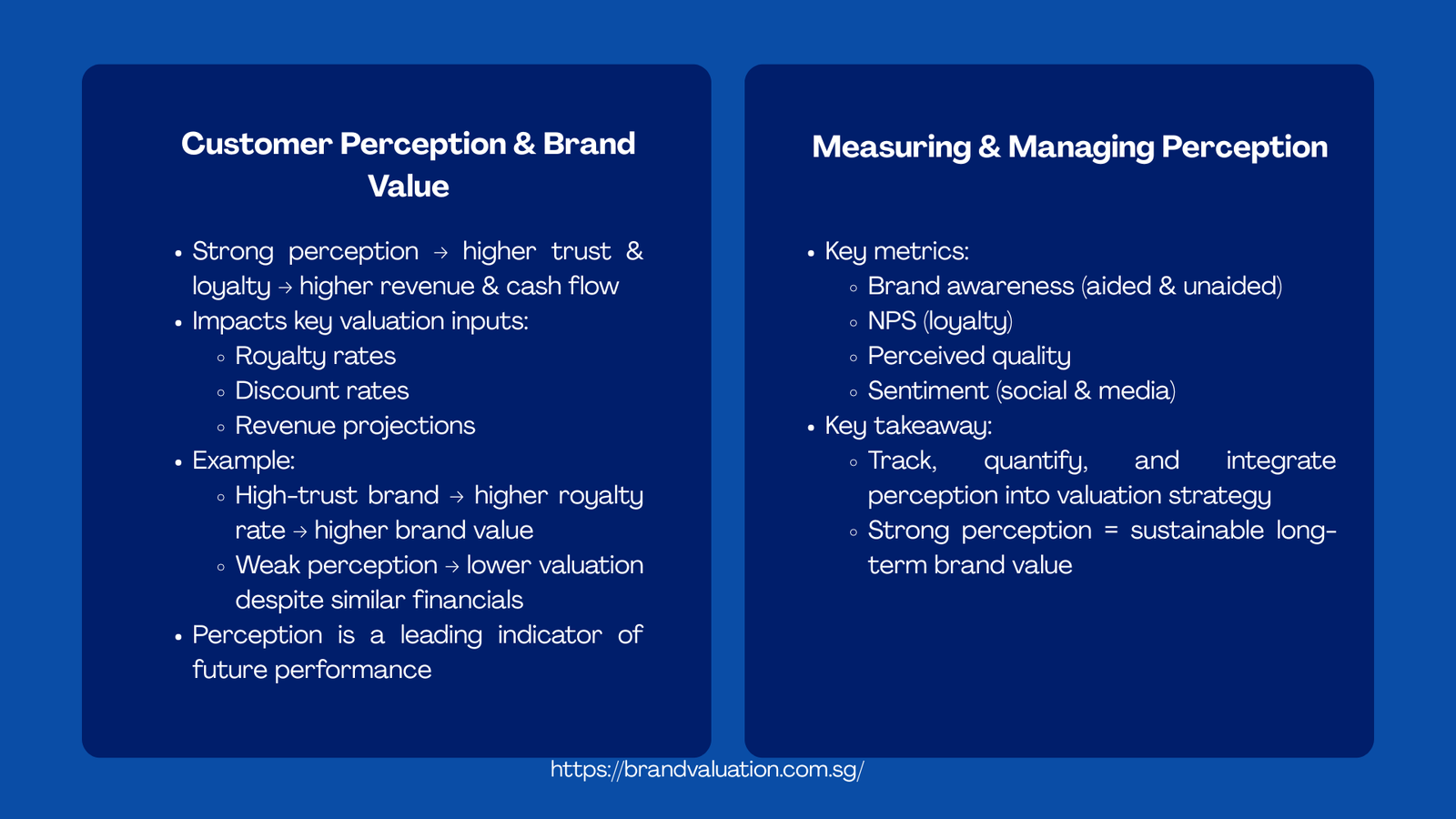
The link between brand value and customer perception is no metaphor. It is measurable, and it feeds into the financial models that valuers build to come up with a brand valuation. The higher the consumer trust and loyalty for a brand, the higher the premium price the brand can command. Premium prices result in higher sales and profits, and higher cash flows. In the income-based Brand Valuation Singapore methods – and in particular the Royalty Relief Method – these higher cash flows translate into a higher brand value.
Let’s look at the illustration of royalty rate benchmarking. In a valuation exercise, the benchmark royalty rate for a company in a particular industry might differ between a business with a highly-regarded brand name and a high level of consumer trust (4%) and a business with a less well-known brand name and a neutral perception (2.5%). If this revenue stream is expected to be hundreds of millions of dollars, the difference in brand value (royalty rate capitalised over projected revenue) is substantial. It’s a difference that perception makes.
This is why it is important to regularly revalue brands. People’s attitudes are not fixed. It changes based on product and service quality, social media buzz, marketing messages, and other events such as changes in management or crises. A brand that was highly valued three years ago may have suffered a decline in perception since that time, and a valuation report that is not reflective of current perception is, effectively, yesterday’s news.
Customer Perception and Brand Valuation: Turning Perception into Data
The question that valuers are most likely to ask is how to translate something as intangible as “customer perception” into a figure that can be used in a valuation model. The effect of customer perception on brand valuations can be most directly measured with specific, quantifiable metrics that valuers will use as inputs to calculate the royalty rate, discount rate, and projected revenues.
Aided (recognising the brand when prompted) and unaided (spontaneously naming the brand) brand awareness studies are very practical perception indicators. Strong unaided awareness in a particular market makes it possible to assume the brand can command a premium royalty rate in that market because it is more likely to be sought out by consumers, rather than replaced. Data on the likelihood of brand recommendations (so-called Net Promoter Scores – NPS) contribute to measurements of loyalty, a major component of projected revenue stability. Scores on perceived quality, usually through survey tools (and increasingly verified through review platform aggregation), underpin assumptions of price premium.
This area has been enhanced in recent years through social listening. Dynamic sentiment analysis of reviews, social media, and news media, as captured via review aggregators, adds a dynamic element. The data is increasingly being factored in by valuers conducting forward-looking valuations, especially if there has been a recent event that has impacted the brand. The table below outlines the key perception signals and impacts on valuation.
Table 1: Key Signals and Valuation Impact
| Perception Signal | How It Is Measured | Effect on Brand Valuation |
|---|---|---|
| Brand Awareness | Aided/unaided recall surveys, search volume | Increases royalty relief rates and income multiples |
| Customer Loyalty / NPS | Net Promoter Score, repurchase rates | Justifies reliable cash flow forecasts |
| Perceived Quality | Surveys, review sites | Justifies price premium and margin assumptions |
| Reputation Sentiment | Social listening, media sentiment scores | Provides evidence for risk discount or value add |
| Trust Index | Third-party brand trust surveys, rankings | Limits risk in discounted cash flows |
The process flow below shows how these perception signals flow through the valuation process – from customer perception to a monetised brand equity value.
Process Flow 1: From Experience to Brand Value
Consumer Experience Touchpoints & interactions | ▶ | Perception Signals Awareness, trust, loyalty | ▶ | Market Research Surveys, NPS, sentiment | ▶ | Valuation Inputs Royalty rates, risk discount | ▶ | Brand Value Monetised brand equity |
Five Principles to Link Perception and Brand Value : Customer Perception and Brand Valuation
Making the link between customer perception and Brand Valuation Singapore more meaningful is to do so through key principles. Here are five things that are at the core of what practitioners do – whether they are consulting to clients, developing their own skills or planning for a valuation.
- Perception is a leading, not a lagging indicator. The financials are what have happened in the past. What customers think is an indicator of the future. A brand that is increasing in consumer trust will likely see improved revenue and margins in the next few years – and a brand that is losing trust will see that reflected in its financials, even if the current financials are positive. Perception monitoring professionals can spot opportunities and risks before they are reflected on the income statement.
- Some perception dimensions are more equal than others. Perception dimensions such as trust and perceived quality are most directly linked to pricing power and margin development – and are therefore the perception dimensions that are most important for valuation. Brand awareness is important for brands seeking to build market share but not as important in predicting a premium for brands with a deep brand footprint. Managers should determine which perception dimension is key for the valuation purpose they have and focus on that accordingly.
- Geographic consistency is a valuable perception. A brand with a high and consistent perception across several markets is worth more than one with market-specific brand equity. Across markets, geographic consistency of perception lowers the risk of future cash flows and therefore the discount rate in valuations based on income. For global brands, perceiving and documenting consistency in brand perception is not only a marketing objective but a strategy to create value.
- Post-crisis is perception recovery comprises a predictable pattern. The documented impact of brand crises on brand value is quite clear: Brand Valuation Singapore usually drops when brands face a crisis. But the evidence from brand crises is that the recovery, in terms of perception, is quicker and more thorough for brands that have a strong perception prior to the crisis. So, building perception in the “peace days” is also an insurance policy against risk – it provides a cushion to hasten recovery. This is shown in Process Flow 2, which you’ll see later in this article.
- Perception is as perception does. The importance of internal perception (or employee sentiment and brand belief) is increasingly being recognised as a contributor to external perception and hence value. Brands with engaged employees are more likely to provide a consistent customer experience, create positive word-of-mouth and attract employees that deliver on the brand promise. In valuations that take account of employer brand or talent acquisition (such as in professional services, technology and healthcare) internal perception data should be used.
Customer Perception and Brand Valuation: Case Studies in Action
The best examples of the link between consumer perceptions and brand value are those brands that have had dramatic swings in either direction – and in the resulting changes in value.
Consider a large UK telecommunications provider that for some years in the early 2010s received consistently low marks for its customer service. Complaints to Ofcom, and consumer satisfaction surveys, ranked it as the worst in its industry for customer service. For five years, its brand equity ratings – as calculated by independent brand tracking agencies – fell significantly and the difference between its value and that of its nearest competitor grew. When the company undertook a Brand Valuation Singapore for its refinancing exercise, the discounted royalty rate it applied to the stream of revenue reflected the perception discount: the brand was worth less than the same business for which there was a higher level of sentiment. The take out here is clear: if you have long term perception issues, it is not a customer experience issue. It’s a balance sheet problem. This is a reminder of the impact on brand value from customer perception at work.
This is in contrast to a Scandinavian outdoor brand that focused on building its business on genuine consumer relationships. It prioritised building a community, delivering high quality products and communicating its supply chain processes, rather than investing in traditional media. Over a ten-year period, its NPS scores were among the highest in the apparel industry and independent brand equity studies showed steadily increasing levels of consumer trust and aspirations. When the company conducted a valuation for a private equity sale, the royalty rate benchmark applied to the firm’s revenue was well in excess of industry standards – as a direct result of the evidence of brand perceptions. The brand was perceived as being worth more on the basis of the perception data.
The third case was a turnaround story. In the mid-2010s, a product recall led to a product safety incident for a US consumer food brand. It led to widespread negative media attention, and a plunge in social sentiment over a six-month period. A Brand Valuation Singapore shortly after the crisis revealed a drop in the year-on-year value – the discount rate (to account for the risk of these projections) on future revenues had increased from 9% to 13%, taking 23% off the value of the brand compared with the previous year. The firm undertook a recovery campaign, which included open disclosure, product reformulation, independent testing and a communication campaign to consumers. After three years, perceptual measures were back to pre-crisis levels and so was the brand valuation. The take-out from this story is that the link between customer perceptions and brand value is dynamic; it can break down, but with hard work, it can be restored.
Process Flow 2: The Brand Recovery Curve
Reputation Event Crisis or negative signal | ▶ | Perception Decline Trust & sentiment drop | ▶ | Recovery Strategy Communication & reform | ▶ | Perception Rebuild NPS & sentiment recovery | ▶ | Valuation Restored Revised upward over time |
Table 2: How Perception Shapes Value Scenarios
| Scenario | Customer Perception State | Likely Valuation Outcome |
|---|---|---|
| Premium consumer tech brand | High trust, aspirational, and loyal | High income multiple, high royalty rate multiple |
| Mass retailer after scandal | Lack of trust, bad news, negative NPS | Low valuation; high risk rate used |
| Traditional food brand in a new category | Low awareness, mixed/positive view | Value – cost approach with upside potential |
| Disruptive brand, popular with millennials | High awareness, mixed quality perception | Potential value; sensitive to the length of time assumptions |
Customer Perception and Brand Valuation: Challenges in Measurement
Although the theory of the impact of customer perception on Brand Valuation Singapore is compelling, practitioners face a number of challenges when they attempt to use customer perception data in a credible way.
First, there are issues with the quality and comparability of the data. There are many types of consumer surveys, differing in sample size, question wording and geographic locations. An NPS score collected via an in-app survey cannot easily be compared to a score collected from a nationally representative sample using a panel survey. For valuers who use perception data, it is important to consider the quality of the data – how the data was collected, whether it is representative of the population of consumers, and how consistent it is over time to allow for trend analysis. For those developing internal perception monitoring, spending the time to get the data collection right will save time (and money) in the long run when it comes to be used in a valuation.
The second issue is how to convert subjective perceptions to quantitative valuation assumptions without misleadingly implying that they are more precise than they really are. If a valuer raises a royalty rate by 0.5 percentage points because of high levels of consumer trust, that’s a judgement because research benchmarks can’t necessarily explain this rate. Some novices to the field can feel uneasy about this uncertainty and either overstate the level of precision or exclude the perception/value relationship from the analysis entirely. The better response is to transparently explain the reasoning, triangulate with multiple measures of perception, and use sensitivity analysis to indicate how the value changes if the perception-related assumptions change.
The third issue is the timing of the perception and valuation. Consumer sentiment can change very quickly – a social media phenomenon can change perception measures in a matter of days – whereas brand valuations are generally done once a year, or as part of a transaction. So, a valuation might not reflect a recent perception change – either up or down. Those in the industry who recognise this timing risk can be more likely to identify and communicate it, suggesting a mid-cycle perception study where there has been a significant change in sentiment, or including a qualification with a Brand Valuation Singapore to note recent sentiment shifts.
Customer Perception and Brand Valuation: Applying Insights for Impact
Perception and valuation is a hugely important and underleveraged link in business strategy. Brands that recognise its importance – and how to manage it – achieve a virtuous cycle: better perception leads to more value, which in turn enables better financing options, more effective franchise fees, more valuable partnership opportunities, and greater strength in times of crisis.
For those starting out in brand strategy, marketing or the advisor community, what can be done? First, consider perception data a financial input. When you measure your NPS, brand awareness or sentiment, present these data in terms of what they mean for pricing power, revenue stability, and risk – the terms that valuation people understand.
Second, put a process in place for perception tracking. One-off, annual surveys won’t reveal the most relevant information. A systematic perception monitoring programme that tracks perception through multiple sources (survey, social media, and review platforms) provides the basis for arguing a perception-based valuation adjustment. Third, link perception to the whole valuation process. Knowing how to value a brand based on the impact of customer perceptions means being able to draw a line from an insight about a consumer to a royalty rate assumption or discount rate adjustment. That’s the skill of connecting the “soft” and “hard” that is so in short supply.
And lastly, invest in perception. Brands that bounce back quickest from crises, have the highest valuation multiples, and partner best with other brands are almost always those that thought about perception as a key resource well before any deal or crisis made it necessary. Knowing how customer perception impacts Brand Valuation Singapore is not only a way to better understand Brand Valuation Singapore – it’s a way to build brands that are more valuable.