Brand Valuation for Franchise Expansion
A Practical Guide for Franchise Professionals
Introduction to Brand Valuation for Franchise Expansion
Franchise expansion is a major milestone for any company. Whether a business intends to expand to new cities, move into new regions or even expand globally, the process involves more than just a great product or service – it involves knowing the value of the brand. Brand valuation for franchise expansion strategy is the practice that offers this insight, converting the intangible world of the brand into a tangible asset that can inform and power your decisions to expand.
For mid- to entry-level franchise development, corporate strategy, or business advisors, brand valuation can be a true competitive advantage. It enables you to have a voice in discussions about entering markets, hiring franchisees, setting royalties, and considering investments. Brand valuation is not the sole preserve of financial professionals – it permeates all aspects of a franchise.
This article covers the basics of valuing a brand in a franchise business – including the techniques used, how brand valuation is applied to support investment strategies, some of the common pitfalls of practitioners, and lessons from case studies. Whether you’re valuing the portfolio of a client or developing such capabilities in your own organisation, this article provides a starting point.
How Brand Valuation for Franchise Expansion Drives Growth
The brand is a franchise’s “product”. When a franchisee enters into a contract, they are not purchasing a formula, an operations manual, or a piece of equipment; they are purchasing the right to operate under a brand name that is familiar to consumers and which provides market positioning. This makes the brand the currency of a franchise agreement, and why the role of brand valuation in franchise expansion is a key question for emerging, established, and mature franchise businesses.
For example, if a quick-service restaurant brand is looking to expand from Australia to Southeast Asia, the first question to ask is what is the value of the brand in that region? Prior to a franchisor signing a franchisee agreement, the franchisor and the potential franchisee will want to know the value of the brand in the new market. Will it be able to charge a higher price? Is it already known in the market? What’s an appropriate royalty rate? These questions don’t lend themselves to guesswork. There is a rigorous process that delivers the evidence upon which these decisions are made.
And beyond the sale, a brand is an indicator of franchise strength to lenders, investors, and regulators. A comprehensive brand valuation report enables access to capital for growth, makes franchise disclosure reports possible, and provides a competitive edge for a sale. So, in a sense, having a defined brand value provides a franchise system with “paper” credibility.
Brand Valuation for Franchise Expansion: Key Methods
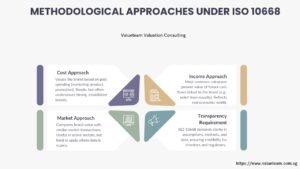
Brand valuation is not a one-size-fits-all endeavour, and it’s important to understand the various methods. Methods for valuing brands for franchise growth can be broadly grouped into three approaches: the income approach, the market approach, or the cost approach. They all have different rationales, different data needs, and different applications.
The income approach, and in particular the Royalty Relief Method, is a common one in franchising. This approach is based on evaluating the royalties a business would pay to license its brand (if it didn’t already own it) and discounting those costs to a present value. This is a particularly effective method for franchises, as royalty rates are a real component of the system, and so the assumptions are more easily justified.
The market approach values the brand based on similar assets that have recently been purchased or sold – either through M&A data or licensing benchmarks. The cost approach, on the other hand, estimates the cost to recreate the brand – good as an absolute bottom in a valuation, but often too low because of the value of existing relationships with customers. In reality, most rigorous valuations employ multiple approaches, triangulating to a reasonable value. These key methods and their considerations are summarised in the table below.
Table 1: Brand Valuation Methods and Their Franchise Applications| Method | How It Works | Best Used For | Limitation |
|---|---|---|---|
| Income Approach | Future royalty or earnings that can be attributed to the brand. | Stable companies with a history of revenue. | Bases its forecasts on uncertainties. |
| Market Approach | Comparisons between the brand and comparable transactions or publicity traded brands. | Thriving sectors of M&A. | Needs similar data, which is not necessarily at your disposal. |
| Cost Approach | Estimates the cost of re-creating the brand. | New products or intra-organizational benchmarking. | Underrates the importance of a strong brand equity. |
| Royalty Relief Method | Calculated royalties are saved when the brand is owned as opposed to when it is licensed. | Franchising and licensing situations. | The choice of the appropriate royalty rate is not an easy task. |
Brand Valuation for Franchise Expansion: 5 Key Steps
To effectively use brand valuation in a franchise expansion strategy, a process should be followed. There will be variations to each engagement, but the five steps outlined below are the core of most brand valuations for franchises.
Step 1: Establish the Purpose and Scope
The first step in the valuation process is to determine the purpose and scope of the valuation. To inform a Franchise Disclosure Document? To determine royalty fees in a new territory? To set up an investor roadshow? The objective is to determine the process, the amount of formality, and the quality of documentation. For the franchise professional, this also includes determining the scope of the brand(s) to be valued, master or sub-brands, product lines, or a combination.
Step 2: Do Brand and Market Research
The quality of the data used in a valuation is crucial. This step includes both quantitative and qualitative data on the performance of the brand – brand awareness surveys, Net Promoter Scores, social media sentiment, trademark applications, and competitive comparisons. In the case of franchises, unit-level economics (average turnover, profit margins, and payback period) are particularly relevant because this is the business model that franchisees are keenly examining.
Step 3: Choose the Valuation Methodology
Based on the purpose of valuation set in Step 1 and the data collected in Step 2, the valuators determine the best method(s) of valuation. For an established franchise system with a rich royalty history, the Royalty Relief Method may be the primary, and market comparables the secondary method. For a new brand with the first franchise agreement, the cost floor and/or income may be primary. The point is, the method is justified and documented, not just made up.
Step 4: Stress Test and Run Sensitivity Assessments
All valuations are based on assumptions such as discount rates, growth rates, royalty rates, and market share. In the case of a franchise expansion, many of these assumptions will involve markets where the brand has no current presence and are therefore uncertain. Sensitivity analysis involves changing the inputs and assessing the impact on the valuation. How does the value of the brand change with a 5% growth rate for royalties instead of 8%? How does a higher discount rate affect the value in a more risky emerging market? These tests highlight the key value drivers and provide an understanding of the plausible scenarios.
Step 5: Report, Report, Review
Brand valuations are not a “set and forget” process. As franchises expand, as new outlets are opened, and as the business environment changes, the valuation should be updated – usually each year or prior to major transactions. It’s also about the communication of the valuation. A comprehensive report, detailing the assumptions, methodology, and valuations, is a useful tool for attracting franchisees, engaging with investors, and planning. Those professionals who can turn the numbers and outputs of Brand Valuation Singapore into clear stories of business value for the organisation are of huge value.
Key Factors Assessed in a Franchise Brand Valuation
Table 2: Franchise Valuation Factors and Their Strategic Relevance| Factor | What It Measures | Why It Matters for Expansion |
|---|---|---|
| Brand Recognition | Recollection and awareness in target markets. | Minimizes the cost of acquiring customers. |
| Royalty Rate History | Rates that are charged in other comparable franchises. | Establishes fair expectations of partners in terms of fees. |
| Franchisee Profitability | Mean unit revenue and margins. | Recruits good franchisee applicants. |
| Trademark Portfolio | IP registrations: Strength and coverage. | Shields brand in new markets. |
| Customer Loyalty Index | Retention rates, NPS, repeat purchase data | Indicates sustainable request in new markets. |
Case Studies and Best Practices: Brand Valuation for Franchise Expansion
The lessons from established franchises’ experiences in valuing their brands are also the most revealing. Consider the example of a medium-sized Australian cafe brand that started franchising in Australia, then set its sights on the UK and Canada. In its initial overseas expansion, the brand was not formally valued – the royalty rate was established informally, and the franchise fees were benchmarked against the “feel” of the market. After two years, the brand experienced franchisee litigation over fees and struggled to attract new investors because it couldn’t back the valuation of its market position. A retrospective brand valuation revealed that the brand was seriously under-monetised – its royalty rate was 30% lower than benchmarked rates in both countries.
The take-out here is a fundamental one: ad hoc fee-setting instead of brand valuation is a money and stability drain for franchisors. This highlights the role of brand valuation in supporting franchise growth as much more than a compliance-driven exercise, but as a revenue and relationship driver.
By contrast, a US fitness franchise that undertook a Brand Valuation Singapore prior to rolling out its international master franchise program experienced a smoother and more profitable roll-out. Through a clear Brand Valuation Singapore (using the Royalty Relief Method and cross-validated with transaction data from similar brands), the franchisor was able to confidently determine master franchise fees for territories in Europe and the Middle East. The transparency of the process was welcomed by master franchisees and facilitated trust from the start. The system has since grown to more than 200 international units in the four years since its expansion began, with a lower-than-average attrition rate.
A third example is that of a UK-based retail brand that experienced a valuation issue with expansion to markets where its trademark is not registered. When it tried to register a franchise agreement with a local entrepreneur in one of the markets, the local entrepreneur was already registered with a similar trademark, leading to a legal and commercial conflict. This example demonstrates that brand valuations in a franchise must be complemented by intellectual property planning. Trademark registrations and their strength and geographic scope are an integral consideration of a brand valuation, and failing to consider this aspect can jeopardise both.
Challenges & Opportunities: Brand Valuation for Franchise Expansion
Despite the process, there are a number of challenges practitioners face in using Brand Valuation Singapore methods for franchise expansion. Being aware of them before they occur can help overcome them.
A common issue is the lack of data – especially in markets where a brand is seeking to expand. The Royalty Relief Method is based on benchmark royalty rates from similar industries and markets, but these may be unavailable for emerging industries or markets. In these situations, analysts need to build a database of comparables from international licensing databases, industry publications and interviews with experts, and clearly articulate the assumptions underlying the database.
The second challenge is the trade-offs between conservatism and optimism in financial forecasts. Franchisors will want their brand to be valued as highly as possible, especially when the valuation is to be used to sell franchises or pitch investors. But valuers need to ensure their valuations are defensible and supportable. This issue can be addressed by a clear statement of purpose and standards up front. When the purpose is revealed to a third party (such as a prospective master franchisee or a bank), an over-optimistic valuation can leave the franchisor exposed to legal and reputational problems in the event that estimates are not met.
A third issue, especially for those new to brand valuation, is a misconception that Brand Valuation Singapore is a purely financial activity. But the most valuable valuations are interdisciplinary. Marketing teams provide consumer insight data. Operations teams provide unit-level economics. Legal teams identify gaps in trademark protection. Strategy teams clarify expansion intent. It is those individuals who can collaborate across these disciplines – taking input from different parts of the organisation and translating this into a valuation story – who are most likely to provide the most value in franchise expansion strategies.
Brand Valuation for Franchise Expansion: Key Takeaways
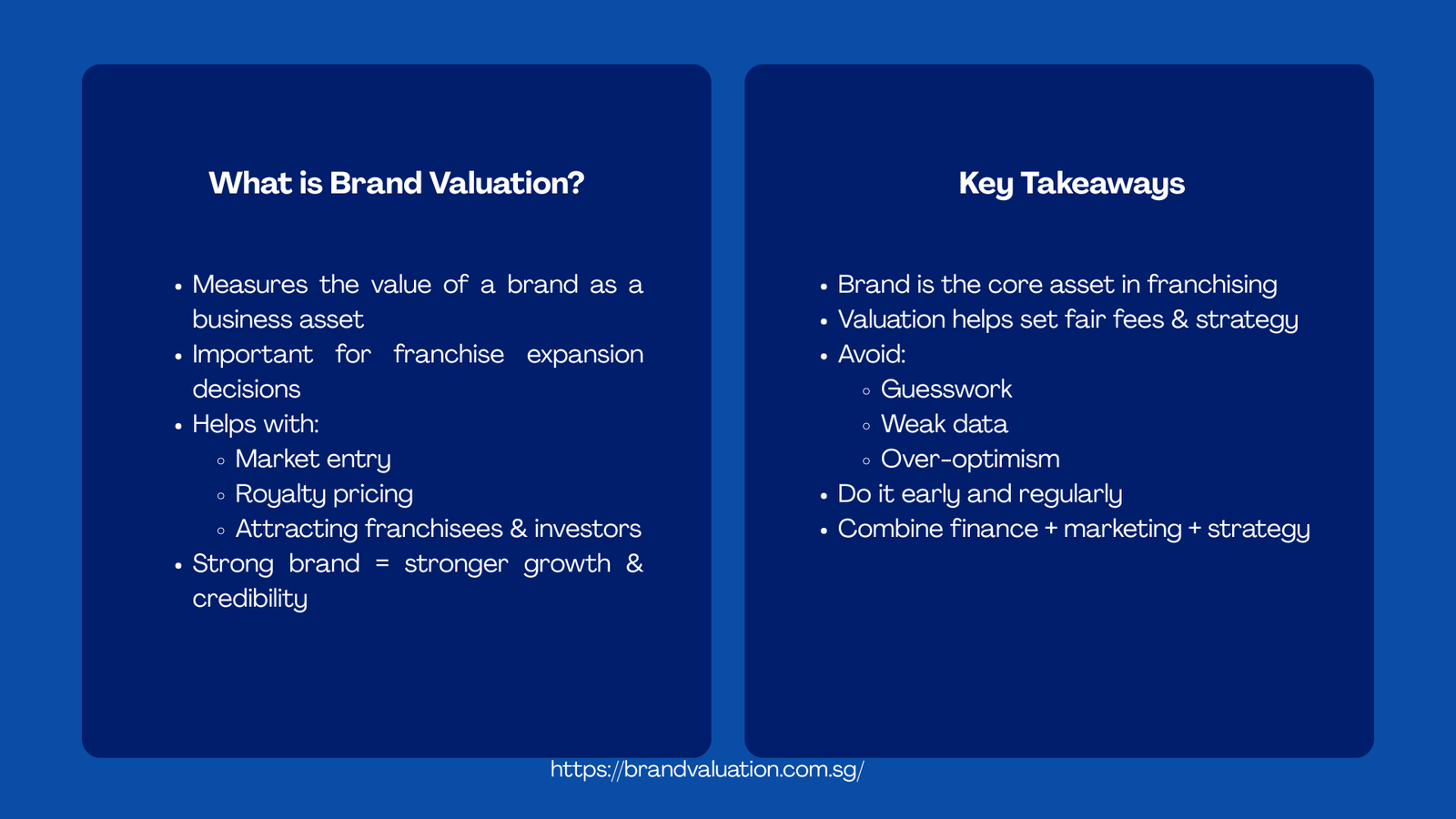
Brand valuation is a tool, not a concept, that influences the growth of franchise systems, recruitment of franchisees, and preservation of equity. Whether you are just starting out in the industry or moving into more strategic roles, develop an understanding of the Brand Valuation Singapore for franchise expansion strategy for every phase of the franchise life cycle.
The takeaways from this article can be summed up in a few bullet points. First, don’t wait until there is a transaction to do a valuation: do it as part of the expansion planning. Second, be mindful of the methodology you select and be able to justify your choice; if you have a strong justification for your methodology, it is more likely to be trusted than a higher number with a poor justification. Third, think of Brand Valuation Singapore as an ongoing process rather than a “one and done” deal; it should be revisited as the franchise system evolves and the market environment changes.
Fourth, tie valuation to business. Your franchisees will ultimately drive brand value, and they are making decisions at the unit level every day of the week – decisions that impact the unit economics and which, in turn, impact Brand Valuation Singapore and franchise growth. Operational systems, training, and quality control are not only important for operations, but for brand value.
And finally, build the interdisciplinary skill-sets to communicate with valuers, legal, marketing, and finance professionals. The best franchise expansion professionals are those who can effectively communicate with these people and translate Brand Valuation Singapore techniques for franchise growth into collective action. In an increasingly competitive marketplace with an ever-increasing range of franchise choices, understanding and documenting the brand value is a powerful weapon.