How Brand Value Affects Pricing Strategy

How Brand Value Affects Pricing Strategy

How Brand Value Affects Pricing Strategy

With two products being exactly the same, and selling at vastly different prices, the price discrepancy is nearly always due to the brand name. Whether you’re a finance, marketing or strategy professional, it’s critical to understand how brand value influences pricing strategy because a good brand is not just a business enabler, but it’s also a catalyst for how much customers are willing to pay before looking for a more affordable option. From packaged foods to enterprise software, this dynamic is repeated across almost all categories in the consumer business, and savvy professionals who grasp it are better able to justify pricing decisions with facts, not just gut instinct. This article discusses the growth process of brand equity and its relationship to pricing power, the brand value effect on margin and positioning, and how brand perception and brand loyalty value lead to tangible and measurable brand competitive advantage. Throughout the journey, real-world examples illustrate how this is done on the ground for companies in vastly different stages of brand development. 
How Brand Value Affects Pricing Strategy

What Is the Direct Brand Value Impact on Pricing Decisions and How Brand Value Affects Pricing Strategy?

Economists refer to a potential customer’s willingness to pay as the best measure of the brand’s value impact on price. This ceiling can be raised by a strong brand, which lowers the risk element because the consumer knows that the brand will be there for him or her again, and it also adds intangible value, like status or identity, which a generic product cannot provide no matter how well it performs a function. It’s exactly how brand value drives pricing in real life: A company with a strong brand can more effectively increase the list price above the average in the category, can run slightly less promotions to achieve volume, and can recover from a price increase more quickly than a company with a price-sensitive customers. The influence on the brand value here is not just in the nameplate; it’s how a company has to invest to acquire the customer, because a trusted brand has a higher conversion rate, while one just beginning to build its reputation in the market has a much lower one. This effect is cumulative: every time a price increase is successful, and customers don’t noticeably defect, the positioning of premium becomes even stronger, and the next increase is even easier, creating a virtuous circle that weaker brands, who must compete mainly on price, can’t structurally reach.

This does not mean brand strength should be a soft, fluffy marketing variable that is not part of the financial numbers for the finance and pricing professional. Both conjoint analysis and the van Westendorp price sensitivity study are well-established market research techniques that can separate the price premium attributable specifically to brand, while holding the functional attributes of the products compared constant across the two. After quantifying that premium, it becomes a number that the finance team can add to the margin forecast, brand valuation models, and business case for continuing to invest in the brand, giving it real weight in the business case for commercial decisions. This new way of thinking, from brand as a soft, qualitative issue to brand as a hard business metric that can help drive margin, is the one thing that is now differentiating out the finance functions that really collaborate with marketing on pricing from those that continue to see pricing and brand as two completely separate conversations in the company. Many companies that have made this change have found that pricing discussions are less heated between finance and marketing, as both functions are based on the same set of facts, and not on different, sometimes competing, assumptions about what the brand can actually deliver. 

How Does Brand Equity Growth Translate Into Pricing Power?

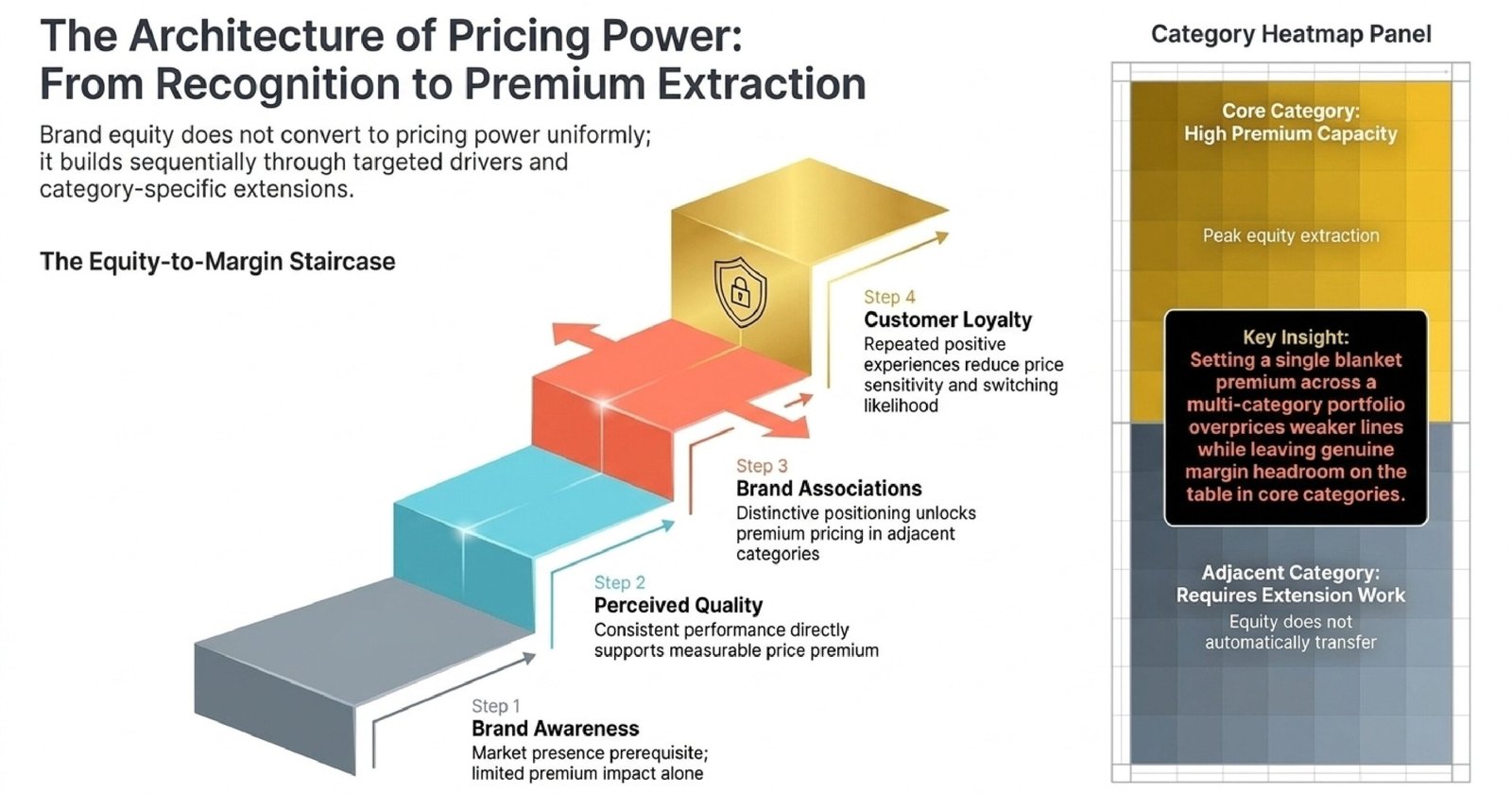
Growing brand equity is a series of positive experiences that evolves over a period of years – not months – and creates real trust. Each component of brand equity’s impact on pricing power will vary: Brand awareness by itself does not necessarily give brands pricing power, since customers must be aware of the brand before they can begin to think about the quality, associations, or loyalty it offers; however, once a customer has recognized a brand, perceived quality and strong associations are what may justify paying more for that brand. Pricing power can be observed overtime, usually as a result of a recurring brand tracking study that compares the companies’ brand equity to competitors’ equity to see how the price can increase over time, well before it is evident in the reported margins, and provide an early warning to management when it is time to raise price. Businesses that fail to do this tracking will end up making price decisions when they’re forced to do so by a competitor or a margin loss rather than when they choose to do so in response to an increase in brand equity that has already been realized, but not yet expressed in a price decision.

But the reality is that growth in brand equity doesn’t always equate to the same level of pricing power in every customer segment or every product line. A brand may enjoy a big price premium in its core product line, but have relatively little control over the price of the new product line it has recently moved into because the equity generated in one product line may not be transferred to the other without effort. Failure to factor in this variability may result in pricing team members setting a one-size-fits-all premium on the entire portfolio, which can be seen pretty shortly after launch with weak performance in the overpriced lines and surprisingly strong demand in the underpriced lines. Therefore, it is a worthwhile investment of any pricing team that deals with multiple categories under one brand umbrella to build the brand equity growth – category by category – view. 

Table 1: Brand Equity Growth Drivers and Their Pricing Impact – How Brand Value Affects Pricing Strategy
Equity DriverHow It Builds Over TimeTypical Pricing Impact
Brand awarenessConsistent marketing and market presenceLimited alone, but a prerequisite for premium pricing
Perceived qualityConsistent product performance and reliabilityDirectly supports a measurable price premium
Brand associationsDistinctive positioning and messaging over timeSupports premium pricing in adjacent categories
Customer loyaltyRepeated positive experiences and relationship buildingReduces price sensitivity and switching likelihood

How Does Consumer Brand Perception Shape Willingness to Pay?

Consumer brand perception is a mental shortcut and a way in which consumers form their opinions about the quality and value of a product prior to ever being exposed to it, which is why brand perception can be beneficial even for first-time consumers. Positive perception equals the willingness to give the benefit of the doubt on price; when it’s positive, the customer is willing to view something as more expensive as higher value or exclusivity, and is less likely to think about the price as a premium. This phenomenon is especially apparent in products with characteristics that are hard to judge for the typical customer – like skincare products or wine – where the average consumer relies on brand perception instead of doing her own technical analysis at the point of sale. This substitution effect is especially strong for new customers lacking first-hand knowledge of the product, since what they perceive from the advertising, packaging, word of mouth, and general brand reputation is, at the point of first purchase, the only information available for them.

However, perception is not fixed and the pricing of the product can help to modify it either positively or negatively. So, if a price is too low compared to a brand’s positioning, then even consumers’ brand perception is harmed, as if the brand has reduced quality, which is particularly true in the luxury and premium segments where the aggressive pricing has historically been proven to negatively impact brand equity built over years. On the other hand, a well conducted price rise – particularly where customers feel it has resulted in a real improvement to their product or experience – can strengthen the positive perception and not weaken it, if the perception of the price rise is accompanied by a feeling that the product or experience has been enhanced. That’s why seasoned pricing teams rarely ever suggest an increase in price without also remarks about the reason, whether it may be a genuine product improvement, an extension of the service, or a direct component that relates to growing input expenses. An unexplainable price increase is much more likely to be interpreted by the customer as an opportunistic move than a justified one. Whether it’s a retailer or a direct-to-consumer brand, this tactic of communicating a price increase has come into practice more and more, because, by itself, it tends to raise more attention to consumer perception of a brand than does a price increase. 

What Five Steps Help Translate Brand Value Into Pricing Strategy?

  1. Measure the brand premium directly. To identify the portion of the price premium that is “captive” to the brand and separate it from the functional aspects, use conjoint analysis or price sensitivity research so that the number can be used for real pricing decisions.
  2. Ensure tracking of equity by segment and category. Practice a ‘two-part pricing’ approach by pricing brands and product lines separately, since power to do so isn’t evenly distributed across a company’s entire product line.
  3. Use price as a signal of treatment. Know that the perception of the brand towards the consumers is affected by price movements before making any price adjustment either up or down.
  4. Guard loyalty, not volume. Don’t short-term discount to drive volume at long-term brand loyalty value and future pricing power.
  5. Review pricing power on a regular basis. Review brand tracking data and pricing elasticity studies on a regular basis; brand equity and competitive landscape changes over time and an outdated assessment can lead to poor pricing decisions.

What Real-World Examples Show How Brand Value Affects Pricing Strategy?

For example, look at Halcyon Outdoor Gear, an apparel company that took almost 10 years to establish a reputation for well-made and ethically produced hiking gear before trying to jack up prices more than average for the category. However, when the company finally implemented a roughly 15 per cent price increase, internal sales figures revealed there was virtually no corresponding impact on unit volume, a finding directly confirmed by the finance team as being linked to the growth of brand equity over the years, achieved through a consistent programme of product quality and clear communication with suppliers. The pricing team attributed this to the power of the consumer brand perceptions with the company’s core hiking and outdoor customers who had developed a brand meaning that was beyond the product function, thus making them significantly less price sensitive than a typical outdoor apparel customer. Hearing this outcome has led the company to incorporate brand equity tracking as a regular component of its annual pricing review cycle, not just as one of the inputs when a major pricing call is already underway.

From a contrasting perspective: Marchetti Coffee Roasters was a specialty coffee company that sought volume growth by discounting regularly and prominently in grocery store promotional displays. Although sales volume increased in the short term, brand tracking studies conducted over an eighteen-month period demonstrated a loss in perceived quality and exclusivity, and highlighted a negative brand value effect, quite different to what management was hoping for. The task was to change this perception, and that meant phasing out some discount promotional outlets completely and replacing them with more focused retail investments, which was a slow and expensive process that it took about two years to get right. The two examples share a common theme: Pricing decisions are not easily done sans cost in the short term because customers don’t like to be outsmarted—whether by up or down—they don’t like it, and that’s why a more thoughtful approach to pricing is needed than a short-term, quarter-to-quarter, revenue-focused one is generally able to offer. The companies that learn this lesson develop a pricing governance process which clearly mandates a brand impact assessment in addition to the usual financial business case for any material price change before it is approved. 

What Challenges Come With Brand Competitive Advantage and Brand Loyalty Value?

Creating a true brand competitive advantage through pricing is challenging because brand price is not linear and does not happen automatically; a slight price change may not be obvious by its product features for months, and only then when a “tipping point” is reached in the mind of the customer, that is, a psychological price change occurs, does it have an obvious impact. This can tempt finance teams under short-term margin pressure to accelerate price hikes faster than brand equity can support, making them think that if they don’t see the market taking any action, it’s a sign of price power when it might not necessarily be true when competitors strike back or the economy tightens. The true essence of brand competitive advantage – the hallmark of brands that have already been established – is the patience to not want to squeeze the last ounce of short-term profit from earned trust and confidence. Another problem is that the value of brand loyalty varies among customers: some customers are very loyal and are willing to accept higher prices while others, who are less loyal, will churn easily and average figures of price elasticity can capture very uneven underlying dynamics if only a single blended pricing decision is made. Where possible, loyalty program data can be used to identify this segmentation, as it usually indicates a clear gradient between a brand’s most loyal customers and the more occasional, price-sensitive buyers and much more valuable for use in the pricing decision than a simple average elasticity across all customers. Businesses that take the time to factor in this aspect of brand loyalty are more likely to create tiered pricing or loyalty-based promotions that sustain high-value customers and maintain their market share among less loyal, price-sensitive customers.

Perhaps the best lesson taken from the experience of the brand and pricing professionals is that brand-based pricing requires an incremental approach, not a wholesale “portfolio” approach. When it comes to rolled-out price increases, it’s important to act in a phased way; try the change on a small number of markets or channels first and see how customers react before implementing it on a larger scale; that way, you won’t risk negating brand loyalty value with a blanket decision. Practitioners also discover that brand and pricing teams must work significantly closer together than they usually do in many companies, as there is a tendency to make pricing decisions without thinking about their brand implications, and vice versa. Companies that structure this partnership, such as a cross-hybrid pricing and brand steering committee that meets to discuss big decisions, are more likely to prevent these conflicts from occurring before a decision is put into effect, as opposed to finding out about them after the sale has taken place. 

Table 2: Common Challenges in Brand Loyalty Value and Practical Mitigations – How Brand Value Affects Pricing Strategy
ChallengePractical Mitigation
Price increases outpacing genuine brand equityValidate pricing power with research before broad rollout
Uneven loyalty across customer segmentsSegment pricing analysis rather than relying on blended averages
Discounting eroding long-term perceptionLimit promotional depth and frequency in premium-positioned lines
Brand and pricing teams working in isolationEstablish shared metrics and joint review of pricing decisions
Slow recovery after perception damageTreat perception repair as a multi-year investment, not a quick fix

Conclusion: How Brand Value Affects Pricing Strategy

Price and brand are not mutually independent and can be managed separately from one another: they are continuously influencing one another, and companies that grasp the brand value on price can price with confidence and not guesswork. Creating and maintaining a strong brand equity growth; being aware of the value impact of each price decision; defending the brand value perception and brand value loyalty that enables premium pricing – these are the skills that are applicable in many different industries and careers, including marketing, finance and strategy. In the case of practitioners cultivating this skill, the next step is to analyze a brand’s pricing history and its brand tracking data, and determine when a price move clearly made or hurt the perception of the brand, and then use that trend to sharpen their sense of how much the brand truly deserves to be priced for, before deciding on the next price move. Establishing this judgment early in a career – before it becomes a specialism, like pricing or brand strategy – is a skill distinction for Finance and Marketing professionals alike, as few others will have explicitly developed it.


Frequently Asked Questions

Q1. How does brand value affect pricing strategy?

Strong brand value can support higher prices by increasing customer trust, perceived quality, and confidence in the product or service. When customers see greater value in a brand, they may be more willing to pay a premium compared with competing alternatives.

Yes, strong brands can often charge premium prices because customers associate them with higher quality, reliability, or unique benefits. A well-established brand can use this perceived value to differentiate its offerings and maintain stronger pricing power.

Brand value is important because it can influence how customers perceive the worth of a product or service beyond its functional features. Understanding brand value helps businesses develop pricing strategies that reflect customer expectations, market positioning, and perceived differentiation.

Yes, brand value can significantly influence customer willingness to pay by creating stronger perceptions of quality, trust, and exclusivity. Customers who have a positive connection with a brand may accept higher prices because they believe the overall value justifies the additional cost.

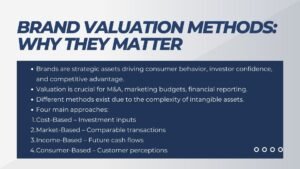
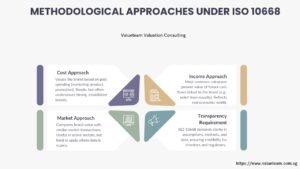
Businesses can measure brand value using recognized valuation approaches that consider factors such as financial performance, market position, customer behavior, and brand-related earnings. A structured brand valuation can help companies understand the financial contribution of their brand and support strategic decisions.

How Brand Value Affects Pricing Strategy

How Brand Value Affects Pricing Strategy

With two products being exactly the same, and selling at vastly different prices, the price discrepancy is nearly always due to the brand name. Whether you’re a finance, marketing or strategy professional, it’s critical to understand how brand value influences pricing strategy because a good brand is not just a business enabler, but it’s also a catalyst for how much customers are willing to pay before looking for a more affordable option. From packaged foods to enterprise software, this dynamic is repeated across almost all categories in the consumer business, and savvy professionals who grasp it are better able to justify pricing decisions with facts, not just gut instinct. This article discusses the growth process of brand equity and its relationship to pricing power, the brand value effect on margin and positioning, and how brand perception and brand loyalty value lead to tangible and measurable brand competitive advantage. Throughout the journey, real-world examples illustrate how this is done on the ground for companies in vastly different stages of brand development. 

How Brand Value Affects Pricing Strategy

What Is the Direct Brand Value Impact on Pricing Decisions and How Brand Value Affects Pricing Strategy?

Economists refer to a potential customer’s willingness to pay as the best measure of the brand’s value impact on price. This ceiling can be raised by a strong brand, which lowers the risk element because the consumer knows that the brand will be there for him or her again, and it also adds intangible value, like status or identity, which a generic product cannot provide no matter how well it performs a function. It’s exactly how brand value drives pricing in real life: A company with a strong brand can more effectively increase the list price above the average in the category, can run slightly less promotions to achieve volume, and can recover from a price increase more quickly than a company with a price-sensitive customers. The influence on the brand value here is not just in the nameplate; it’s how a company has to invest to acquire the customer, because a trusted brand has a higher conversion rate, while one just beginning to build its reputation in the market has a much lower one. This effect is cumulative: every time a price increase is successful, and customers don’t noticeably defect, the positioning of premium becomes even stronger, and the next increase is even easier, creating a virtuous circle that weaker brands, who must compete mainly on price, can’t structurally reach.

This does not mean brand strength should be a soft, fluffy marketing variable that is not part of the financial numbers for the finance and pricing professional. Both conjoint analysis and the van Westendorp price sensitivity study are well-established market research techniques that can separate the price premium attributable specifically to brand, while holding the functional attributes of the products compared constant across the two. After quantifying that premium, it becomes a number that the finance team can add to the margin forecast, brand valuation models, and business case for continuing to invest in the brand, giving it real weight in the business case for commercial decisions. This new way of thinking, from brand as a soft, qualitative issue to brand as a hard business metric that can help drive margin, is the one thing that is now differentiating out the finance functions that really collaborate with marketing on pricing from those that continue to see pricing and brand as two completely separate conversations in the company. Many companies that have made this change have found that pricing discussions are less heated between finance and marketing, as both functions are based on the same set of facts, and not on different, sometimes competing, assumptions about what the brand can actually deliver. 

How Does Brand Equity Growth Translate Into Pricing Power?

Growing brand equity is a series of positive experiences that evolves over a period of years – not months – and creates real trust. Each component of brand equity’s impact on pricing power will vary: Brand awareness by itself does not necessarily give brands pricing power, since customers must be aware of the brand before they can begin to think about the quality, associations, or loyalty it offers; however, once a customer has recognized a brand, perceived quality and strong associations are what may justify paying more for that brand. Pricing power can be observed overtime, usually as a result of a recurring brand tracking study that compares the companies’ brand equity to competitors’ equity to see how the price can increase over time, well before it is evident in the reported margins, and provide an early warning to management when it is time to raise price. Businesses that fail to do this tracking will end up making price decisions when they’re forced to do so by a competitor or a margin loss rather than when they choose to do so in response to an increase in brand equity that has already been realized, but not yet expressed in a price decision.

But the reality is that growth in brand equity doesn’t always equate to the same level of pricing power in every customer segment or every product line. A brand may enjoy a big price premium in its core product line, but have relatively little control over the price of the new product line it has recently moved into because the equity generated in one product line may not be transferred to the other without effort. Failure to factor in this variability may result in pricing team members setting a one-size-fits-all premium on the entire portfolio, which can be seen pretty shortly after launch with weak performance in the overpriced lines and surprisingly strong demand in the underpriced lines. Therefore, it is a worthwhile investment of any pricing team that deals with multiple categories under one brand umbrella to build the brand equity growth – category by category – view. 

Table 1: Brand Equity Growth Drivers and Their Pricing Impact – How Brand Value Affects Pricing Strategy
Equity DriverHow It Builds Over TimeTypical Pricing Impact
Brand awarenessConsistent marketing and market presenceLimited alone, but a prerequisite for premium pricing
Perceived qualityConsistent product performance and reliabilityDirectly supports a measurable price premium
Brand associationsDistinctive positioning and messaging over timeSupports premium pricing in adjacent categories
Customer loyaltyRepeated positive experiences and relationship buildingReduces price sensitivity and switching likelihood

How Does Consumer Brand Perception Shape Willingness to Pay?

Consumer brand perception is a mental shortcut and a way in which consumers form their opinions about the quality and value of a product prior to ever being exposed to it, which is why brand perception can be beneficial even for first-time consumers. Positive perception equals the willingness to give the benefit of the doubt on price; when it’s positive, the customer is willing to view something as more expensive as higher value or exclusivity, and is less likely to think about the price as a premium. This phenomenon is especially apparent in products with characteristics that are hard to judge for the typical customer – like skincare products or wine – where the average consumer relies on brand perception instead of doing her own technical analysis at the point of sale. This substitution effect is especially strong for new customers lacking first-hand knowledge of the product, since what they perceive from the advertising, packaging, word of mouth, and general brand reputation is, at the point of first purchase, the only information available for them.

However, perception is not fixed and the pricing of the product can help to modify it either positively or negatively. So, if a price is too low compared to a brand’s positioning, then even consumers’ brand perception is harmed, as if the brand has reduced quality, which is particularly true in the luxury and premium segments where the aggressive pricing has historically been proven to negatively impact brand equity built over years. On the other hand, a well conducted price rise – particularly where customers feel it has resulted in a real improvement to their product or experience – can strengthen the positive perception and not weaken it, if the perception of the price rise is accompanied by a feeling that the product or experience has been enhanced. That’s why seasoned pricing teams rarely ever suggest an increase in price without also remarks about the reason, whether it may be a genuine product improvement, an extension of the service, or a direct component that relates to growing input expenses. An unexplainable price increase is much more likely to be interpreted by the customer as an opportunistic move than a justified one. Whether it’s a retailer or a direct-to-consumer brand, this tactic of communicating a price increase has come into practice more and more, because, by itself, it tends to raise more attention to consumer perception of a brand than does a price increase. 

What Five Steps Help Translate Brand Value Into Pricing Strategy?

  1. Measure the brand premium directly. To identify the portion of the price premium that is “captive” to the brand and separate it from the functional aspects, use conjoint analysis or price sensitivity research so that the number can be used for real pricing decisions.
  2. Ensure tracking of equity by segment and category. Practice a ‘two-part pricing’ approach by pricing brands and product lines separately, since power to do so isn’t evenly distributed across a company’s entire product line.
  3. Use price as a signal of treatment. Know that the perception of the brand towards the consumers is affected by price movements before making any price adjustment either up or down.
  4. Guard loyalty, not volume. Don’t short-term discount to drive volume at long-term brand loyalty value and future pricing power.
  5. Review pricing power on a regular basis. Review brand tracking data and pricing elasticity studies on a regular basis; brand equity and competitive landscape changes over time and an outdated assessment can lead to poor pricing decisions.

What Real-World Examples Show How Brand Value Affects Pricing Strategy?

For example, look at Halcyon Outdoor Gear, an apparel company that took almost 10 years to establish a reputation for well-made and ethically produced hiking gear before trying to jack up prices more than average for the category. However, when the company finally implemented a roughly 15 per cent price increase, internal sales figures revealed there was virtually no corresponding impact on unit volume, a finding directly confirmed by the finance team as being linked to the growth of brand equity over the years, achieved through a consistent programme of product quality and clear communication with suppliers. The pricing team attributed this to the power of the consumer brand perceptions with the company’s core hiking and outdoor customers who had developed a brand meaning that was beyond the product function, thus making them significantly less price sensitive than a typical outdoor apparel customer. Hearing this outcome has led the company to incorporate brand equity tracking as a regular component of its annual pricing review cycle, not just as one of the inputs when a major pricing call is already underway.

From a contrasting perspective: Marchetti Coffee Roasters was a specialty coffee company that sought volume growth by discounting regularly and prominently in grocery store promotional displays. Although sales volume increased in the short term, brand tracking studies conducted over an eighteen-month period demonstrated a loss in perceived quality and exclusivity, and highlighted a negative brand value effect, quite different to what management was hoping for. The task was to change this perception, and that meant phasing out some discount promotional outlets completely and replacing them with more focused retail investments, which was a slow and expensive process that it took about two years to get right. The two examples share a common theme: Pricing decisions are not easily done sans cost in the short term because customers don’t like to be outsmarted—whether by up or down—they don’t like it, and that’s why a more thoughtful approach to pricing is needed than a short-term, quarter-to-quarter, revenue-focused one is generally able to offer. The companies that learn this lesson develop a pricing governance process which clearly mandates a brand impact assessment in addition to the usual financial business case for any material price change before it is approved. 

What Challenges Come With Brand Competitive Advantage and Brand Loyalty Value?

Creating a true brand competitive advantage through pricing is challenging because brand price is not linear and does not happen automatically; a slight price change may not be obvious by its product features for months, and only then when a “tipping point” is reached in the mind of the customer, that is, a psychological price change occurs, does it have an obvious impact. This can tempt finance teams under short-term margin pressure to accelerate price hikes faster than brand equity can support, making them think that if they don’t see the market taking any action, it’s a sign of price power when it might not necessarily be true when competitors strike back or the economy tightens. The true essence of brand competitive advantage – the hallmark of brands that have already been established – is the patience to not want to squeeze the last ounce of short-term profit from earned trust and confidence. Another problem is that the value of brand loyalty varies among customers: some customers are very loyal and are willing to accept higher prices while others, who are less loyal, will churn easily and average figures of price elasticity can capture very uneven underlying dynamics if only a single blended pricing decision is made. Where possible, loyalty program data can be used to identify this segmentation, as it usually indicates a clear gradient between a brand’s most loyal customers and the more occasional, price-sensitive buyers and much more valuable for use in the pricing decision than a simple average elasticity across all customers. Businesses that take the time to factor in this aspect of brand loyalty are more likely to create tiered pricing or loyalty-based promotions that sustain high-value customers and maintain their market share among less loyal, price-sensitive customers.

Perhaps the best lesson taken from the experience of the brand and pricing professionals is that brand-based pricing requires an incremental approach, not a wholesale “portfolio” approach. When it comes to rolled-out price increases, it’s important to act in a phased way; try the change on a small number of markets or channels first and see how customers react before implementing it on a larger scale; that way, you won’t risk negating brand loyalty value with a blanket decision. Practitioners also discover that brand and pricing teams must work significantly closer together than they usually do in many companies, as there is a tendency to make pricing decisions without thinking about their brand implications, and vice versa. Companies that structure this partnership, such as a cross-hybrid pricing and brand steering committee that meets to discuss big decisions, are more likely to prevent these conflicts from occurring before a decision is put into effect, as opposed to finding out about them after the sale has taken place. 

Table 2: Common Challenges in Brand Loyalty Value and Practical Mitigations – How Brand Value Affects Pricing Strategy
ChallengePractical Mitigation
Price increases outpacing genuine brand equityValidate pricing power with research before broad rollout
Uneven loyalty across customer segmentsSegment pricing analysis rather than relying on blended averages
Discounting eroding long-term perceptionLimit promotional depth and frequency in premium-positioned lines
Brand and pricing teams working in isolationEstablish shared metrics and joint review of pricing decisions
Slow recovery after perception damageTreat perception repair as a multi-year investment, not a quick fix

Conclusion: How Brand Value Affects Pricing Strategy

Price and brand are not mutually independent and can be managed separately from one another: they are continuously influencing one another, and companies that grasp the brand value on price can price with confidence and not guesswork. Creating and maintaining a strong brand equity growth; being aware of the value impact of each price decision; defending the brand value perception and brand value loyalty that enables premium pricing – these are the skills that are applicable in many different industries and careers, including marketing, finance and strategy. In the case of practitioners cultivating this skill, the next step is to analyze a brand’s pricing history and its brand tracking data, and determine when a price move clearly made or hurt the perception of the brand, and then use that trend to sharpen their sense of how much the brand truly deserves to be priced for, before deciding on the next price move. Establishing this judgment early in a career – before it becomes a specialism, like pricing or brand strategy – is a skill distinction for Finance and Marketing professionals alike, as few others will have explicitly developed it.

Frequently Asked Questions

Q1. How does brand value affect pricing strategy?

Strong brand value can support higher prices by increasing customer trust, perceived quality, and confidence in the product or service. When customers see greater value in a brand, they may be more willing to pay a premium compared with competing alternatives.

Yes, strong brands can often charge premium prices because customers associate them with higher quality, reliability, or unique benefits. A well-established brand can use this perceived value to differentiate its offerings and maintain stronger pricing power.

Brand value is important because it can influence how customers perceive the worth of a product or service beyond its functional features. Understanding brand value helps businesses develop pricing strategies that reflect customer expectations, market positioning, and perceived differentiation.

Yes, brand value can significantly influence customer willingness to pay by creating stronger perceptions of quality, trust, and exclusivity. Customers who have a positive connection with a brand may accept higher prices because they believe the overall value justifies the additional cost.

Businesses can measure brand value using recognized valuation approaches that consider factors such as financial performance, market position, customer behavior, and brand-related earnings. A structured brand valuation can help companies understand the financial contribution of their brand and support strategic decisions.

Related Posts

Everything You Need to Know About Brand Valuation with Valueteam

Valueteam helps businesses unlock the true value of their brand for growth, fundraising, or M&A. Our expert brand valuation services deliver clarity, precision, and confidence.