How Brand Value Changes During a Crisis

How Brand Value Changes During a Crisis

How Brand Value Changes During a Crisis

A product recall or data breach, a leadership scandal, or a poorly worded social media post can all wipe out years of brand building in seconds. In the age of the digital revolution, the ability to leverage brand value in a crisis is not a specialty of marketing, communications, finance or corporate strategy – it’s a key business literacy. Brand value is not the same as the value of a seemingly static component of a balance sheet; it’s a living asset that responds to public trust, media attention, customer sentiment and leadership reactions—and it can change in just hours within a single news cycle. This article explains what is really happening to the value of a brand when a crisis strikes, how a company quantifies the damage, and how some of the key points of the article can be applied to a junior to mid-level career, whether that means providing a perspective on managing a brand, advising a brand, sitting in a finance team modeling reputational risk, or simply trying to understand why a company’s stock and reputation move in lock step when bad news gets out. It also examines real-life scenarios, the “how” of how organisations respond, and the skills that are relevant in this field, no matter the job description. 
How Brand Value Changes During a Crisis

What Actually Happens to Brand Value During a Crisis?

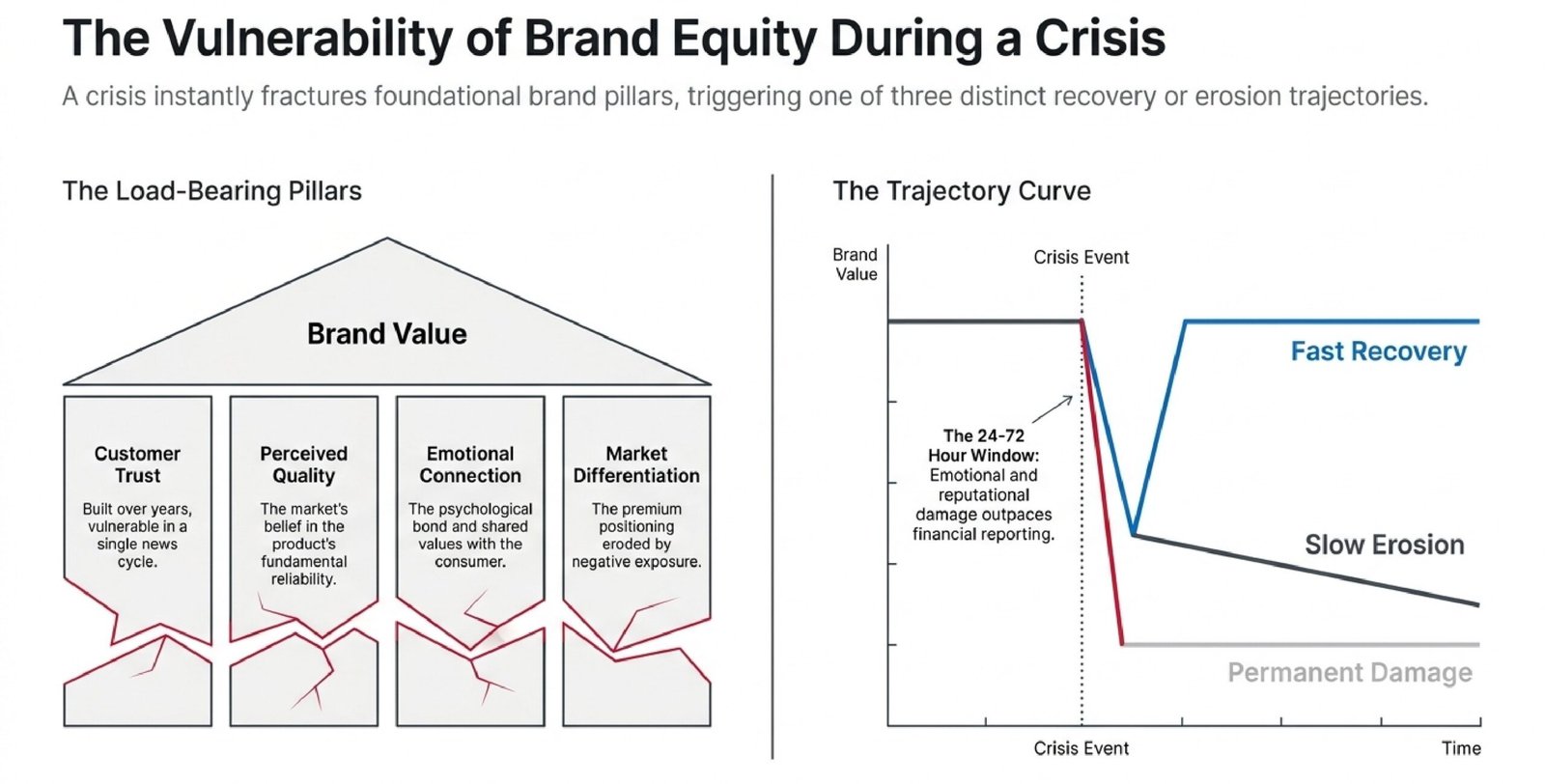
Briefly, brand value will plummet in crisis situations and then take one of three courses of action: fast recovery, slow erosion, or permanent damage, depending on the company’s response. The four pillars of brand value are customer trust, perceived quality, emotional connections, and market differentiation. A crisis hits one or more of these pillars at once, making the value drop far more quickly and drastically than the value can be built up over several years. Taking a decade to establish a reputation for reliability, a brand can have that reputation called into question in a single news cycle—trust is a two-way street; it builds up over time when things go well, but it can be lost in an instant when a situation fails to go well in front of a big audience. The details of how it works are important here. There are three immediate reactions to a crisis: Media opinion goes sour; Customer purchase intent wanes; Investors begin to factor reputational risk into pricing. Brand valuation companies and financial analysts observe parameters such as the brand strength score, negative coverage’s share of voice, customer churn rates, and more to gauge the impact. While a factory fire or a disruption in the supply chain has a more direct and tangible impact on profitability, the financial impact of a brand reputation may be more insidious (in losses in conversions, higher customer acquisition cost,s and lower pricing power). That is why it’s important for anyone in this field to grasp qualitative indicators, like sentiment, tone, and trust surveys, as well as quantitative indicators, such as sales, stock price movement, and market share. It also helps to understand the timeframe of a typical cris,is as the value of brands is not usually a linear, clean decrease. This damage is primarily in terms of reputation and emotion in the first 24 to 72 hours – before the headlines, the social media response, and the internal panic, before the financial figures have caught up. In subsequent weeks, the damage starts to be quantified: there are changes in sales figures, increases in customer service vol,ume and analysts start to provide initial estimates of the financial exposure. By 3-6 months, the situation is more transpa,rent and this is typically when the formal brand crisis valuation reports are released by third-party firms. The experts who recognize this timeline can set expectations appropriately with stakeholders rather than trying to guarantee results when the data hasn’t yet been collected. 

How Do Companies Measure Brand Value After a Crisis?

Financial modeling and consumer research are usually used together to measure brand value after a crisis event, as neither can provide the full story. Analysts tend to rely on the royalty relief method, which involves trying to determine what the company would pay to license its own name, and comparing pre-crisis and post-crisis numbers. The reduction of the forecasted future royalty income reflects a reduction in brand value. There are two types of firms that publish brand value rankings annually, such as Interbrand and Brand Finance, and, when a brand falls a long way in these rankings following a scandal, it’s a visible, citable metric for the damage inflicted on it by the market. On the consumer research side, companies conduct trust surveys, look at the Net Promoter Score movement, and monitor social listening data for changes in tone. This can be helpful to consider as an example: If you have financial modeling, you know where the wound is, you know what size; with consumer research, you know why the wound occurred, and you know whether the wound is healing or not. For those in brand or communications, be comfortable with being able to combine both data types and tell a story, as executives and clients are not just interested in the number, they’re interested in what caused the number, and what can be done about it. Digital and behavioral data are also increasingly being used as indicators of brand value following crisis events. While slower valuation reports are more formal, website traffic trends, search volume for the brand name plus negative keywords, app uninstall rates, and customer service ticket volumes are all indicators that provide near real-time data. The value to a crisis response team of a junior analyst who can compile a straightforward dashboard that links search volumes, social sentimen,t and sales data is likely to be greater than having the work evaluated by an external firm that takes weeks to publish its full report. The following table shows the primary strategies that professionals use to attempt to quantify the 
Table 1: Methods for Measuring Brand Value After Crisis
Measurement Method What It Captures Typical Data Source
Royalty relief / financial modeling Projected future earnings loss Financial statements, analyst reports
Brand strength score Trust, loyalty, differentiation Brand valuation firms (Interbrand, Brand Finance)
Consumer sentiment tracking Public perception, tone of coverage Social listening tools, media monitoring
Net Promoter Score (NPS) shifts Customer willingness to recommend Customer surveys
Stock price and market cap movement Investor confidence Public market data
In practice, most organizations do not use just one method at a time! The more typical internal process involves collecting sentiment and social listening data in the first few days of a crisis, then modelling the potential revenue loss or impact in the first couple of weeks, and, if the crisis is sufficiently large, a formal report from an external brand valuation team would potentially be produced within 1 to 2 quarters. The difficulty for the people tasked with coordinating the three workstreams is that these three workstreams have different timelines and different terminologies, and it’s important for them, no matter what department they’re from, to be able to translate between the qualitative sentiment data and the quantitative financial models so that the leadership can get one single picture and not three incongruent reports. 

What Do Real Crisis Cases Teach Us About Brand Valuation?

Examining the value of a brand after a crisis event is a lot clearer with real-world examples, as theory is not enough without seeing how companies acted in a crisis. Think of a multinational car company that was embroiled in one of its largest emissions violations about 10 years ago. Its brand value declined by billions of dollars based on independent brand value estimates in the months that followed public disclosure, and the stock price plummeted in days. What was unique about this case was not only the scale of the drop, but the process by which it was recovered; the company survived and eventually restored trust, albeit after a series of transparency, leadershi,p and significant investment in new product lines, which took several years to restorthe e level of brand strength scores to pre-crisis levels. For professionals, the lesson is that recovery is often slow, even when the underlying core of the business is sound. In the case of a major global airline, however, a different pattern emerges when it comes to a widely publicized customer mistreatment incident that went “viral” on social media. In the financial sense, the damage was not as severe as in the automotive case, but there was certainly more reputational than monetary damage, with the incident being recorded on video and made public, and public opinion, once formed, moved faster than the company’s official responses. An important difference, as this case illustrates, is that brand crisis valuation is not always in line with the actual operational crisis, but rather in proportion to the degree of visibility of the incident, its emotional quality, and its shareability. Sometimes a small operational problem is more damaging to a brand than a bigger problem that stays hidden in the background. A third case that should be explored is a large tech firm that suffered a massive data leakofr many millions of user accounts. The harm in the data breach case was not apparent and immediate, like the automotive and airline examples, but rather happened over time as more information came to light about the duration of the breach. Some aspects of brands’ value – including indicators of trust, like sharing personal information with the company – took longer to come back than sales did, analysts noted, suggesting that various elements of the brand value are recovering at different rates. In each of these cases, the single factor that has been found to consistently correlate with the speed and extent of brand recovery is transparency at the outset of the situation, even when the news is negative. In each of these cases, the one thing that has proven to consistently correlate with the speed and extent of brand recovery is transparency at the outset of the situation, even when the news is negative. 

What Are the Benefits and Challenges of Tracking Brand Value During a Crisis?

Though it will take time and expertise to invest in tracking brand value during crisis periods, there is real business value in it. The most apparent is that it ensures leadership a sort of early warning system – when the strength scores in brands or the sentiment metrics begin to drop before sales, the company can deal with a moderate issue in a proactive rather than reactive manner, and avoid turning a moderate challenge into a full-blown reputational crisis. Another benefit of tracking is that it also brings accountability – communications teams, legal teams, and executive teams have all got to be on the same page and have a view based on facts and data, not just “how the public seems to feel” (which can vary based on which of the internal teams is reporting it). The problems are the same. It’s more difficult to measure brand value than revenue or profit, which means that various companies will come up with different brand value estimates for the same crisis, leading to confusion among decision-makers who want a single clear number. There is also the issue of timing: financial and reputational impact can be delayed by weeks or months, so companies may not appreciate the true extent of a crisis in the initial stages until the full impact of the data has been absorbed. For professionals new to this role, the biggest dilemma is how to be honest about uncertainty without giving away false precision too soon. It’s better to report to leadership that the damage may be major, but the extent will take more time to determine. Internal alignment is another challenge that is underrated. In a crisis, legal teams may wish to minimise public communication to reduce exposure to liability, communication teams may wish to act swiftly to manage the narrative; and ffinanceteams may wish to have numbers in hand before taking a public stance. These competing priorities can hamper a company’s response at precisely the wrong moment, when it’s time to safeguard brand value during crisis situations. During these stressful times, junior and mid-level professionals who are able to relay information in a manner that aligns with a legal standard of caution, communications timeline and financial accountability are often valued more highly than those positioned higher in the chain of command with formal authority. 

Five Key Steps for Managing Brand Value During a Crisis

No matter what their industry, organisations that have done the best job of protecting their brand during a crisis have taken the same sorts of steps. First, they admit the problem promptly,and with honesty: A delayed or defensive response by them almost always damages the brand value during times of crisis more than the crisis itself, and silence or evasiveness is usually misinterpreted by the public as an admission of guilt, even if it’s not what’s meant. Secondly, they centralize the communication h,aving one aredible spokesperson or a single communication channel, thereby eliminating the risk of many conflicting messages going back and forth among the various departments, regions, or executives. Thirdly, they invest in listening. This means listening to what people are saying outside the company, both about the public in the media and about the employees in the company. They don’t just have to go by what they think people are saying because what people say within the company is often very different from what they say outside the company. Fourth, they do visible corrective actions (product recalls, policy changes, refunds, leadership accountability measures, etc.), since words by themselves do not restore trust – and sometimes action can serve as a counterproductive means of worsening sentiment if the public thinks it is merely a lip-service response. Fifth, they track recovery continuously over time with the same metric by which they measured the initial damage, so they can gauge whether brand valuation efforts following their crisis initiatives are actually helping or hurting, simply because the media buzz has died down. These five steps are not necessarily carried out in sequence, but are more likely to take place concurrently. A company could be embarking on step one (the first public statement) simultaneously as data teams begin creating sentiment tracking dashboards (step three), with legal and operations teams already developing a corrective action plan (step four). The best skill to learn is not for any one individual step, but for how these workstreams must be coordinated in time, and frequently with incomplete information and competing internal priorities. It’s worth noting that people at the beginning of their careers can develop expertise in this field without having to hold a senior communications position or a finance degree. Building relevant skills is easy to do, from reading the annual brand value reports published by brand value companies, following how certain companies react to issues in xvxi blwv, or even practicing basic sentiment analysis with free social listening tools. Having a strong ability to discuss the emotional and financial aspects of a brand crisis, which is still uncommon and highly desirable, is a growing requirement for many marketing, communications, and corporate strategy job postings. Developing the ability to identify what went right or wrong for real companies during a crisis, and how their brand values changed accordingly, is one of the most useful skills to learn before you’re put into a situation to manage a crisis. Remember also that not all crises are created equal, nor are their responses, and it’s the study of a variety of cases that is more important than the memorization of a formula. Others come out of those crises stronger than before in terms of brand loyalty, especially if they act on the crisis with values the public had not previously thought of as being associated with the brand – and they’re not lying, that’s for certain. Others experience long-term damage even after the technical problems are resolved, because the trust of customers was lost for the ivsp dccw, and the trust re-established was not as quick as the problem was solved. This is one of the more advanced understandings a crisis management practitioner can add to a crisis response team, and that sense of distinction is only gained, again, by studying actual crisis situations, not by reading crisis management theory. 

Conclusion: How Brand Value Changes During a Crisis

The answer is that it’s about speed, transparency ,and consistency of response: those who get these three things right quickly make the best recovery and still maintain most of their pre-crisis brand value. The real-world lesson for junior to mid-level marketing, communications, financ,e and strategy professionals is that a brand’s reputation impaconto the bottom line will not be found in either the financial or reputational realm alone. Activities that can be taken forward as next steps are to learn the basic methods used to measure brand value after a crisis event, understand how the key brand valuation firms report on corporate crises, and practice the translation of sentiment and trust data into actionable terms for their executives and clients. As professionals develop the ability to connect numbers with narrative during a crisis, they will always be more useful to organizations and clients, and those who learn to do this early in their careers are more likely to be useful in higher-level crisis response roles. 

Frequently Asked Questions

Q1. How does a crisis affect brand value?

A crisis can reduce brand value by damaging customer trust, perceived quality, reputation, and market differentiation. The financial impact may also appear through lower sales, increased customer churn, reduced pricing power, and weaker investor confidence.

Companies measure brand value after a crisis using financial modelling and consumer research. Common methods include the royalty relief method, brand strength scores, consumer sentiment tracking, and market performance indicators.

Yes, brand value can recover after a crisis. The speed and extent of recovery depend on how effectively a company responds, communicates transparently, takes corrective action, and rebuilds customer trust.

Key factors include customer trust, media coverage, consumer sentiment, leadership response, perceived quality, crisis visibility, and investor confidence. These factors can significantly affect how stakeholders perceive a brand.

Tracking brand value helps companies identify reputational damage, understand potential financial consequences, and assess whether crisis response strategies are successfully rebuilding trust and brand strength.

How Brand Value Changes During a Crisis

How Brand Value Changes During a Crisis

A product recall or data breach, a leadership scandal, or a poorly worded social media post can all wipe out years of brand building in seconds. In the age of the digital revolution, the ability to leverage brand value in a crisis is not a specialty of marketing, communications, finance or corporate strategy – it’s a key business literacy. Brand value is not the same as the value of a seemingly static component of a balance sheet; it’s a living asset that responds to public trust, media attention, customer sentiment and leadership reactions—and it can change in just hours within a single news cycle. This article explains what is really happening to the value of a brand when a crisis strikes, how a company quantifies the damage, and how some of the key points of the article can be applied to a junior to mid-level career, whether that means providing a perspective on managing a brand, advising a brand, sitting in a finance team modeling reputational risk, or simply trying to understand why a company’s stock and reputation move in lock step when bad news gets out. It also examines real-life scenarios, the “how” of how organisations respond, and the skills that are relevant in this field, no matter the job description. 
How Brand Value Changes During a Crisis

What Actually Happens to Brand Value During a Crisis?

Briefly, brand value will plummet in crisis situations and then take one of three courses of action: fast recovery, slow erosion, or permanent damage, depending on the company’s response. The four pillars of brand value are customer trust, perceived quality, emotional connections, and market differentiation. A crisis hits one or more of these pillars at once, making the value drop far more quickly and drastically than the value can be built up over several years. Taking a decade to establish a reputation for reliability, a brand can have that reputation called into question in a single news cycle—trust is a two-way street; it builds up over time when things go well, but it can be lost in an instant when a situation fails to go well in front of a big audience. The details of how it works are important here. There are three immediate reactions to a crisis: Media opinion goes sour; Customer purchase intent wanes; Investors begin to factor reputational risk into pricing. Brand valuation companies and financial analysts observe parameters such as the brand strength score, negative coverage’s share of voice, customer churn rates, and more to gauge the impact. While a factory fire or a disruption in the supply chain has a more direct and tangible impact on profitability, the financial impact of a brand reputation may be more insidious (in losses in conversions, higher customer acquisition cost,s and lower pricing power). That is why it’s important for anyone in this field to grasp qualitative indicators, like sentiment, tone, and trust surveys, as well as quantitative indicators, such as sales, stock price movement, and market share. It also helps to understand the timeframe of a typical cris,is as the value of brands is not usually a linear, clean decrease. This damage is primarily in terms of reputation and emotion in the first 24 to 72 hours – before the headlines, the social media response, and the internal panic, before the financial figures have caught up. In subsequent weeks, the damage starts to be quantified: there are changes in sales figures, increases in customer service vol,ume and analysts start to provide initial estimates of the financial exposure. By 3-6 months, the situation is more transpa,rent and this is typically when the formal brand crisis valuation reports are released by third-party firms. The experts who recognize this timeline can set expectations appropriately with stakeholders rather than trying to guarantee results when the data hasn’t yet been collected. 

How Do Companies Measure Brand Value After a Crisis?

Financial modeling and consumer research are usually used together to measure brand value after a crisis event, as neither can provide the full story. Analysts tend to rely on the royalty relief method, which involves trying to determine what the company would pay to license its own name, and comparing pre-crisis and post-crisis numbers. The reduction of the forecasted future royalty income reflects a reduction in brand value. There are two types of firms that publish brand value rankings annually, such as Interbrand and Brand Finance, and, when a brand falls a long way in these rankings following a scandal, it’s a visible, citable metric for the damage inflicted on it by the market. On the consumer research side, companies conduct trust surveys, look at the Net Promoter Score movement, and monitor social listening data for changes in tone. This can be helpful to consider as an example: If you have financial modeling, you know where the wound is, you know what size; with consumer research, you know why the wound occurred, and you know whether the wound is healing or not. For those in brand or communications, be comfortable with being able to combine both data types and tell a story, as executives and clients are not just interested in the number, they’re interested in what caused the number, and what can be done about it. Digital and behavioral data are also increasingly being used as indicators of brand value following crisis events. While slower valuation reports are more formal, website traffic trends, search volume for the brand name plus negative keywords, app uninstall rates, and customer service ticket volumes are all indicators that provide near real-time data. The value to a crisis response team of a junior analyst who can compile a straightforward dashboard that links search volumes, social sentimen,t and sales data is likely to be greater than having the work evaluated by an external firm that takes weeks to publish its full report. The following table shows the primary strategies that professionals use to attempt to quantify the 
Table 1: Methods for Measuring Brand Value After Crisis
Measurement Method What It Captures Typical Data Source
Royalty relief / financial modeling Projected future earnings loss Financial statements, analyst reports
Brand strength score Trust, loyalty, differentiation Brand valuation firms (Interbrand, Brand Finance)
Consumer sentiment tracking Public perception, tone of coverage Social listening tools, media monitoring
Net Promoter Score (NPS) shifts Customer willingness to recommend Customer surveys
Stock price and market cap movement Investor confidence Public market data
In practice, most organizations do not use just one method at a time! The more typical internal process involves collecting sentiment and social listening data in the first few days of a crisis, then modelling the potential revenue loss or impact in the first couple of weeks, and, if the crisis is sufficiently large, a formal report from an external brand valuation team would potentially be produced within 1 to 2 quarters. The difficulty for the people tasked with coordinating the three workstreams is that these three workstreams have different timelines and different terminologies, and it’s important for them, no matter what department they’re from, to be able to translate between the qualitative sentiment data and the quantitative financial models so that the leadership can get one single picture and not three incongruent reports. 

What Do Real Crisis Cases Teach Us About Brand Valuation?

Examining the value of a brand after a crisis event is a lot clearer with real-world examples, as theory is not enough without seeing how companies acted in a crisis. Think of a multinational car company that was embroiled in one of its largest emissions violations about 10 years ago. Its brand value declined by billions of dollars based on independent brand value estimates in the months that followed public disclosure, and the stock price plummeted in days. What was unique about this case was not only the scale of the drop, but the process by which it was recovered; the company survived and eventually restored trust, albeit after a series of transparency, leadershi,p and significant investment in new product lines, which took several years to restorthe e level of brand strength scores to pre-crisis levels. For professionals, the lesson is that recovery is often slow, even when the underlying core of the business is sound. In the case of a major global airline, however, a different pattern emerges when it comes to a widely publicized customer mistreatment incident that went “viral” on social media. In the financial sense, the damage was not as severe as in the automotive case, but there was certainly more reputational than monetary damage, with the incident being recorded on video and made public, and public opinion, once formed, moved faster than the company’s official responses. An important difference, as this case illustrates, is that brand crisis valuation is not always in line with the actual operational crisis, but rather in proportion to the degree of visibility of the incident, its emotional quality, and its shareability. Sometimes a small operational problem is more damaging to a brand than a bigger problem that stays hidden in the background. A third case that should be explored is a large tech firm that suffered a massive data leakofr many millions of user accounts. The harm in the data breach case was not apparent and immediate, like the automotive and airline examples, but rather happened over time as more information came to light about the duration of the breach. Some aspects of brands’ value – including indicators of trust, like sharing personal information with the company – took longer to come back than sales did, analysts noted, suggesting that various elements of the brand value are recovering at different rates. In each of these cases, the single factor that has been found to consistently correlate with the speed and extent of brand recovery is transparency at the outset of the situation, even when the news is negative. In each of these cases, the one thing that has proven to consistently correlate with the speed and extent of brand recovery is transparency at the outset of the situation, even when the news is negative. 

What Are the Benefits and Challenges of Tracking Brand Value During a Crisis?

Though it will take time and expertise to invest in tracking brand value during crisis periods, there is real business value in it. The most apparent is that it ensures leadership a sort of early warning system – when the strength scores in brands or the sentiment metrics begin to drop before sales, the company can deal with a moderate issue in a proactive rather than reactive manner, and avoid turning a moderate challenge into a full-blown reputational crisis. Another benefit of tracking is that it also brings accountability – communications teams, legal teams, and executive teams have all got to be on the same page and have a view based on facts and data, not just “how the public seems to feel” (which can vary based on which of the internal teams is reporting it). The problems are the same. It’s more difficult to measure brand value than revenue or profit, which means that various companies will come up with different brand value estimates for the same crisis, leading to confusion among decision-makers who want a single clear number. There is also the issue of timing: financial and reputational impact can be delayed by weeks or months, so companies may not appreciate the true extent of a crisis in the initial stages until the full impact of the data has been absorbed. For professionals new to this role, the biggest dilemma is how to be honest about uncertainty without giving away false precision too soon. It’s better to report to leadership that the damage may be major, but the extent will take more time to determine. Internal alignment is another challenge that is underrated. In a crisis, legal teams may wish to minimise public communication to reduce exposure to liability, communication teams may wish to act swiftly to manage the narrative; and ffinanceteams may wish to have numbers in hand before taking a public stance. These competing priorities can hamper a company’s response at precisely the wrong moment, when it’s time to safeguard brand value during crisis situations. During these stressful times, junior and mid-level professionals who are able to relay information in a manner that aligns with a legal standard of caution, communications timeline and financial accountability are often valued more highly than those positioned higher in the chain of command with formal authority. 

Five Key Steps for Managing Brand Value During a Crisis

No matter what their industry, organisations that have done the best job of protecting their brand during a crisis have taken the same sorts of steps. First, they admit the problem promptly,and with honesty: A delayed or defensive response by them almost always damages the brand value during times of crisis more than the crisis itself, and silence or evasiveness is usually misinterpreted by the public as an admission of guilt, even if it’s not what’s meant. Secondly, they centralize the communication h,aving one aredible spokesperson or a single communication channel, thereby eliminating the risk of many conflicting messages going back and forth among the various departments, regions, or executives. Thirdly, they invest in listening. This means listening to what people are saying outside the company, both about the public in the media and about the employees in the company. They don’t just have to go by what they think people are saying because what people say within the company is often very different from what they say outside the company. Fourth, they do visible corrective actions (product recalls, policy changes, refunds, leadership accountability measures, etc.), since words by themselves do not restore trust – and sometimes action can serve as a counterproductive means of worsening sentiment if the public thinks it is merely a lip-service response. Fifth, they track recovery continuously over time with the same metric by which they measured the initial damage, so they can gauge whether brand valuation efforts following their crisis initiatives are actually helping or hurting, simply because the media buzz has died down. These five steps are not necessarily carried out in sequence, but are more likely to take place concurrently. A company could be embarking on step one (the first public statement) simultaneously as data teams begin creating sentiment tracking dashboards (step three), with legal and operations teams already developing a corrective action plan (step four). The best skill to learn is not for any one individual step, but for how these workstreams must be coordinated in time, and frequently with incomplete information and competing internal priorities. It’s worth noting that people at the beginning of their careers can develop expertise in this field without having to hold a senior communications position or a finance degree. Building relevant skills is easy to do, from reading the annual brand value reports published by brand value companies, following how certain companies react to issues in xvxi blwv, or even practicing basic sentiment analysis with free social listening tools. Having a strong ability to discuss the emotional and financial aspects of a brand crisis, which is still uncommon and highly desirable, is a growing requirement for many marketing, communications, and corporate strategy job postings. Developing the ability to identify what went right or wrong for real companies during a crisis, and how their brand values changed accordingly, is one of the most useful skills to learn before you’re put into a situation to manage a crisis. Remember also that not all crises are created equal, nor are their responses, and it’s the study of a variety of cases that is more important than the memorization of a formula. Others come out of those crises stronger than before in terms of brand loyalty, especially if they act on the crisis with values the public had not previously thought of as being associated with the brand – and they’re not lying, that’s for certain. Others experience long-term damage even after the technical problems are resolved, because the trust of customers was lost for the ivsp dccw, and the trust re-established was not as quick as the problem was solved. This is one of the more advanced understandings a crisis management practitioner can add to a crisis response team, and that sense of distinction is only gained, again, by studying actual crisis situations, not by reading crisis management theory. 

Conclusion: How Brand Value Changes During a Crisis

The answer is that it’s about speed, transparency ,and consistency of response: those who get these three things right quickly make the best recovery and still maintain most of their pre-crisis brand value. The real-world lesson for junior to mid-level marketing, communications, financ,e and strategy professionals is that a brand’s reputation impaconto the bottom line will not be found in either the financial or reputational realm alone. Activities that can be taken forward as next steps are to learn the basic methods used to measure brand value after a crisis event, understand how the key brand valuation firms report on corporate crises, and practice the translation of sentiment and trust data into actionable terms for their executives and clients. As professionals develop the ability to connect numbers with narrative during a crisis, they will always be more useful to organizations and clients, and those who learn to do this early in their careers are more likely to be useful in higher-level crisis response roles. 

Frequently Asked Questions

Q1. How does a crisis affect brand value?

A crisis can reduce brand value by damaging customer trust, perceived quality, reputation, and market differentiation. The financial impact may also appear through lower sales, increased customer churn, reduced pricing power, and weaker investor confidence.

Companies measure brand value after a crisis using financial modelling and consumer research. Common methods include the royalty relief method, brand strength scores, consumer sentiment tracking, and market performance indicators.

Yes, brand value can recover after a crisis. The speed and extent of recovery depend on how effectively a company responds, communicates transparently, takes corrective action, and rebuilds customer trust.

Key factors include customer trust, media coverage, consumer sentiment, leadership response, perceived quality, crisis visibility, and investor confidence. These factors can significantly affect how stakeholders perceive a brand.

Tracking brand value helps companies identify reputational damage, understand potential financial consequences, and assess whether crisis response strategies are successfully rebuilding trust and brand strength.

Related Posts

Everything You Need to Know About Brand Valuation with Valueteam

Valueteam helps businesses unlock the true value of their brand for growth, fundraising, or M&A. Our expert brand valuation services deliver clarity, precision, and confidence.