Learn How to Measure Brand Value
Brand Value Explained: Methods to Measure Your Brand’s Financial Impact
Learn How to Measure Brand Value
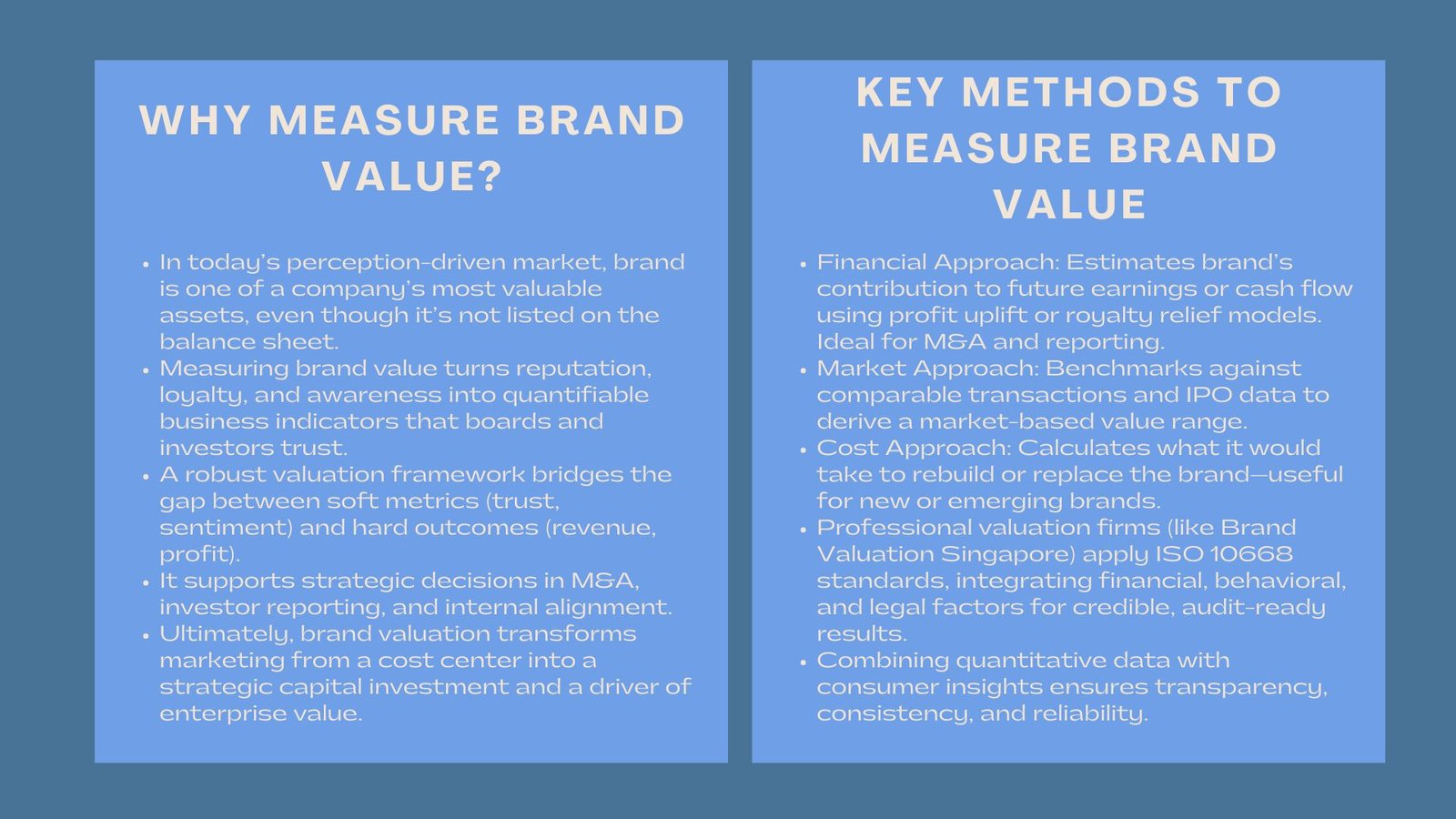
A brand is a highly significant asset that any business should have in its possession in an age where the performance of a business is more or less influenced by perception. However, brand equity is not in a balance sheet, as in the case of factories or cash reserves. To the finance professionals and corporate executives, the capability to measure financial contribution of a brand has become a strategic requirement. The knowledge of how to measure and report brand value will help organizations to make reputation and customer loyalty enjoyable and measurable business indicators that investors and boards can rely on. Brand valuation is no longer a subject that is restricted to marketing dialogues, but a financial science. The accuracy of brand valuation can be applied to make the decisions of companies whether they are merging and acquiring, present investors, or aligning their strategies internally. It closes the difference between sensuous perception and calculable performance by converting abstract equity into a justifiable amount.The Significance of Measuring Brand Values.
Making Intangibles Strategic Assets.
The problem of the contemporary businesses is how to correlate soft measures like awareness, trust, and customer sentiment with hard financial performance. This is solved through a strict valuation process that looks at the direct impact of the brand on revenue growth, margins and growth. It is a quantitative lens that can enable management teams to see the value as very well originated and it makes sure that marketing investments are not seen as discretionary expenditures, but as strategic capital investments.Motivating More Effective Decision-making in Transactions.
Enterprise value frequently consists of a high percentage of brands in corporate deals. In case of acquisition or divestiture of businesses, defensible brand valuation is used to establish to what extent brand assets should contribute to the purchase price. Lack of good valuation could cause arbitrarily estimated goodwill in the negotiation and cause mispricing or conflict. Applying the structured valuation models allows the company to be in a clear position about what drives the deal value and prevent overpayment or underestimation that is costly.Making Marketing Performance Consistent with Financial Reporting.
Effective valuation process unites the marketing and finance. It offers a common language, through which the two functions are able to measure the financial contribution of brand initiatives. In the long-term, monitoring the evolution of the brand values can assist in determining the campaigns, innovations, or changes in strategies that can actually contribute to the increase in the enterprise value. This makes brand management a responsible and result-oriented discipline to be incorporated in a corporate governance.Measuring Brand Value Approaches.
Financial Approach
The financial methodology estimates contribution made by the brand to future future earnings or cash flow. It deals with recognition of brand revenues, coming up with a proper royalty rate or profit enhancement, and discounting the values of these to reflect current value. This approach resembles investment analysis, which suggests a distinct relationship between brand value and enterprise value. It is also quite useful in valuation in the context of mergers, acquisition, or financial reporting.Market Approach
Your brand is compared to similar transactions or IPO data in the market approach. Analyzing the relative values placed on similar brands in your industry, analysts may come up with an estimate of a realistic market-based range. This comparative lens can be used to confirm the assumptions and aid in the discussion of the strategies with the investors or people who intend to purchase it. It is also able to provide information on the impact of brand perception on market capitalization and strength in competition.Cost Approach
The cost approach determines the amount of resources necessary to create a brand afresh or replace it. It takes into account the cost of advertisement, research, product development, and brand building. Though it does not directly gauge customer loyalty or reputation, it gives a baseline, particularly when utilizing with a newer brand or start-up that does not have such a long history of financial statements. This approach would make sure that brand value is not lower than the investment needed to establish it.The manner in which Professional Valuation Firms could give valid results.
The compliance with International Standards.
The prominent practitioners adhere to international standards such as the ISO 10668 that outlines the principles on financial, behavioral and legal study of brand value. Our team at Brand Valuation Singapore uses this holistic approach at the company to bring about accuracy, transparency and consistency. This is to make sure that your valuation is not just strong but also one that is accepted by auditors, investors and even regulators.Integrating Quantitative and Qualitative Wisdom.
Brand essence cannot be expressed by numbers. This is why professional valuation is a combination of financial modelling and consumer research. Analysts review the revenue sources, brand recognition questionnaires, client maintenance information and rival benchmarks. This multi-dimensional model exposes the relationship between emotional attachment and market positioning and its application into generation of long-term cash flow.Ensuring Open and Justifiable Reporting.
The stakeholders of corporations need simplicity, not complexity. Professional valuation reports are written not just giving the final figure, but also give the underlying assumptions, methods and sensitivities. The top executives are presented with a summary of the relationship between brand value and the business outcome on the high level, and the finance team is able to look at more technical appendices, whether due to compliance or audit. Such transparency on two levels brings about confidence and credibility within the organization.Corporate Practice of Brand Valuation Insights.
Strategic Planning and capital Allocation.
When brand value is established, it will serve as a guide in resources allocation. Organizations are able to focus on marketing cases which provide the greatest financial payoff, consolidate non-performing sub-brands and invest where there is the greatest potential to increase equity. In the long term, tracking the value of the brand is an objective data of strategy performance.Improving Investor Communication and Governance.
A viable brand valuation adds value to your story in investor relations. It also gives testimony to the control of intangible assets-a factor that is becoming particularly significant in markets where a brand trust is a stock driver. Brand valuation as a part of annual reports or ESG disclosures will show that the company is accountable and investor trust is high.Licensing, Franchising, and Monetization
A quantified brand value also opens doors to revenue generation through licensing or franchising. Our brand valuation services Singapore team assists clients in developing royalty rate models grounded in data and market benchmarks. This guarantees reasonable compensation of use of the third party brand and helps to monetize uniformly in all markets. In this process, brand equity will be a direct source of financial performance.Changing the Discipline of Brand Measurement.
Integrating Brand Value in Corporate KPIs.
Thought-provoking businesses are also incorporating brand value measurements into the executive dashboards and key performance indicators. This orientation results in a culture in which effectiveness in marketing and financial responsibility go hand in hand and this serves to affirm that brand management is a fundamental part of enterprise achievement and not a peripheral endeavor.Enhancing the Confidence of Stakeholders.
In a world where people are more scrutinized, there is good governance through open communication of brand worth. Investors, auditors, and business partners are assured that the company is aware of the drivers of its intangible wealth. Such transparency boosts credibility, reduces risk and places the organization in a good position as a responsible custodian of its intellectual property and reputation.Building Long-Term Equity
Brand valuation is not a single occasion- it is a continuous practice. With the moving market, consumer preferences, and the competitive environment, there is no need to maintain your brand as relevant and correctly appreciated without the frequent reevaluation. Through monitoring brand performance over time, it will enable organizations to remain strategically agile and protect the creation of long-term equity. Our brand valuation methodology for businesses ensures consistent monitoring and actionable insights across market cycles.Conclusion
Brand valuation converts the theoretical notion of brand equity to a tangible financial resource. Using systematic procedures, open analysis and global benchmarks, organizations can realize the full economic potential of their brands. This enables the executives to be informed when it comes to making decisions in the capital markets, marketing strategy and the corporate transactions. Brand Valuation Singapore collaborates with corporates and finance teams to measure, communicate and increase brand value with accuracy and integrity. By so doing, we assist companies to use their most intangible asset to become one of their most powerful performance drivers, credibility, and long-term performance.Frequently Asked Questions
Q1. What does it mean to measure brand value?
Measuring brand value involves assessing the financial and strategic contribution a brand makes to a business. It helps organizations understand how brand recognition, customer loyalty, market positioning, and reputation translate into economic benefits and long-term business performance.
Q2. Why is measuring brand value important for businesses?
Brand value measurement helps companies make informed decisions regarding marketing investments, strategic planning, mergers and acquisitions, licensing, franchising, and investor communications. A clear understanding of brand value also helps businesses identify opportunities to strengthen their competitive advantage and improve profitability.
Q3. What methods are commonly used to measure brand value?
The most widely recognized approaches are the Income Approach, Market Approach, and Cost Approach. The Income Approach estimates future economic benefits generated by the brand, the Market Approach compares similar brand transactions, and the Cost Approach evaluates the cost of creating or replacing the brand asset.
Q4. What factors influence brand value?
Several factors contribute to brand value, including brand awareness, customer loyalty, reputation, market share, pricing power, customer experience, competitive positioning, and financial performance. Strong brands often generate higher customer retention and greater revenue potential, which can significantly increase their overall value.
Q5. Who should learn how to measure brand value?
Learning how to measure brand value is beneficial for business owners, finance professionals, accountants, valuation specialists, marketing managers, investors, consultants, and corporate executives. Understanding brand valuation principles enables professionals to better evaluate intangible assets and support strategic business decisions with data-driven insights.