ESG Integration in Business Valuations
A Practical Guide for Finance, Advisory, and Strategy Professionals
Introduction to ESG Integration in Business Valuations
The method of valuating businesses is evolving. Until the last century, financial analysis was limited to a narrow range of financial variables: revenue, earnings, cash flow and cost of capital, with the other factors, typically explained in qualitative terms, simply serving as a context for the analysis. This consensus is quickly being overturned and is changing forever. ESG integration in Business Valuation is now a common expectation, not a niche topic anymore, in the investment banking, private equity, asset management and corporate advisory fields. ESG—environment, social and governance—issues, such as climate change, should be part of the analysis behind portfolio decisions, mergers and acquisitions and pricing of IPOs, say institutional investors controlling trillions of dollars in assets.
This is due to several factors: ESG disclosure requirements are now becoming a reality in regulatory frameworks across the European Union, the United Kingdom and now, more and more, in Asia-Pacific; a growing body of empirical evidence that demonstrates that robust ESG performance is linked to reduced cost of capital and better long-term financial performance; and a series of high-profile corporate failures where non-financial risks – climate exposure, supply chain labour violations, governance failures – have turned into significant financial consequences that traditional valuation models have struggled to predict. The consequence of this is that those without experience of incorporating ESG into financial analysis are becoming a minority in the job market and in the provision of financial analysis-based advice.
This article is a practical resource for junior to mid-level practitioners from any discipline within finance, advisory, and strategy fields to understand how to integrate ESG considerations into business valuation. It explains how ESG factors contribute to company value, the methods that can be used for integration, a five-step process for practitioners, real-life case evidence and some of the challenges that make it a truly difficult practice to do well. The aim is not to push ESG as a political or ethical stance, but to enable professionals to factor in ESG as a financial variable.
Why ESG Factors Are Now Essential Financial Valuation Drivers
It is important to have a straightforward understanding of the pathways or the mechanisms that shape the link between environmental, social and governance (ESG) characteristics and financial outcomes, in other words, the transmission mechanisms. There is no theory behind these mechanisms; they can be seen in earnings reports, credit spreads, equity multiples, and premiums in transactions across industries and geographies.
The regulatory exposure and transition risk are the direct effect on value from the environmental pillar. As carbon pricing is extended (either tax-based or cap-and-trade-based), the cost structure of a carbon emissions-intensive company increases. Also, it has a need to upgrade and replace carbon-intensive assets, stranded asset write-downs in case of accelerated regulation, and reputational risk in terms of customer relationships and talent acquisition. Other companies, however, that already have low carbon operations and/or are benefiting from clean energy business and/or revenue streams from sustainable materials and/or environmental services could benefit from a green premium—a valuation premium arising from lowered regulatory risk and access to capital from investors who value ESG-compliant business.
The social and governance pillars are also equally impactful, although the impact may not be measurable, measured, or estimated as easily as the impact on the environment. A company with a history of safety problems, high staff turnover and labour issues in its supply chain has a higher effective cost of equity and legal and reputational risks. A governance discount is expected for such a company because of its potential to make an earnings misstatement or to make capital allocation decisions that destroy shareholder value. The impact on company valuation of the ESG factors is therefore not a single answer, but a matrix of effects: each of the three pillars has a different impact on the value of the company, in different ways, at different speeds and in various degrees of quantifiability depending on the industry and the characteristics of the company.
| ESG Pillar | Key Metrics | Valuation Mechanism Affected | Direction of Impact |
|---|---|---|---|
| Environmental | Carbon emissions intensity, energy use, generation of waste and water management | Discount rate (Stranded Asset Risk), revenue (green premiums/carbon costs), capex needs. | Positive if low-carbon; negative if carbon-intensive or transition-exposed |
| Social | Staff turnover, records of safety, conditions of labour within the supply chain, relations with the community | Revenue stability (brand and customer loyalty), operating cost (talent retention), litigation risk premium | Any positive number is considered positive; any negative number is considered negative. |
| Governance | Independence of the board, quality of the audit, alignment of executive compensation and shareholder rights | Cost of capital, Governance premium/discount, Earnings quality, M&A transaction premium | Positive if it is clear & transparent, negative if it is focused or opaque. |
Table 1: ESG Pillars, Key Metrics, and Their Mechanisms of Valuation Impact
Essential ESG Valuation Methods and Financial Analysis Techniques
The ESG valuation methods that are used for financial analysis by practitioners range from simple adjustments to ESG indicators in standard models to more complex and sophisticated scenario-based approaches that demand a large amount of data infrastructure and analytical expertise. There is no one best solution – it will vary depending on the aim or purpose of the valuation, the quality of the ESG data available and the type of business being valued.
The ESG-adjusted Discounted Cash Flow model is the most theoretically sound of the three models, as it requires the analysts to be explicit about how particular ESG factors are impacting particular financial line items. Raising the operating expense line with a reduced carbon cost assumption, increasing the litigation reserve in the working capital model, and elevating the equity risk premium in the WACC calculation are examples of how strong environmental performance could be reflected, while the opposite is true of a weak safety record and poor governance in the working capital model and the WACC calculation, respectively. This is the value of the mapping of ESG to financial inputs; to consider them as a qualitative overlay is not mapping. It demands a decision by the analyst about the importance of the financial materiality of each of the three ESG factors and, in turn, provides a more solid and verifiable analytical basis.
ESG-tilted comparable company analysis involves weighting peer multiples with the idea of tilting the weights up for companies that perform better on the ESG measures, and down for companies that are more materially lacking on the ESG measures. This is becoming a more common practice amongst equity research analysts following large institutional mandates, as it is reasonably efficient to do so after a solid framework for ESG scoring has been established. The problem is that the set of companies rated in a similar manner is not consistent because of the differences in how companies are rated by different providers (e.g., MSCI, Sustainalytics, ISS). The practitioners who adopt this approach need to choose the rating source carefully and record their choice. Practitioners use different valuation methods for financial analysis in practice, the most important of which are described in the table below.
| Method | How ESG Is Applied | Best Suited For | Limitation |
|---|---|---|---|
| ESG-Adjusted DCF | ESG factors change the revenue growth, margin, capex or discount rate in the cash flow model | Business that clearly have cost or benefit effects on ESG. | Sensitivity of the assumptions; ESG inputs might not be accurate. |
| ESG-Tilted Comparables | Peer multiples scaled up/down according to relative ESG score | Companies that have ESG scores with the same rating in the same industry. | There are inconsistencies because of the difference in ESG rating providers. |
| Scenario / Sensitivity Analysis | Climate or regulatory scenarios that are considered as bear/base/bull scenarios for financials | Industries which are carbon-intensive or are transition-exposed. | The results of scenario design are subjective, and are based on policy assumptions. |
| Integrated Reporting Scorecard | Qualitative ESG scores in conjunction with financial risk-adjusted dashboard | Companies in the early stages or where there is limited data and quantification is challenging | Qualitative or may not be able to be translated directly to a valuation number. |
Table 2: ESG Valuation Methods, Application Logic, and Key Limitations
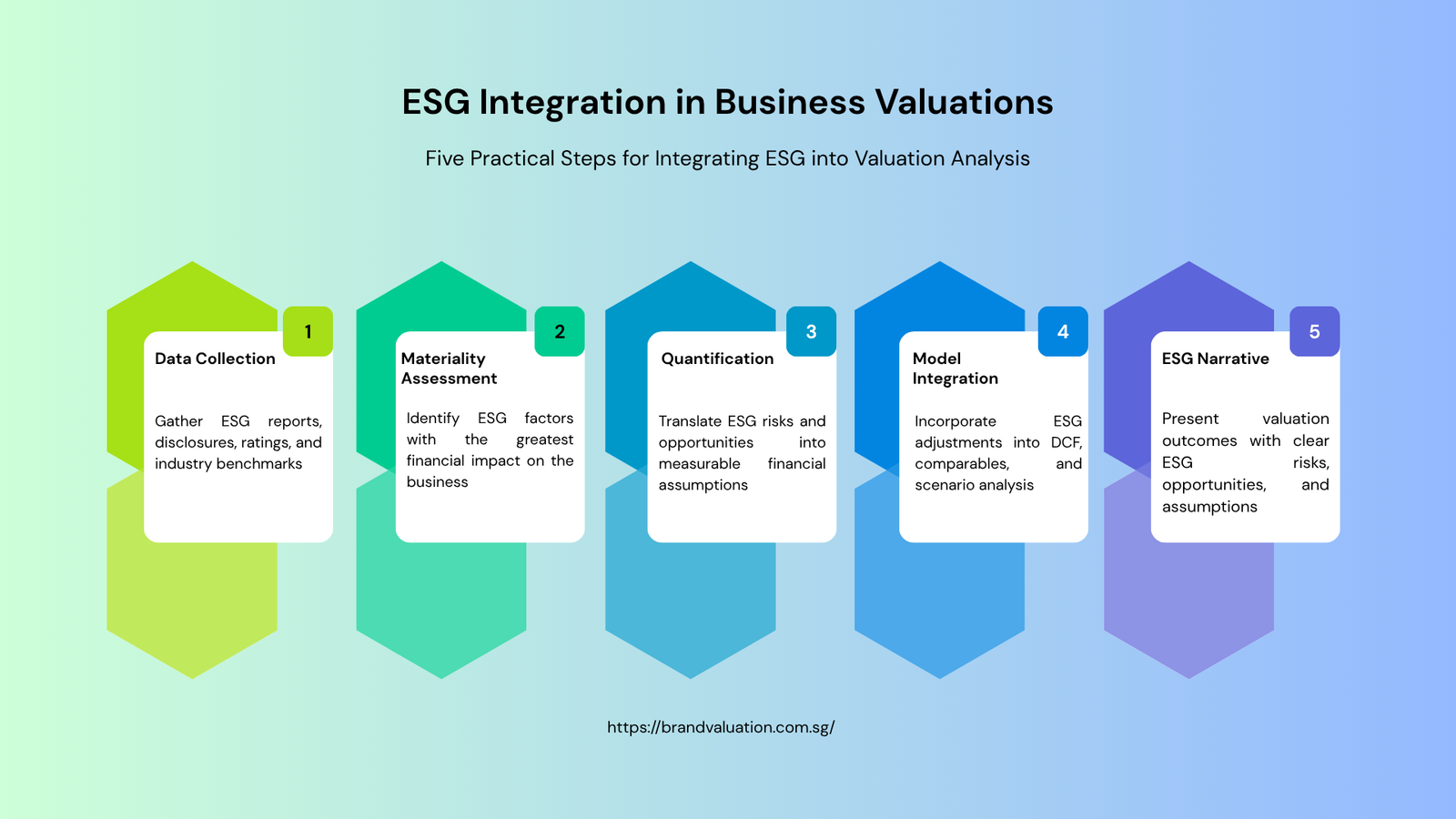
Five Practical Steps for Integrating ESG into Valuation Analysis
The process of effectively integrating ESG when doing business valuations is structured and includes gathering of data, to a financial output. The following five steps are similar to those undertaken by seasoned practitioners in the fields of investment banking, private equity due diligence and equity research.
Step 1: Gather and review ESG-related data from multiple reliable sources
A solid set of data is the basis for any ESG-integrated valuation. This involves utilizing several resources: the company own sustainability reporting and integrated annual reporting, scores and underlying data from ESG rating agencies, regulatory reporting where the environment and governance information are required, and—if available—supply chain and sectoral databases. No one source can be enough. Selective disclosure of company-published sustainability reports, ratings by third parties may fall short of true company performance and the variations in the regulatory filings across jurisdictions. Triangulating data from several sources creates a more accurate picture of the company’s ESG profile than doing so from any one of these rating scores. Many sources provide data on ESG, and understanding what each one measures, how up to date it is and the methodological limitations is therefore a first critical skill in valuation that embraces ESG .
Step 2: Conduct a materiality assessment to identify the most relevant ESG factors
There are factors beyond the financial at play with regard to ESG factors, and not every business will be financially material to these factors. A water management risk that is weighty for a beverage company that has a lot of physical water consumption is not so relevant for a software company that has little or no physical water consumption. The materiality assessment is used to determine the relevant ESG factors that could impact the business’s financial results, and is identified in line with an industry-specific materiality framework, like the Sustainability Accounting Standards Board (SASB) or the Global Reporting Initiative (GRI). This step needs a real understanding of the industry and what the business model’s components are, what its most important cost drivers are, and where its most important regulatory and reputational exposure is. The results of the materiality assessment are a prioritised list of ESG factors to be passed on to the quantification step.
Step 3: Quantify material ESG factors in monetary terms for financial evaluation
This is the most technical step and it’s the one that has the sharpest distinction between the quality of ESG valuation methods for financial analysis. The quantization involves assigning a range of specific financial assumptions to each of the ESG factors identified in this materiality assessment: A carbon price trajectory over a company’s emissions intensity, to estimate future carbon cost exposure; A customer churn assumption that is increased by 50 to 100 basis points, reflecting documented reputational risk from supply chain controversy; A WACC premium applied to reflect governance concerns around board independence. Every quantification needs an evidence base, such as academic studies, peer benchmarks, regulatory guidance or transaction data, and a sensitivity range, as point estimate is not always as credible as a range due to the inherent uncertainty in the mapping of ESG to financial.
Step 4: Incorporate ESG-related adjustments into the valuation model
Once the quantifications of the ESG adjustments are complete, the next step is to incorporate these adjustments in a structured, transparent manner into the valuation model. For a DCF, it also translates into making sure that the ESG adjustments are built into the relevant financial line items and not applied in a black box adjustment to the terminal value. All of the ESG-based assumptions should be labelled and separately sensitised to ensure that the reader of the analysis is aware which portion of the valuation gap between the Base Case and the ESG adjusted case is for each of the factors. This transparency is especially relevant in M&A transactions where advisors to the counterparties may be looking to understand and assess the valuation work and in institutional investment transactions where the valuation positions of the portfolio managers must be understood and explained by them in relation to the ESG drivers.
Step 5: Present the ESG narrative alongside the financial analysis and valuation results
A thorough valuation analysis must be conducted without neglecting ESG, but a reason for the adjustments must also be explained. The last step is to build a coherent story between the ESG aspects of a business and its financial risks and opportunities and then present this narrative along with the quantitative results in a way that can be understood by stakeholders who may not be versed in the technicalities of ESG integration in business valuation, such as a board of directors, management team, and investors. The story should include: The key material issues around ESG and why they are important for this business; How they are incorporated into the model; The range of values with and without ESG; and what the key uncertainties are. This communication is the best place to apply the lessons learned from similar companies and industry trends.
ESG Valuation Integration Process
| ESG Data Collection Ratings, reports, disclosures | ▶ | Materiality Assessment Identify value-relevant ESG risks | ▶ | Quantification Map ESG to financial line items | ▶ | Model Integration Adjust DCF, comps, or scenarios | ▶ | ESG-Adjusted Range Output with risk narrative |
Process Flow 1: End-to-End ESG Integration into Business Valuation
ESG Due Diligence in M&A and Investment Transactions
| ESG Pre-Screen Red flags, exclusions, sector risk | ▶ | Deep ESG Due Diligence Site visits, management interviews | ▶ | Financial Adjustment Price, SPA conditions, reps & warranties | ▶ | 100-Day ESG Plan Post-close improvement roadmap | ▶ | Ongoing Monitoring KPIs, annual ESG reporting |
Process Flow 2: ESG Due Diligence Workflow for M&A and Private Equity Transactions
Real-World ESG Valuation Case Studies and Key Industry Insights
The best ideas on how to measure the effect of ESG on company valuation are those that occur during specific events in which non-financial risks came to pass and had a profound financial impact – and in others where robust ESG performance led to clear valuation premiums.
The 2010 Deepwater Horizon Oil Spill is among the most researched instances of environmental risk translating to value destruction on the money market. The price of BP’s shares dropped by some US$100 billion in the weeks after the blowout of the Macondo well, far bigger than the initial cleanup estimates. The valuation of the market reaction was not only the immediate crisis, it was a fundamental rethinking of BP’s risk culture, their regulatory relationships and the likelihood of further incidents. In the pre-disaster period, BP’s value didn’t account for a material safety and environmental risk premium, which investors paid for. The lesson for valuation practitioners is that environmental and safety risks in extractive and industrial businesses should be explicitly stress-tested in valuation models, rather than considered to be tail risks to be left out of the model.
The governance aspect is more recent and relates to the German payments company Wirecard, which reported at least in 2020 that it had 1.9 billion euros of cash on its balance sheet, but it didn’t exist. However, in the years leading up to its collapse, Wirecard’s ESG scores were consistently high, even though its governance issues were widely known to investors willing to dig deeper: Its supervisory board lacked challenge on governance, the audit was too weak for the complexity and international nature of the company’s operations and its executive incentives did not align with long-term shareholder interests. The case highlighted the need for proper ESG-tilted analysis or third-party scores to be backed by a proper and proper due diligence process on the underlying governance quality – something that is easily relevant for professionals using ESG-tilted analysis or relying on third-party scores without performing a proper and proper due diligence process.
Fortunately, there is an increasing number of examples within the renewable energy industry of the tangible valuation premium that can be achieved from a strong environmental stance. As ESG-mandate investors deployed capital and regulatory risk from carbon pricing reduced, the cost of capital for utilities and infrastructure companies that were successfully and credibly transitioning towards renewable generation reduced dramatically (like Ørsted from Denmark, where the cost of capital significantly re-rated as they turned from one of the world’s most fossil fuel heavy utilities to one of the largest renewable energy operators). This case highlights the importance of ESG adjustment being able to be an upwards adjustment – particularly for businesses that have proactively reduced their transition risk.
Common ESG Valuation Challenges and How Experts Solve Them
Although there is a clear conceptual rationale for ESG integration in business valuation, in practice there are a series of issues that make the use of ESG truly challenging in a real-world analytical setting.
The most common data quality and comparability issue is probably the most severe. There is no standardization of ESG data as with financial data. Some firms release different metrics, some make calculations in different ways and some calculate over different time periods. Third-party ESG rating agencies have different weights and methods for aggregating these metrics, which can lead to rating scores that vary widely from one agency to another: correlation coefficients between major ESG rating providers have been as low as 0.3–0.5, meaning that the metrics are actually measuring significantly different things. This disconnect poses a core credibility issue for analysts who want to create a company’s ESG-based multiples and for those who compare a company’s ESG to its peers. The practical mitigation is to do more than compare companies by their headline ratings, and compare them by reducing their scores down to the specifics; for example, comparing the emission intensity under Scope 1 and 2, comparing turnover (employee churn), comparing independence of the board members, and so on, depending on the metrics being compared and the consistency of the disclosures.
The quantification challenge shares some commonality with but is separate from the quantification challenge. Where there is reliable ESG data, making adjustments to the financials is based on assumptions that are by their nature uncertain. What should the carbon price trend be for 10 years in the future (DCF)? What should the number of WACC premiums be due to any particular governance weakness? How long will it take before the reaction of customers becomes real business consequences for a company with a supply chain controversy? No one “right” answer exists to these questions and a variety of defensible assumptions exists. The best practitioners face this challenge by developing explicit sensitivity tables that reveal the variability in valuation given a variety of ESG adjustment assumptions; in this way they make uncertainty a transparent part of the valuation, as opposed to a point estimate.
The third challenge is related to stakeholder communication. However, senior executives, board members and some investors continue to be unconvinced by ESG-influenced valuations, due to a lack of confidence in the quality of the data, a perception that ESG is a political movement not a science, or because they have witnessed ESG frameworks being inconsistently implemented. The skepticism needs to be addressed by having practitioners who use ESG valuation techniques for financial analysis be able to back their adjustments with tangible financial data, such as transactions, credit spreads or regulatory cost estimates, rather than simply statements. The more that the ESG adjustment can be attributed to a specific and documented financial adjustment, the more believable it will sound to a sceptical audience.
The Importance of Clear Communication in Professional Financial Writing
ESG is not just a passing fad; it is a restructuring of the way that more sophisticated investors and advisers view and value risk. The skills to employ ESG valuation approaches when conducting financial analysis are a real differentiator in the job market for professionals seeking to advance their careers in finance. The ability to integrate sustainability data and financial modelling has become a relatively unique mix that is sought after by employers in investment banking, private equity, equity research and corporate advisory.
If you are not yet as far in your career, the best place to start is to invest in data literacy. Understand the origins of ESG data, the various data points measured by ESG rating agencies and their differences, and where to obtain data at its base-level from company sustainability reports and regulatory disclosures. The building blocks of all the other skills are the competencies needed to assess the data contained in ESG reports – and not just take them at face value. In parallel, gain knowledge of the standard financial valuation methods – DCF, comparable company analysis and scenario modelling – and learn how to relate particular ESG elements to particular financial line items in these methods.
The learning points for the more advanced practitioners and advisers from the cases and challenges addressed in this article is that the financial mechanism is the way to go, not the ESG ideology. The best type of ESG integration in business valuation is the one that a sceptic can’t argue away – with each adjustment being linked to a particular, documented impact on revenue, cost, capital spending, or the cost of capital. If you consider ESG analysis as a risk-management tool, rather than a values exercise, a much broader range of stakeholders can access it, and it can be far more relevant to the board room, deal room and analyst presentation. That is the best industry practice moving towards—at this degree of rigor, it’s the standard of practice that any serious finance professional is aspiring to be able to understand how ESG factors affect the valuation of a company.