Certified Brand Performance Evaluation Training
Evaluating Brand Performance: Metrics That Matter Most
Introduction: Certified Brand Performance Evaluation Training
Brand performance should not be evaluated by how it seems anymore in the era of data-driven decision-making. Businesses have been spending millions of dollars on brand equity but most of them have not been able to quantify how the investments have been made into actual monetary value. Knowledge of brand performance implies the assessment of tangible and intangible signals designating the capacity of the brand to stimulate growth, consumer loyalty and trust of shareholders. Proper analysis will help the management to measure what initially would have been viewed as intangible. Brand performance evaluation can give a picture of the competitiveness, customer trends, and long-term viability when done systematically. To corporate executives, brand measurement vis-a-vis financial performance is now a competency, a competency that guides resource distribution, risk management, and shareholder reporting.The Consciousness of what drives brand performance.
The Economic Component of a Brand Strength.
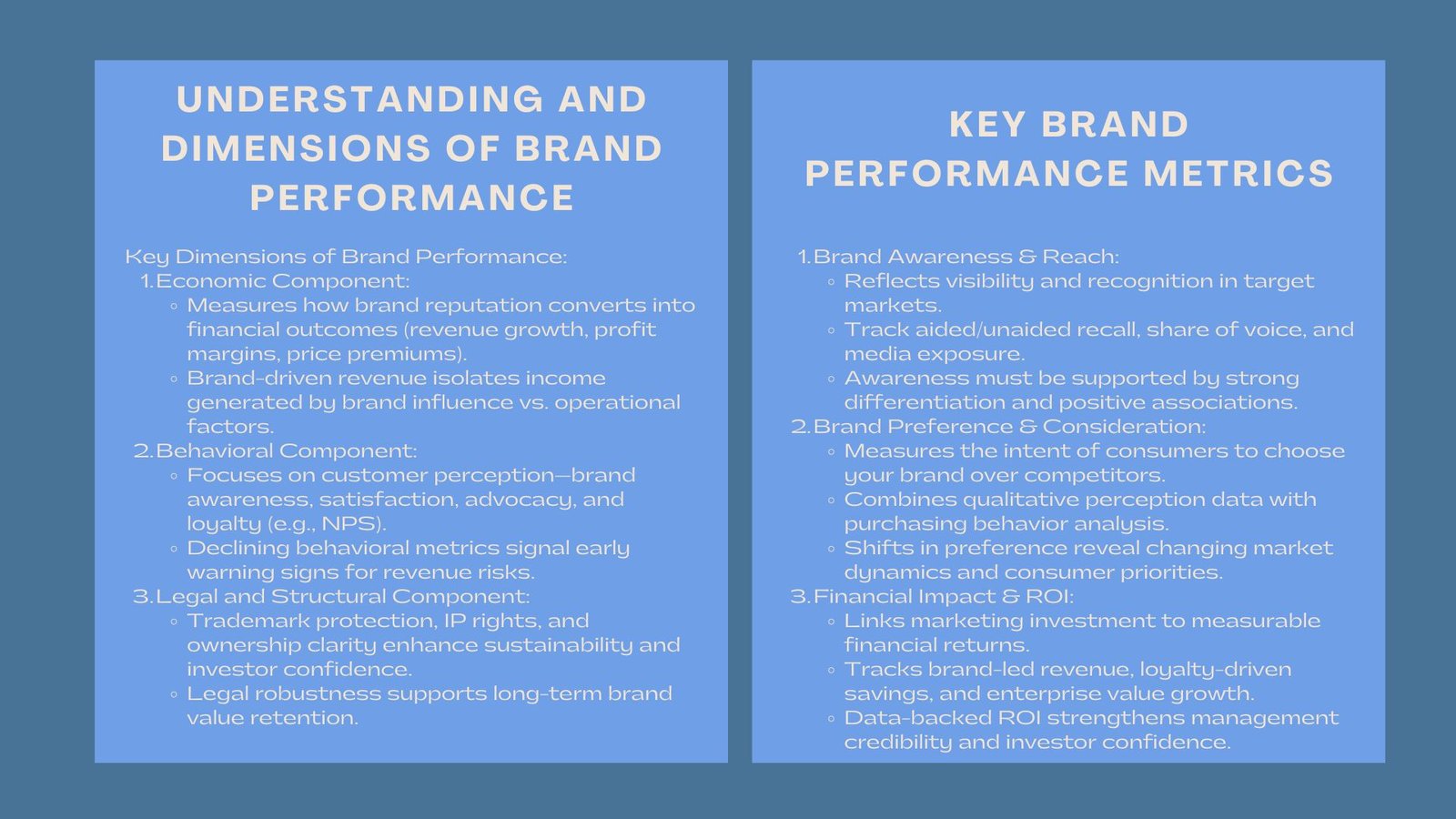
The first area of brand performance is its contribution to the business in terms of finance. The growth of revenue and profitability rates and price premiums are the important measure of the effectiveness of the conversion of a reputation into earnings by a brand. Companies that generate a greater customer trust and perceived quality in their brands achieve higher margins, not necessarily because of cost efficiency. Analysts assess brand-driven revenue to identify the amount of revenue that can be attributed to brand influence as opposed to other operations. This assists organizations to separate the effect of the brand on prices, loyalty and retention. By including this analysis in management reporting, one will have ensured that the brand value is addressed as an economic driver and not just a marketing asset.The Behavioral Dimension: Customer Perception and Loyalty.
Whereas financial outcomes exist of what is occurring, behavioral metrics offer an explanation of why. Brand awareness, customer satisfaction, customer advocacy, and the net promoter scores refer to how customers perceive the brand among the competitors. High behavioral equity indicates resilience; despite the instability of the market, the regular customers allow stabilizing the cash flows and aiding premium positioning. Companies may also predict risks based on their behavioral insights. This drop in brand trust or advocacy is an early warning tool, so a remedial measure is taken before the sales are impacted. Therefore, this behavioral data fills the financial picture with reference to emotional attachment to quantifiable performance.The Legal and Structural Dimension.
Not many companies know the impact of legal and structural factors on the brand performance. A brand can create reliable incomes on the basis of trademarks, protection of intellectual property, and rights on a contract. Poor legal systems subject the business to imitation, dilution or loss of exclusivity. A good brand portfolio, backed by good legal rights, boosts investor confidence as well as the sustainability of the brand value. That is why internationally recognized standards like the brand valuation process and methodology Singapore emphasize legal due diligence alongside financial and behavioral analysis.The important measures that brand performance can be gauged by.
Brand Awareness and Reach
Brand awareness gives an idea of the popularity of the brand across target markets. A high awareness usually increases market penetrations and sales possibilities. Nevertheless, the awareness is not enough and must be coupled with positive brand associations and differentiation. Surveillance of aided and unaided recall, share of voice and media exposure would give a view of the trends in visibility. In the long run, these measures will indicate the success or failure of marketing efforts to promote brand presence.Brand Preference and Consideration.
Whereas awareness implies visibility, preference measures have an impact. Market share can be well predicted by the percentage of consumers that will switch to your brand instead of competitors. Preference analysis is a synthesis of qualitative responses and purchasing patterns to determine the effectiveness of marketing messages in terms of how they are converted into actual decision-making. The score change in preference can be an indicator of a change in the priorities of the consumers or competition. Monitoring these movements helps a brand act in a strategic way- by enhancing the value propositions, modifying prices, or other customer experiences.Financial Impact and ROI
Return on brand investment is the most important measure at the executive level. This involves revenue brought by brand-led initiatives, cost effectiveness due to customer loyalty, and growth of enterprise value in the long-term. ROI calculation involves the need to correlate the marketing spending with the financial performance which can be done by the integration of brand tracking, accounts and operational systems. When companies constantly measure ROI, they are able to support marketing budgets with empirical data. This responsibility increases the credibility of the management and increases the brand value in corporate valuation.Incorporating Brand Metrics in the Corporate Decision-Making.
Creating a Brand Performance Dashboard.
Organizations need to incorporate the metrics in strategic dashboard to make brand measurement actionable. This involves integration of financial, behavior and legal information into a single view-that is accessible by both marketing and financial departments as well as the executive. Single dashboard will create cooperation between departments thus making each department appreciate the impact of their work on the brand equity. This process can also be automated using automated analytics platforms, which will enable real-time information about the sentiment of the market, social interaction, and campaign effectiveness. This is not aimed at gathering more data but converting it to performance-driven intelligence.Amazon is able to align Metrics with Corporate Objectives.
Measurements can only be meaningful when they are on track with business strategy. When aiming at global expansion, a company will be more interested in brand recognition and perception in the new market, whereas an established brand can be concerned with loyalty and increasing the margin. Relevancy in measurement frameworks by adjusting them according to strategic priority avails data overload. Accountability is also promoted by alignment. By making ownership of brand KPIs shared across departments brand performance becomes a goal of the company and is no longer a marketing metric.Integrating Brand Value in the Financial Reporting.
There is a growing demand by investors and regulators that there should be more transparency in the management of intangible assets. Incorporating the value of the brand in the financial reporting resolves the uncertainty between the success of the marketing and the performance of the shareholders.Firms that engage in independent brand valuation for financial reporting Singapore demonstrate both compliance and credibility. Routine reporting of brand-related measurements will create confidence among investors and enhance the market perception. It is an indication that the management is proactively managing the intangible assets as stringently as it is done to physical assets.Value Added Insights: Out of the Box Metrics.
Brand Resilience and Risk Assessment.
Resilience is one of the most crucial metrics that is understudied. It is determined by how a brand can withstand crisis, reputational hits or disruption in the market. Monitoring of brand sentiment, media attention and the time crisis is acted upon, offers a proactive measure of stability. Firms that observe brand resilience are able to detect new risks in time and implement countermeasures before their values are lost. This is a proactive attitude that creates strong brands and weak brands in unstable markets.Personal Impression and Cultural Resonance.
Emotional involvement is one of the strongest brand performance motivation. Brands that appeal to the values and lifestyles of the customers have long-term loyalty. The emotional connection can be measured only through qualitative research interviews, sentiment analysis, and social listening to discover the emotional aspect of brand equity. Emotional strength is also increased by cultural relevance. By aligning brands to the local environments without sacrificing global consistency, brands get stronger and more long-lasting relationships with the consumers.Creativity and Changeability.
Innovation makes a brand relevant in shifting markets. Monitoring the pace of new product development, reactiveness to consumer response, and conversion rate of innovation efforts give insight into responsiveness. Innovative brands in the market have been shown to be able to keep the customer interest and be competitive even as markets change over time. The assessment of innovation as a component of brand performance emphasizes the connection between creative agility and the value generation in the long runCreating a Sustainable Brand Measurement Framework.
To make brand performance measure reliable in the long run, a brand performance measurement must be entrenched in the governance structure of the organization. This is by establishing effective data collection guidelines, review cycles and benchmarking standards that are periodic. Credibility may be increased by the work of external advisors with independent evaluation and verification, whereas in-house teams are concentrated on strategic interpretation. Moreover, by combining brand metrics with other performance metrics, including customer lifetime value, employee engagement, and ESG performance, an organization has a better perspective of corporate health. The greater the knowledge that an organization has on its brand regarding its economic and social contribution, the greater the ability an organization is positioned towards sustainable growth.Conclusion
Brand performance is not a marketing gimmick, but a business strategy that links brand equity to business performance. Financial measures, behavioral measures, and legal measures all show the extent to which a brand spurs growth, risk management, and competitive advantage. Through structures, technology utilization and transparency, organizations will have the opportunity to cease relying on intuition and switch to evidence-based brand management. A disciplined approach will make brand measurement not a reporting task but a tool of management that is dynamic–to allow companies to make informed decisions that would attract investors and create brands that are sustainable.Frequently Asked Questions
Q1. What is brand performance evaluation?
Brand performance evaluation is the process of measuring how effectively a brand achieves its business and marketing objectives. It involves assessing factors such as brand awareness, customer loyalty, market positioning, customer perception, brand equity, and financial performance to determine the overall strength and effectiveness of a brand.
Q2. Who should attend a Certified Brand Performance Evaluation Training program?
This training is suitable for brand managers, marketing professionals, business owners, consultants, corporate executives, valuation specialists, and strategy professionals who want to develop the skills needed to assess brand performance and make data-driven branding decisions.
Q3. What metrics are commonly used to evaluate brand performance?
Common brand performance metrics include brand awareness, customer loyalty, brand preference, customer satisfaction, market share, brand equity, pricing power, customer retention, and revenue growth. These indicators help organizations understand how their brand performs relative to competitors and strategic objectives.
Q4. Why is brand performance evaluation important for businesses?
Regular brand performance evaluation helps businesses identify strengths, uncover improvement opportunities, measure the effectiveness of branding initiatives, and optimize marketing investments. It also supports strategic planning by providing insights into how brand performance contributes to long-term business growth and competitive advantage.
Q5. How can organizations improve brand performance?
Organizations can improve brand performance by strengthening brand positioning, maintaining consistent messaging, enhancing customer experiences, monitoring market trends, measuring brand equity regularly, and aligning branding initiatives with business goals. Continuous evaluation enables businesses to adapt their strategies and maximize brand value over time.