Emerging Trends in Corporate Brand Management
Corporate brand management has undergone a remarkable transformation over the past decade, driven by rapid digitalization, evolving consumer expectations, and heightened emphasis on Environmental, Social, and Governance (ESG) considerations. No longer are brands evaluated solely on product quality, market share, or financial performance. Today, stakeholders—including consumers, investors, employees, regulators, and partners—assess corporate brands on authenticity, sustainability, digital engagement, and innovation. Brands that fail to adapt risk losing market relevance, reputational standing, and strategic growth opportunities.
Emerging trends in corporate brand management underscore the need for a holistic, forward-looking approach that aligns marketing, communications, operations, and ESG initiatives. In Singapore, a regional hub for innovation, technology, and global connectivity, companies increasingly leverage brand strategy innovation to differentiate themselves in competitive markets. Integrating digital tools, sustainability practices, and stakeholder-centric approaches allows organizations to enhance brand equity, foster loyalty, and maximize enterprise value over the long term.
This article explores the major corporate brand management trends shaping today’s business landscape, examines practical strategies for brand innovation in Singapore, and highlights how organizations can measure, manage, and capitalize on these evolving trends to sustain competitive advantage.
Key Corporate Brand Management Trends
Digital-First Branding and Omnichannel Engagement
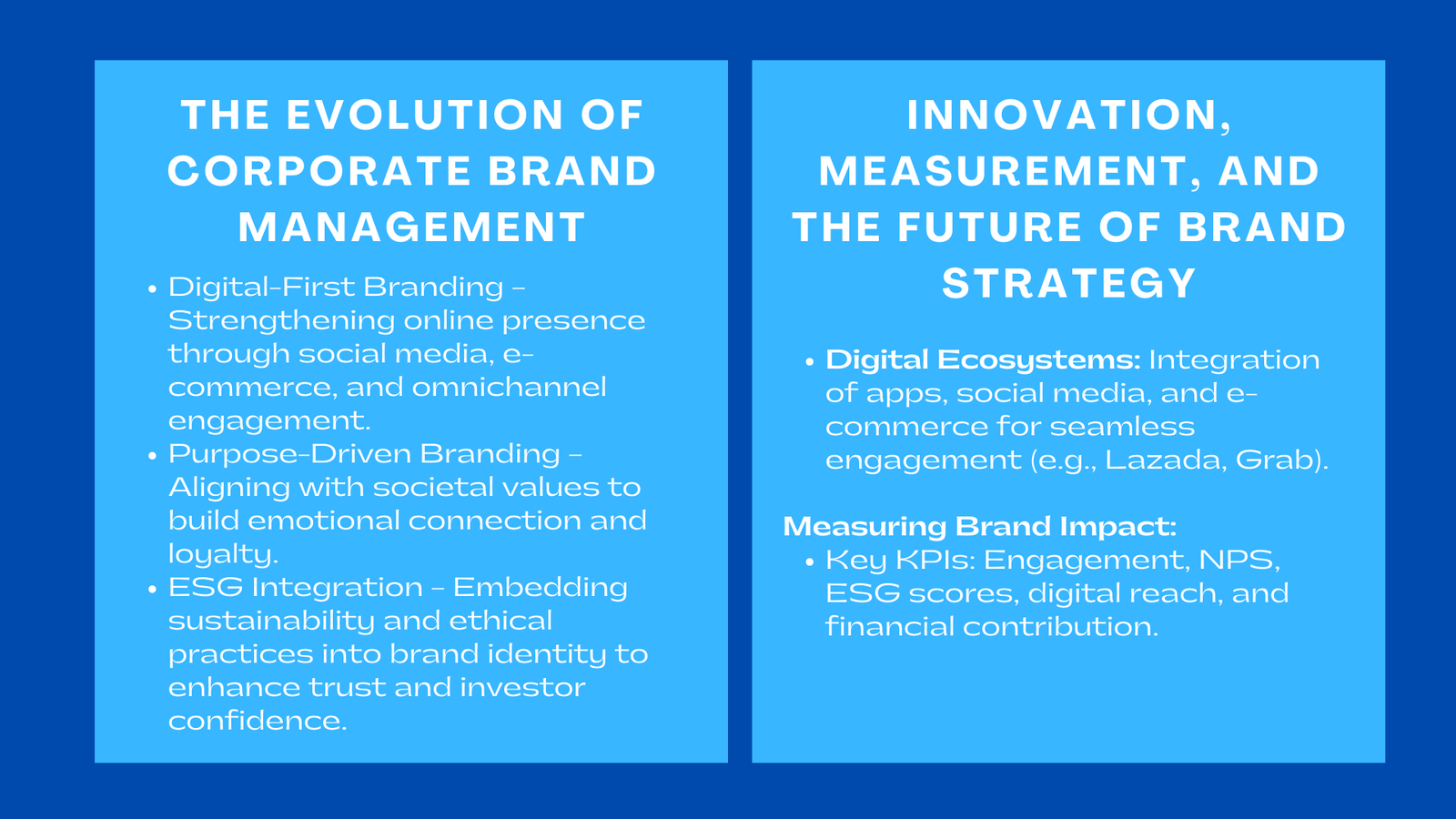
The shift to digital-first branding has accelerated, particularly in the wake of the COVID-19 pandemic, which redefined consumer behavior and forced organizations to strengthen online touchpoints. Companies now prioritize digital channels, including social media, e-commerce platforms, mobile applications, and immersive virtual experiences, to engage stakeholders. Digital-first strategies emphasize real-time communication, personalization, and data-driven insights, allowing brands to respond rapidly to market fluctuations while maintaining competitive relevance. This evolution also highlights the growing importance of brand strength and brand equity valuation in Singapore businesses, where digital engagement directly contributes to measurable brand value and long-term market positioning.
For example, retail brands in Singapore such as Zalora and Love, Bonito have invested heavily in omnichannel digital experiences, integrating online platforms with physical stores to create seamless customer journeys. Personalization engines, AI-driven recommendations, and interactive social media campaigns strengthen engagement while enhancing data collection for brand performance analysis. Organizations adopting digital-first branding benefit from measurable metrics, improved responsiveness, and the ability to translate online engagement into tangible financial outcomes.
Purpose-Driven Branding and Societal Alignment
Purpose-driven branding has emerged as a critical differentiator in today’s marketplace. Consumers, especially Millennials and Gen Z, increasingly prefer brands that demonstrate a clear commitment to social, environmental, and ethical values. Organizations that embed purpose into brand strategy build emotional resonance, enhance credibility, and foster loyalty.
For instance, Singapore-based cosmetics brand The Body Shop emphasizes cruelty-free products and environmental advocacy. These commitments resonate with customers and stakeholders, translating into higher retention rates, stronger advocacy, and a premium positioning in the market. Purpose-driven branding goes beyond marketing messaging; it requires authentic organizational alignment, transparent communication, and measurable impact, ultimately supporting long-term brand equity and financial performance.
Integration of ESG Principles into Brand Strategy
Environmental, Social, and Governance (ESG) considerations have shifted from peripheral compliance obligations to central elements of corporate brand management. ESG performance increasingly influences investor decisions, consumer perception, employee engagement, and corporate reputation. Organizations demonstrating transparent ESG practices, sustainable supply chains, ethical labor standards, and proactive community engagement strengthen stakeholder trust and positively affect enterprise value.
Singapore Airlines, for example, has implemented comprehensive ESG initiatives, including sustainable aviation fuel adoption, waste reduction, and community engagement programs. These efforts enhance brand perception, strengthen loyalty, and improve investor confidence. By embedding ESG into corporate strategy, organizations position themselves as responsible market leaders while mitigating operational and reputational risks.
Employee Advocacy and Internal Branding
Employees are critical ambassadors of corporate brands. Internal branding initiatives, employee engagement programs, and purpose alignment ensure consistent messaging and reinforce the organization’s external reputation. Companies that cultivate strong employee advocacy often experience improved external perception, higher talent retention, and increased operational alignment with brand objectives.
In Singapore, multinational corporations such as DBS Bank and Grab have emphasized internal branding programs that empower employees to communicate brand values authentically. Training programs, incentive structures, and participatory campaigns encourage employees to act as brand champions, reinforcing corporate values both internally and externally.
Data-Driven Brand Strategy and AI Analytics
Data analytics and artificial intelligence are now central to strategic brand management. Advanced analytics provide insights into customer behavior, market trends, brand sentiment, and competitive positioning. Organizations leverage AI-powered tools to optimize campaigns, personalize customer experiences, and track return on investment (ROI) from brand initiatives.
For example, Singaporean companies like Shopee use AI-driven recommendations and predictive analytics to drive engagement, boost conversion rates, and enhance brand loyalty. Data-driven decision-making allows organizations to identify opportunities, mitigate risks, and refine strategies with precision. Integrating these insights into brand valuation models ensures that corporate investments in brand-building initiatives yield measurable returns.
Co-Creation and Stakeholder Engagement
Modern brand strategies increasingly involve co-creation with stakeholders, including customers, partners, and communities. By involving stakeholders in product development, campaigns, and experiences, companies foster deeper engagement, loyalty, and advocacy. Co-creation aligns brand offerings with actual stakeholder needs, enhancing relevance and differentiation in crowded markets.
An example is Grab’s co-created campaigns in Singapore, where customer feedback directly informs service features and app functionality. Collaborative initiatives not only enhance customer satisfaction but also strengthen brand positioning as a responsive and innovative organization. Co-creation strategies are particularly effective in competitive markets where differentiation depends on agility and responsiveness.
Brand Strategy Innovation in Singapore
Digital Ecosystems for Seamless Engagement
Singapore’s status as a technology and innovation hub has created fertile ground for experimenting with brand strategy innovation. Companies are increasingly integrating apps, websites, social media, and e-commerce platforms to build cohesive digital ecosystems. These ecosystems provide seamless customer experiences, enhance engagement, and enable the collection of rich behavioral data that informs strategic decision-making.
For example, Lazada Singapore integrates mobile app functionality, personalized recommendations, and loyalty programs to enhance shopping experiences. The result is not only improved customer engagement but also an enhanced ability to quantify brand contributions to enterprise value, supporting both marketing and finance functions.
Sustainability-Led Brand Positioning
Sustainability is a core pillar of brand innovation in Singapore. Companies are embedding ESG principles into brand positioning, communicating commitments to ethical sourcing, energy efficiency, waste reduction, and community impact. These initiatives strengthen brand trust, attract environmentally conscious consumers, and positively influence investor perception.
Unilever Singapore, for instance, emphasizes sustainable sourcing and community programs, creating measurable brand value while fulfilling ESG objectives. Integrating sustainability into brand strategy demonstrates corporate responsibility and enhances both reputational and financial outcomes.
Innovation Hubs and Collaborative Partnerships
Singaporean companies leverage innovation hubs, accelerators, research institutes, and strategic partnerships to drive creativity and relevance. Collaboration with startups and research centers enables rapid experimentation, adoption of emerging technologies, and development of new products or services that resonate with evolving market demands.
For example, multinational corporations such as Microsoft and Grab collaborate with local accelerators to co-develop innovative solutions that enhance brand relevance, operational efficiency, and customer experience. Such partnerships ensure that brands remain competitive in fast-moving markets while fostering regional leadership in innovation.
Culture of Continuous Learning and Experimentation
Innovative brand strategies require organizations to cultivate a culture of continuous learning. Singapore companies increasingly invest in employee upskilling, design thinking workshops, and cross-functional collaboration to enhance creativity and adaptability. By fostering experimentation, companies can pilot new campaigns, technologies, and ESG initiatives without disrupting existing operations. Continuous learning ensures that brands evolve in step with consumer expectations, regulatory changes, and technological advances, safeguarding long-term value creation.
Leveraging Technology for Personalization and Engagement
Technology is a critical enabler of personalized brand experiences. AI-driven content curation, chatbots, and recommendation engines allow companies to tailor offerings and communications to individual customer preferences. These capabilities increase engagement, strengthen brand loyalty, and improve monetization opportunities.
For instance, Spotify and Netflix utilize AI personalization in their platforms, enhancing brand perception and user retention. Singaporean companies adopting similar technologies can differentiate themselves regionally while delivering measurable financial and experiential benefits.
Measuring and Managing Brand Impact
KPIs and Brand Performance Metrics
Measuring brand impact is essential for managing corporate brand strategy effectively. Organizations track metrics such as customer engagement, brand awareness, Net Promoter Score (NPS), ESG scores, digital footprint, and financial contribution to enterprise value. These indicators provide insight into the effectiveness of marketing campaigns, digital initiatives, ESG integration, and overall brand performance.
Integration with Strategic Planning
Effective brand management requires integrating measurement into strategic planning. Linking brand performance to enterprise objectives ensures that marketing, digital innovation, and ESG initiatives directly enhance brand equity and financial outcomes. Companies can then prioritize investments in high-impact areas and adapt strategies based on quantitative and qualitative feedback.
Continuous Improvement and Iterative Strategy
Brand management in dynamic markets requires a continuous improvement mindset. Regular assessment, stakeholder feedback, and iterative adjustments ensure that strategies remain aligned with evolving expectations. Companies adopting this approach in Singapore can respond effectively to changes in consumer behavior, technological advances, and competitive pressures, maintaining relevance and sustainable growth.
Conclusion to Emerging Trends in Corporate Brand Management
Corporate brand management is evolving at an unprecedented pace, influenced by digitalization, ESG imperatives, changing stakeholder expectations, and competitive pressures. Companies that adopt emerging trends in corporate brand management—such as digital-first strategies, purpose-driven branding, ESG integration, employee advocacy, data-driven insights, and co-creation—are better positioned to strengthen brand equity, enhance stakeholder engagement, and drive sustainable enterprise value.
Singapore offers a unique environment for brand strategy innovation Singapore, leveraging technology, sustainability, innovation hubs, and strategic partnerships. Organizations that integrate these practices into their operations, communication, and strategic planning gain measurable advantages, from enhanced customer loyalty to improved investor confidence and long-term profitability.
Forward-looking corporate brand management is no longer optional. To succeed in dynamic, competitive markets, companies must continuously innovate, measure, and refine their brand strategies. By embracing technology, ESG principles, stakeholder engagement, and data-driven insights, organizations can achieve resilient, respected, and high-value brands that stand the test of time.