How Strong Branding Increases Customer Loyalty?
Understanding How Strong Branding Increases Customer Loyalty?
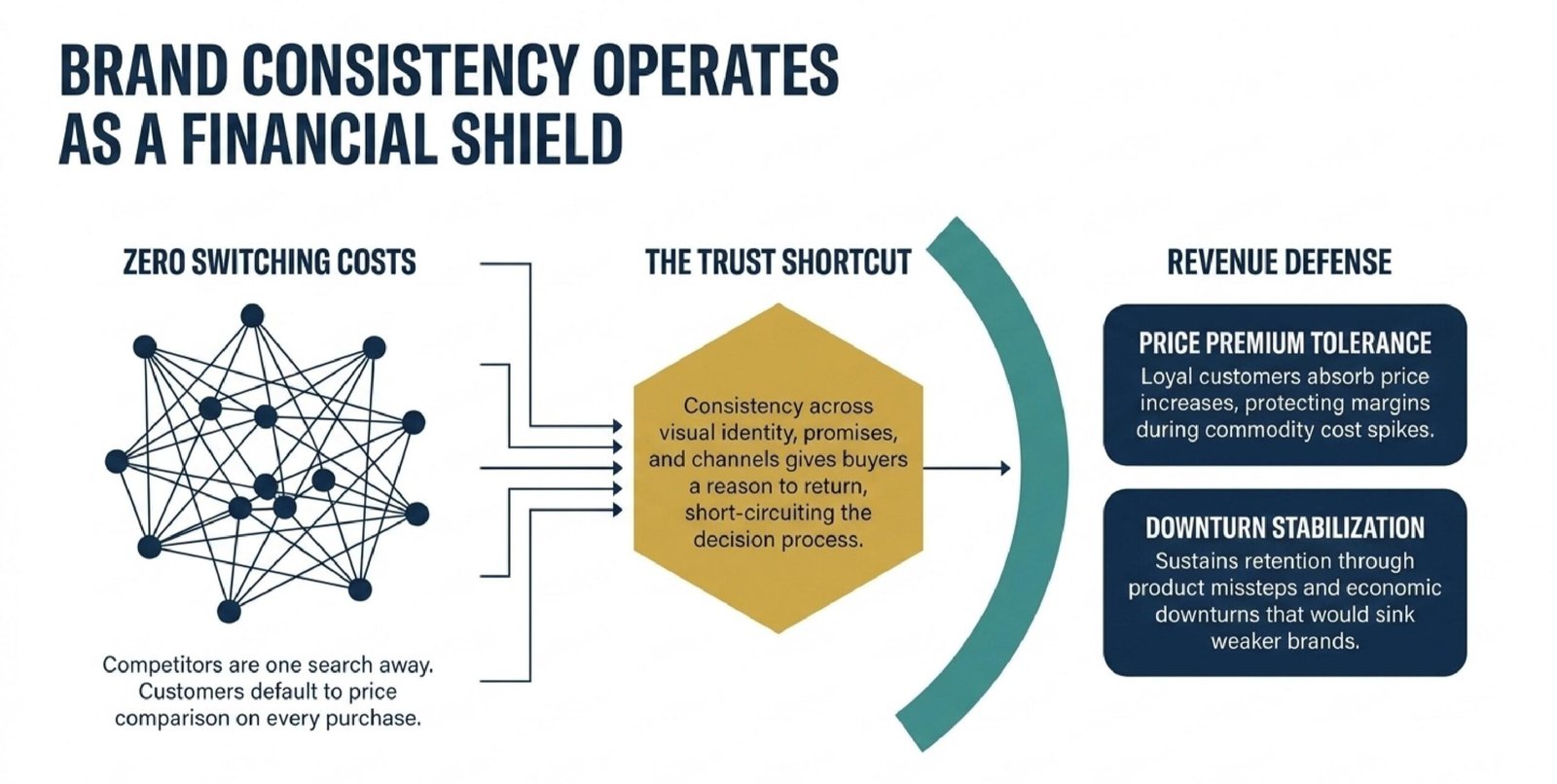
Effective branding is the reason why customers have a reason to return to the company and not to compare prices on every purchase in competitive markets. A brand that is transparent about its values, keeps its promises, and demonstrates itself on a regular basis through multiple channels becomes an easy-to-trust shortcut – customers no longer question if a product is worth buying; they simply assume it is. This is even more important today than ever before – the costs of switching have been driven to virtually nothing thanks to digital markets, and a competitor is just a search away. Those that pursue a disciplined brand loyalty initiative, which is backed by periodic global brand valuations, are more likely to stick with a product line even when it makes a mistake, even when it faces an uptick in price, even when it is down during a recession. The practice of branding in the region and the Brand Strategy Singapore demonstrate the application of the discipline in a high-speed, competitive environment. While knowing how branding can be quantified to drive measurable loyalty is not a soft skill, it is a fundamental one for finance and marketing professionals developing careers in this field and is increasingly influencing the assessment of these careers in the field of valuation and brand management.
How Does Strong Branding Increase Customer Loyalty and Build a Global Brand Valuation Advantage?
A successful branding strategy is most evident when it boosts customer loyalty, and not only when it is felt. That’s where the global brand valuation comes in: independent valuation companies work out the value of a brand by estimating the contribution to profitability, market share, and customer loyalty. A brand with high loyalty metrics like repeat purchase rate, price premium tolerance,e and customer advocacyis worthe more than a competitor that is not well recognized but performs the same function. The link is important for professionals who work in valuation or corporate finance: brand value is not just a marketing figure; it is an asset of the balance sheet, which is relevant for investors, acquirers, and lenders, and is carefully examined in mergers and acquisitions, especially in the purchase price allocation exercises. Over a number of economic cycles and downturns, this has remained true, with brands with the highest scores for customer retention consistently recording the greatest brand valuation growth year-over-year; this is evident in the annual global brand valuation rankings published by the companies that specialize in the assessment of intangible assets.
These rankings are usually based on three things: The financial performance of the branded business,thee brand’s influence on purchase decisions, and brand strength against competitors (loyalty, awareness, differentiation). For instance, a technology firm with a loyal customer base may outperform its competitor with the same revenue but higher churn, because its growth is being valued by analysts less when its customers are repeat buyers. That’s why it is becoming the norm to also include customer lifetime value calculations in global brand valuation exercises rather than simply revenue multiples. The process usually takes three steps: first, the brand’s contribution to total company earnings is separated from the overall company earnings; second, a royalty-relief or excess-earnings model is applied to the earnings figure; and finally, the earnings figure is adjusted according to a brand strength score derived from loyalty, market share stabilit,y and geographic reach. The accurate, reliab,le and well-documented customer information is an input that is used in all stages, but is also the most difficult to find for a valuation team, especially at companies that have not routinely collected customer retention measurements. This can also be where problems arise: When customer data is stored in multiple non-conformant formats in the legacy system, there are multiple definitions of what constitutes an active customer within the individual business units, and there is no historical benchmarking, the process can be delayed or the figure’s confidence reduced. Whether it’s a valuation or brand strategy report, for those junior analysts switching to these jobs, it is a useful skill to learn how to read these reports, as it demonstrates how qualitative interpretation of a brand’s perception can be converted into a supported number that can be used by boards, investor,s and auditors alike.
Why Does Strong BrandinIncreasees Customer Loyalty Depend on Brand Loyalty Strategy Execution?
A brand loyalty strategy is a deliberate series of decisions that a company makes to ensure that customers will return. These decisions include ensuring a consistent product quality, communicating clearly, providing after-sales customer suppor,t and strengthening the brand promise at all touchpoints. If that’s the case, even a good logo and a clever ad campaign will not last long, as customers don’t respond to a single impressi;n, they respond to the experience over time. Businesses that embrace the concept of customer loyalty as a fact of business typically formalize it: they establish goals for retention, monitor satisfaction ratings, and designate one department to handle customer satisfaction instead of outsourcing it. This organization is designed to divide brands that have been loyal to them for decades from those that only have a short time of popularity and that lose customers to the competitor who is slightly cheaper. Many organisations codify this in a written playbook, which outlines tone of voice, service responses and escalation processes – that means that loyalty is not dependent on one manager’s judgment.
Execution is as important as Design. One of the most recognizable outdoor clothing brands has cultivated its brand loyalty through a straightforward, but always consistent, campaign: “Long-lasting goods, hassle-free repairs and replacement—told in the same manner in every store and each market.” Those who personally felt the promise were likely to become repeat buyers, but also, more importantly, unpaid brand advocates who would recommend the brand to their peers. The goal any brand loyalty initiative should strive for: Loyalty that translates into referrals, not just repeat sales. That result was intended to be plainly functional, with employee training manuals making the same point at each counter; supply chains were checked to make sure that the level of durability was consistent with the marketing promise; and customer input channels were directly connected to product design reviews. The takeaway for professionals developing these strategies is that repetition of your message, and not creativity per se, is what leads to retention over time. Years of trust can be built in a matter of one bad experience: a support team that doesn’t stick to the brand’s public promises, for example. This is why many companies today audit their customer-facing team against their brand standards on a regular basis and not just once.
What Does Strong Branding That Increases Customer Loyalty Look Like in Real-World Markets?
Real-world examples help to make the link between branding and loyalty real. A popular coffee store chain gained global popularity, not just because the coffee was superior, but because they created an in-store experience, an identifiable company brand, and a loyalty program where frequent customers were rewarded with tailored offers via a loyalty app. The company has openly attributed the loyalty program to its revenue protection during times of commodity price increases, while customers who join the program spend measurably more per visit and visit more often than non-customers. This process took several years to develop: the loyalty app itself was redesigned multiple times to make it easier to redeem, staff members were retrained to know customers by name (where possible), and store layouts were standardized to make it easier to navigate. Strong branding also contributes to customer loyalty in a concrete and revenue-protective way by enticing customers who are willing to pay more for the brand than customers who do not feel a strong connection to a brand. This is reflected in price increases over time, as customers will tolerate them if the product is a strong brand, but not otherwise; high brand valuation scores are a direct result of this.
Another example would be the consumer electronics industry, where one such manufacturer has been able to enjoy decades of premium pricing power solely based on brand trust and by having the product ecosystem they have in place to make switching to another brand feel high, even though it isn’t actually. Its customers regularly have to pay more for similar functionality ,as the brand has always had a predictable, high-quality product through various generations, in a controlled retail environment, in similar packaging, with similar after-sales service, and rarely differs from country to country. Another lesson is taken from a global athletic footwear company that found its customer loyalty had dropped off significantly after a couple of years of sub-par product quality and lagged response times to customers’ complaints on social media platforms; only a public pledge to improve product quality and deliver target service-response times – taking about two years – restored the level of customer loyalty it had lost. What these cases demonstrate is that strong branding that creates customer loyalty is not universal across all sectors – in the retail sector, it can be about a consistent service; in the tech sector, it can be about a well-designed ecosystem and a disciplined brand loyalty strategy. However, the basic lesson that comes across loud and clear from all of these cases is that trust is earned through repetition and reliability, and it’s lost through inconsistency.
How Can Companies Apply Brand Strategy Singapore Lessons to Strengthen Customer Loyalty?
Southeast Asia provides a valuable lens for those who want to learn more about brand strategy in the region, and the region’s market in Singapore is often mentioned as a state-of-the-art example, given its consumer sophistication and high number of international brands competing with one another. Where customers compare brands regionally and globally on a daily basis, companies can’t afford to depend on brand recognition they’ve gathered elsewhere; it’s a brand that needs to be tailored to this market, and it’s a brand that needs to be marketed here just as you market everywhere else. In a brand strategy in Singapore, it is crucial to adopt a digital-first approach to loyalty programs, provide personalized customer support, and be responsive to social media messages. After all, Singaporeans value brands that are more responsive and interactive and go beyond typical advertising methods. It is a model that other brands across the region are using to tune their loyalty schemes to the more sophisticated, technology-literate customer base, and is often the focus of brand strategy teams seeking to update loyalty programs designed for an earlier, less technologically advanced era of retail.
The “takeaway” from brand strategy Sin ingapore practice is that consistency and local relevance are not mutually exclusive, but can be achieved by design. Generally, the brands are able to keep a consistent core identity, use the same logo, tone, and quality standard, while making adjustments to the loyalty, such as payment integration or reward levels, to fit the local shopping habits. Typically, it begins with a “field test” of consumer research in the region to determine what aspects of the loyalty program customers appreciate the most, and then a small pilot of these “hot” areas in a handful of stores or digital properties before rolling them out, to ensure that bad consumer interactions don’t harm trust on a larger scale. Those who are embarking on a new role in brand management or valuation can learn from this balance, as it shows, in a compact, fast-moving market, how quickly, and how quickly, a strong brand can establish the loyalty of customers when the local brand execution is of high quality or poor quality. The big lesson here is that a could-be used to implement a well-adapted brand loyalty strategy—grounded on brand strategy Singapore practice—gives an accessible model for any cut-throat, digitally advanced market.
What Challenges Limit Strong Branding Efforts to Increase Customer Loyalty?
Creating brand loyalty is not an easy task. In order to ensure consistency across a variety of different markets, product lines, and customer service teams, companies must invest in it continually, and many do not, especially if they are growing quickly or have gone through mergers, where brand consistency can be a challenge. Itis alsos hard to measure the return on this investment – as with a paid advertising campaign, the effects of a brand loyalty strategy often include improvements in retention rates and in tolerance for price premiums that appear over time. This makes it more difficult to advocate to the brand team for the investment, particularly if the effects of a brand valuation improvement may not be first seen in financial statements for several reporting cycles after the actual customer behavior change. But there’s more to the mix, as marketing, the customer service team, and finance each have different metrics for what constitutes a loyal customer, and it can be difficult to agree on one common definition across an entire organisation that can be used to take action.
The one thing that most businesses that have failed here have learned is that loyalty is more easily broken than nurtured. One famous product recall, one data privacy breach, and one customer service error can destroy all of your brand’s building and ear building in a matter of weeks because trust is not a two-way street; customers are far more likely to notice a breach of a promise than they are to notice aonsistent brand fulfillment. The companies that recover well are those that acknowledge the failure and explain it; if they don’t, it’s usually a denial, and that will take longer to build trust than a candor or explanation of what went wrong and how it changes; the rest of the slow-to-recover companies will be either too slow to acknowledge the failure or giving inconsistent public messages across markets or using a brand strategy Singapore style that was not coordinated with the global communications team. To professionals advising on brand strategy, the lesson is that it can only drive customer loyalty if it is supported by some operational consistency that the brand promises – otherwise, it’s just marketing and no marketing dollars can replace a product or service that fails to deliver.
Five Key Points: How Strong Branding Increases Customer Loyalty
- Rather than any specific advertising campaign, consistency, be it in visual identity, tone, pricing, and/or service quality, is the strongest single indicator of customer loyalty over the long haul.
- A good loyalty program will encourage repeat customers by providing rewards for repeat buying and will create first party data to improve future targeting.
- Routine brand valuation events throughout the year enable businesses to measure the value they are getting from investing in their brand and provide proof to leadership about why they should keep investing in their brand, particularly during budget cycles when marketing budgets are being challenged.
- When a crisis happens, transparent communication is much more effective in keeping up brand trust than being silent or waiting until dayslaterr. It should be done in advance, not after the crisis has happened.
- Having a documented brand ownership program with clear brand retention metrics and targets,beats a ‘onone-offbrand effort and provides a playbook for new team members to use for their branding
Table 1: Global Brand Valuation Rankings and Loyalty Indicators (Illustrative) – How Strong Branding Increases Customer Loyalty?
| Industry | Typical Loyalty Driver | Valuation Impact |
| Coffee & Retail | Loyalty app and consistent in-store service | Higher price premium tolerance |
| Consumer Electronics | Ecosystem lock-in and design consistency | Sustained repeat purchase revenue |
| Outdoor Apparel | Warranty and repair policy | Strong customer advocacy and referrals |
| Southeast Asian Multinationals | Localized loyalty mechanics | Faster regional market share gains |
Table 2: Brand Loyalty Strategy Components at a Glance – How Strong Branding Increases Customer Loyalty?
| Component | Purpose |
| Consistent Visual Identity | Builds instant recognition and trust across markets |
| Customer Service Standards | Reinforces the brand promise at every interaction |
| Loyalty and Rewards Programs | Converts repeat purchases into measurable customer data |
| Crisis Communication Plan | Protects accumulated trust during setbacks |
| Localization Framework | Adapts a global identity to regional expectations |
Conclusion: Turning Strong Branding Increases Customer Loyalty Into Practice
Building brand loyalty with strong branding requires a conscious effort, regular monitoring, and safeguarding during challenges. All global brand valuation research, case studies, and regional brand strategy Singapore initiatives confirm that loyalty is not a product of advertising expenditures, but a result of a consistent and reliable strategy throughout the customer experience. There are four steps that can help professionals embark on a career in finance, marketing, or valuation. First, don’t view brand consistency as a design rule—be sure to regularly audit customer touchpoints and provide a corrective action plan to address discrepancies before they grow larger over time. Second, create a formal brand loyalty program, set some retention metric,s and assign owners to the program in place of a one-off campai,gn which is only executed at the end of a budgetary year. Third, have a clear communications plan in place before a crisis in case there is a setback, as the speed of recovery relies on the time it takes to restore trust, and that’s something that can be trained for before it actually happens. The muscle will be developed through running a crisis simulation at least once a year and pre-approval of templates for communication and the granting of sufficient authority to regional teams to respond quickly without needing to be signed off by a distant head office. Fourth, consider global brand valuation and customer loyalty measures as shared reporting and review them together with finance, znlzq the same numbers that make up the balance sheet for brand investments. Businesses and individuals who absorb these insights will discover that a strong brand grows over time and creates loyal fan,s mklok ln the most dependable, cost-effective way to drive sustainable growth.