How to Measure Brand Value in 2026?

How to Measure Brand Value in 2026?

While asset value is a company’s most important, intangible resource, it is not always clearly recorded on the books, which is why it’s not just a consultancy question for the big boys anymore — it’s a real and recurring topic for finance teams, marketers and job seekers. If you are considering an employer, needs to put together a business argument for a marketing budget, to support a merger, or simply want to know why one of your industry’s companies is valued more than the other, having a language to discuss a brand value assessment is a great way to get everyone on the same page. The article spells out the process in simple repeatable steps, illustrates examples from outside Singapore, compares the most popular brand valuation methods, and outlines the practical issues that face professionals as they try out brand value measurement for the first time. At the end of the day, you should be able to tell others how the number has been constructed, and not just parrot it from a presentation. 
How to Measure Brand Value in 2026?

How to Measure Brand Value in 2026: What Does Brand Value Actually Mean?

Brand value is the monetary value of the brand considered an independent asset, the amount of which a buyer would be willing to pay to license or buy the brand name, excluding the company’s physical assets, patents, cash reserves etc. It differs from brand equity, which indicates the qualitative nature of consumer perception, loyalty and awareness. This can be measured by surveys, social listening or Net Promoter Score, not currency. Brand equity is like the raw material, and brand value is the dollar amount that a careful brand value assessment turns that raw material into: usually by predicting the cash flow that is likely to come from the brand in the future, and then discounting it back to the present day, at an appropriate risk-adjusted rate. The first and most frequent error professionals make when they first come across brand valuation reports is mixing these two concepts together, so it is important to keep them distinct: understanding how to measure brand value in 2026 begins with separating them.

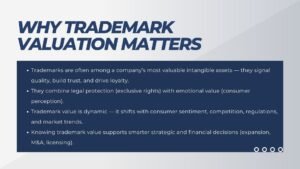
There are more reasons than you might first think to brand value measurement . Investors rely on it for mergers and acquisitions: A strong brand can command a higher purchase price than just the tangible asset, and accountants use it to satisfy intangible asset reporting rules, which mandate businesses periodically test the carrying value of their brands to ensure that it hasn’t been inflated. Marketing uses it to justify budget applications, and it’s a way of taking the time a finance director needs to support a campaign’s spend with some hard numbers. Often alongside traditional financial ratios, published brand value rankings are used by investors and analysts as a proxy for the long-term competitive advantage of companies that appear to have the same financial profile on revenue and margin alone. And more and more, job seekers rely on brand value data to indicate the “stability” and growth “pathway” of an organization when deciding between job offers; especially in sectors where public financial data is scarce or a company has not yet gone public and disclosures are not being made. It is one thing to take a press release at face value and quite another to be able to follow the methodology behind a given headline number, question, and use it to make your own decisions. 

How to Measure Brand Value in 2026: What Does the Five-Step Process Look Like?

When valuing a company, most professional valuation companies use a general five-step process, including some of the more well-known such as Interbrand and Brand Finance. Some providers use different terms, but enough of the ideas are similar and once you understand one, then you can comprehend the others. This involves both breaking down the business and analyzing the financial performance, and then figuring out what part of that is due to the brand itself and what part is due to other factors such as distribution networks, patented technology or raw pricing power in an industry where there is little or no competition. What’s happening in each of these 5 stages should be easily discernible to any practitioners looking at a published valuation report. 

Table 1: Five Steps in How to Measure Brand Value in 2026
Step What Happens Why It Matters
1. Market Segmentation The business is split into segments by product line, geography, or customer type. Brand contribution can vary significantly across segments.
2. Financial Forecasting Revenue and earnings are projected for each segment over several years. Provides the raw cash flows the brand will eventually be valued against.
3. Role of Branding Index Analysts estimate what share of demand is driven by the brand versus other factors. Isolates brand-specific value from operational or price advantages.
4. Brand Strength Score The brand is scored on loyalty, awareness, and market position to set a discount rate. A stronger, more resilient brand carries less risk and a higher value.
5. Net Present Value Future brand-attributable earnings are discounted back to today’s value. Produces the final published brand value figure.

For most companies, the toughest part is the third step, which is differentiating between brand and price/convenience/habit-driven demand. This is where a lot of subjectivity gets in to an otherwise data-centric process since two analysts, analyzing the same financial data, are able to reasonably arrive at different branding index percentages depending on the assumptions they make in the process regarding customer switching behavior and competition intensity within the relevant market. Smaller, private companies have an extra burden here, as they typically don’t have the several years of consistent segmented financial data required by the process; many junior analysts spend more time trying to get the company’s financials to report consistently across different reporting structures, product categorizations, and to get the numbers back to prior periods than they do actually running the valuation model. Remember too that this is a five-step process that is repeated: Major brands are revalued yearly, so it is more useful to remember that there was a movement, rather than the revaluation number, for instance, when comparing its performance against direct competitors, seasonal demand changes, or a new product launch over time. 

How to Measure Brand Value in 2026: What Do Real-World Examples Look Like?

Let’s take a mid-sized consumer electronics company called Solstice Devices, which is based in Poland, that commissioned an external brand assessment prior to a Series C round. Solstice’s finance folks had solid revenue numbers, but didn’t have a good answer for investors on why their products always sold at a premium to virtually identical competitor hardware, running similar components from the same region, with the same suppliers. The valuation firm divided up Solstice’s business by product, predicted its five-year earnings in conservative and optimistic scenarios, and, via consumer surveys and careful pricing analysis, concluded that about forty percent of Solstice’s price advantage was based on the confidence customers place in its products over many years because they have been consistently reliable and responsive to their needs, not on any particular feature or patent. That number was a major feature of the funding pitch deck, and the quantitative evidence in the sales pitch was what sales teams had long been looking for in their customer conversations, but had only been assumed based on the revenue multiple alone, which in turn led to a higher valuation than was warranted based on the revenue.

A different use case was identified at a Canadian-based, business-to-business, software company we’ll call Rivermark Analytics, which leveraged brand value information for talent acquisition in a highly competitive engineering job market with candidates frequently holding multiple offers in hand. Since it’s a medium-sized firm that is battling larger, more prominent employers for experienced engineers, Rivermark has taken a less intense approach to measuring its internal brand value, and the summary sheet of the results is included in recruiting materials and on the careers page with employee testimonials, along with year-over-year brand strength gains and trends in customer retention. Candidates who received more than one offer considered these data as one factor among several in their overall analysis of the long-term stability of the companies they were considering. In both scenarios, the lesson is the same: a value of the brand is truly useful when it becomes a decision, whether it’s a term sheet for an investor, a marketing director’s case in front of a group of executives over next year’s marketing budget, or a job candidate considering two job offers over a weekend. 

How to Measure Brand Value in 2026: What Are the Benefits and Challenges?

The advantages of a comprehensive brand value review are much deeper than the headline number that’s splashed across a yearly report or press release. It provides a level of certainty for finance teams to use in merger/acquisition discussions, licensing deals, and in the impairment testing process for accounting purposes rather than relying on ‘gut feel’. It provides marketing leaders with a way to align the spend of their campaigns to a quantifiable increase in their brands’ strength over time, thereby reinforcing the argument for investing in their brands for the long-term and not just on a campaign-by-campaign basis depending on who had the loudest voice in the room. It provides a consistent basis on which to compare companies in the same industry, even if detailed financial information is not made public, especially for newer and private companies which do not yet have a history of public reporting. And for professionals earlier in their careers, knowing how to measure brand value in 2026 is a true transferrable skill that applies to marketing, finance, and strategy careers, and is a positive talking point at interviews when discussed with examples rather than in terms of a textbook.

The problems are also very real, and need to be understood before making an assumption of any brand value figure in a meeting or interview. Each valuation provider may use different assumptions for the discount rate, forecast period, the brand index itself, etc., resulting in significant variations in valuations of the same company and, therefore, published ratings should always be interpreted as “directional” and not “accurate to the decimal point. Another constant limitation is the lack of data, especially for private companies and smaller brands who don’t have the multi-year, segmented financial history that the typical methodology is based on, and who have to use estimates and industry averages instead of clean internal data. The brand value can also shift significantly from year to year due to currency fluctuations and changing market conditions, even though there has been no significant change in the business or its customer base, so it is easy for anyone to get mixed up when comparing two years’ published rankings without being aware of how currency rates affected the results. Those who view brand value as one of multiple factors but not as some sort of absolute figure without context are much better able to use the value in actual decisions and don’t have to look ridiculous when someone with higher rank asks them a probing question about the number—such as an external auditor. 

How to Measure Brand Value in 2026: Which Brand Valuation Methods and Tools Should You Use?

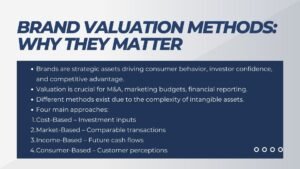
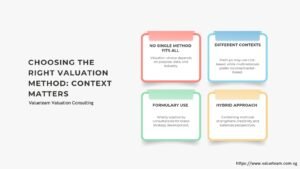
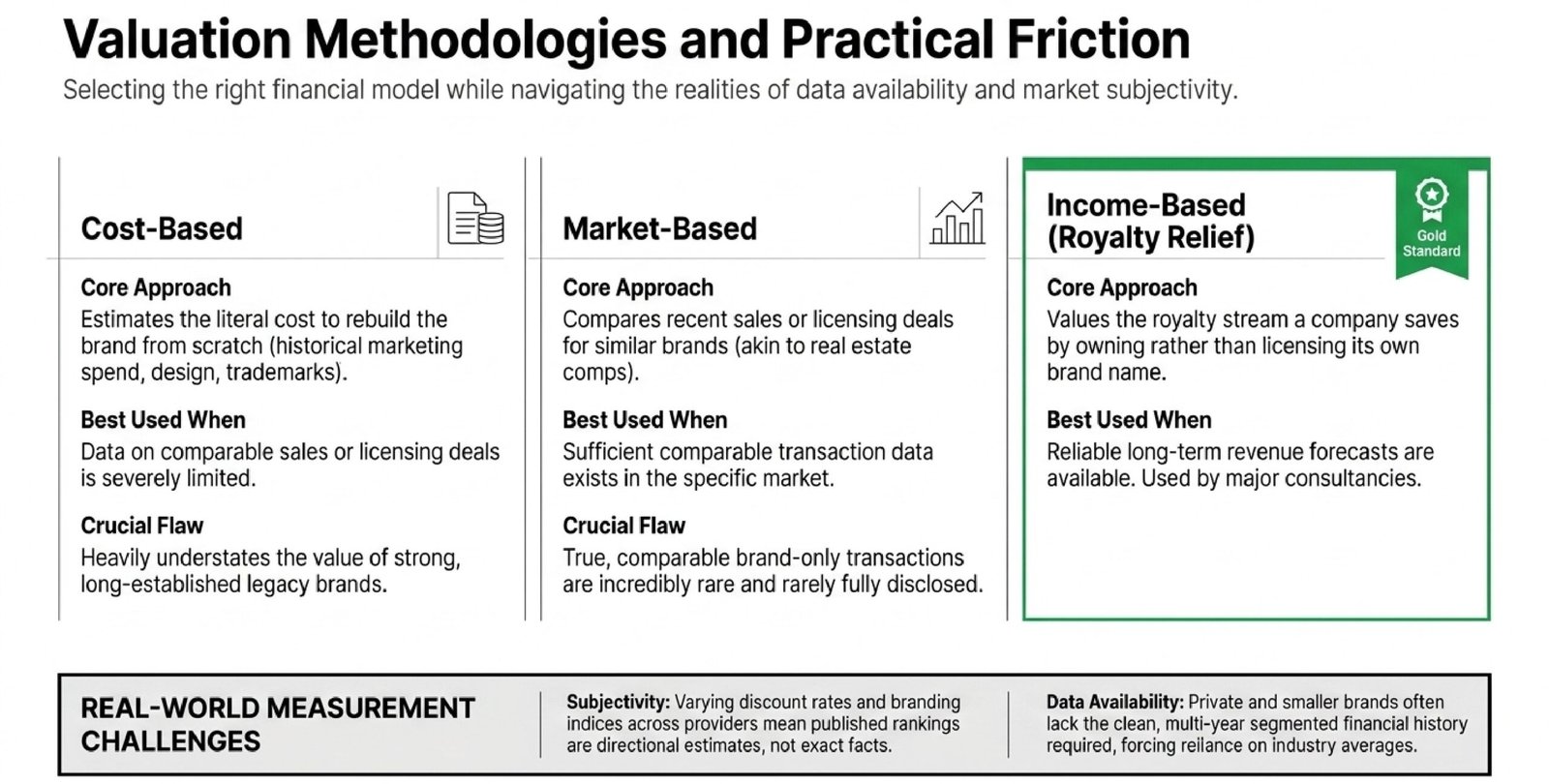
There are three general types of brand valuation method that any professional should be able to differentiate as each addresses a slightly different question and each gives a different answer for the same brand based on the underlying assumption it relies most on. It is easy to calculate, and costs-based methods are based on the principle of how much it would cost to rebuild the brand from scratch, which includes historical marketing spend, design costs and legal fees for trademarks and other costs, but this approach tends to underestimate the value of a truly strong, long-established brand whose value is greater than the sum of its parts. The market-based approach is similar to how the real estate market is valued based on recent similar transactions – in most industries, there is not a sufficient number of truly comparable deals, or brand-only transactions are uncommon and often are not fully detailed to an outside valuation firm. The income-based approach is the more typical valuation method to value a brand, such as that used by large brand valuation firms like Interbrand and Brand Finance, which involves determining the royalty savings a company would have if it did not own its brand name, and then discounting that saved income stream at an appropriate discount rate based on the level of risk of the brand. Most professional valuations, of course, mix them all together, not using any one method alone but cross checking each other before sanity checking the final price before it’s published or shown internally.

There are several platforms available to professionals who would like to implement these concepts but are not interested in a comprehensive external value. A good sense of scale, a benchmark for the industry and a good idea of what to expect from an annual change in brand value can be gained by analysing the rankings of the many publicly available brand value measurement reports carried out by the likes of Interbrand, Brand Finance, Brand Value Institute and Brand Equity. It is a common exercise in finance and marketing training courses to construct a simple model of royalty relief, based on a company’s public revenue data, and an assumed royalty rate derived from a licensing agreement with a competitor or from published ranges of royalties in the industry. It is an actual skill that can be practiced in a spreadsheet and that can be easily demonstrated in an interview or resume. Even if a job seeker doesn’t perform any of these brand valuation methods, they can also watch for informal brand health indicators like consistency on social media, steady growth in customer retention, analyst reviews, and hiring up in marketing and product roles as a good sign of brand health. 

Table 2: Brand Valuation Methods: A Quick Comparison – How to Measure Brand Value in 2026
Method Core Approach Best Used When
Cost-Based Estimates the cost to rebuild the brand from scratch. Data on comparable sales or licensing deals is limited.
Market-Based Compares recent sales or licensing deals for similar brands. Sufficient comparable transaction data exists.
Income-Based (Royalty Relief) Values the royalty saved by owning rather than licensing the brand. Reliable long-term revenue forecasts are available.

Conclusion: How to Measure Brand Value in 2026

Knowing how to measure brand value in 2026 is not about knowing a formula, it’s about understanding which question a number is answering, and which assumptions lie behind it. The next step for junior to mid-level professionals is to become familiar with the five steps described above, understand the strengths and weaknesses of each of the big brand valuation approaches, and accept any financial brand valuation figure published as a reasonable approximation, not as a definitive, unchangeable figure that can be recorded on a balance sheet. If you are seeking to build a business case for next year’s marketing budget, considering a job offer versus another, or just want to start talking about intangible assets like a pro in a strategy meeting, one of the fastest and cheapest ways to turn that knowledge into a skill that you can use and defend when asked is to run a basic brand value assessment exercise on a company that you know well. 
Frequently Asked Questions

Q1. What is brand value?

Brand value is the financial worth of a brand based on factors such as customer perception, brand strength, market performance, revenue contribution, and future earning potential.

Brand value can be measured using income-based, market-based, and cost-based valuation approaches. Businesses can also consider brand equity, customer loyalty, market position, and financial performance.

The three common methods are the income approach, market approach, and cost approach. The most suitable method depends on the purpose of the valuation and the availability of reliable financial and market data.

Brand valuation helps businesses understand the financial contribution of their brand, support strategic decisions, strengthen M&A planning, and identify opportunities to increase long-term brand value.

Strong customer loyalty, positive brand reputation, market differentiation, consistent brand experience, innovation, digital presence, and effective customer engagement can contribute to higher brand value.

How to Measure Brand Value in 2026?

While asset value is a company’s most important, intangible resource, it is not always clearly recorded on the books, which is why it’s not just a consultancy question for the big boys anymore — it’s a real and recurring topic for finance teams, marketers and job seekers. If you are considering an employer, needs to put together a business argument for a marketing budget, to support a merger, or simply want to know why one of your industry’s companies is valued more than the other, having a language to discuss a brand value assessment is a great way to get everyone on the same page. The article spells out the process in simple repeatable steps, illustrates examples from outside Singapore, compares the most popular brand valuation methods, and outlines the practical issues that face professionals as they try out brand value measurement for the first time. At the end of the day, you should be able to tell others how the number has been constructed, and not just parrot it from a presentation. 

How to Measure Brand Value in 2026?

How to Measure Brand Value in 2026: What Does Brand Value Actually Mean?

Brand value is the monetary value of the brand considered an independent asset, the amount of which a buyer would be willing to pay to license or buy the brand name, excluding the company’s physical assets, patents, cash reserves etc. It differs from brand equity, which indicates the qualitative nature of consumer perception, loyalty and awareness. This can be measured by surveys, social listening or Net Promoter Score, not currency. Brand equity is like the raw material, and brand value is the dollar amount that a careful brand value assessment turns that raw material into: usually by predicting the cash flow that is likely to come from the brand in the future, and then discounting it back to the present day, at an appropriate risk-adjusted rate. The first and most frequent error professionals make when they first come across brand valuation reports is mixing these two concepts together, so it is important to keep them distinct: understanding how to measure brand value in 2026 begins with separating them.

There are more reasons than you might first think to brand value measurement . Investors rely on it for mergers and acquisitions: A strong brand can command a higher purchase price than just the tangible asset, and accountants use it to satisfy intangible asset reporting rules, which mandate businesses periodically test the carrying value of their brands to ensure that it hasn’t been inflated. Marketing uses it to justify budget applications, and it’s a way of taking the time a finance director needs to support a campaign’s spend with some hard numbers. Often alongside traditional financial ratios, published brand value rankings are used by investors and analysts as a proxy for the long-term competitive advantage of companies that appear to have the same financial profile on revenue and margin alone. And more and more, job seekers rely on brand value data to indicate the “stability” and growth “pathway” of an organization when deciding between job offers; especially in sectors where public financial data is scarce or a company has not yet gone public and disclosures are not being made. It is one thing to take a press release at face value and quite another to be able to follow the methodology behind a given headline number, question, and use it to make your own decisions. 

How to Measure Brand Value in 2026: What Does the Five-Step Process Look Like?

When valuing a company, most professional valuation companies use a general five-step process, including some of the more well-known such as Interbrand and Brand Finance. Some providers use different terms, but enough of the ideas are similar and once you understand one, then you can comprehend the others. This involves both breaking down the business and analyzing the financial performance, and then figuring out what part of that is due to the brand itself and what part is due to other factors such as distribution networks, patented technology or raw pricing power in an industry where there is little or no competition. What’s happening in each of these 5 stages should be easily discernible to any practitioners looking at a published valuation report. 

Table 1: Five Steps in How to Measure Brand Value in 2026
Step What Happens Why It Matters
1. Market Segmentation The business is split into segments by product line, geography, or customer type. Brand contribution can vary significantly across segments.
2. Financial Forecasting Revenue and earnings are projected for each segment over several years. Provides the raw cash flows the brand will eventually be valued against.
3. Role of Branding Index Analysts estimate what share of demand is driven by the brand versus other factors. Isolates brand-specific value from operational or price advantages.
4. Brand Strength Score The brand is scored on loyalty, awareness, and market position to set a discount rate. A stronger, more resilient brand carries less risk and a higher value.
5. Net Present Value Future brand-attributable earnings are discounted back to today’s value. Produces the final published brand value figure.

For most companies, the toughest part is the third step, which is differentiating between brand and price/convenience/habit-driven demand. This is where a lot of subjectivity gets in to an otherwise data-centric process since two analysts, analyzing the same financial data, are able to reasonably arrive at different branding index percentages depending on the assumptions they make in the process regarding customer switching behavior and competition intensity within the relevant market. Smaller, private companies have an extra burden here, as they typically don’t have the several years of consistent segmented financial data required by the process; many junior analysts spend more time trying to get the company’s financials to report consistently across different reporting structures, product categorizations, and to get the numbers back to prior periods than they do actually running the valuation model. Remember too that this is a five-step process that is repeated: Major brands are revalued yearly, so it is more useful to remember that there was a movement, rather than the revaluation number, for instance, when comparing its performance against direct competitors, seasonal demand changes, or a new product launch over time. 

How to Measure Brand Value in 2026: What Do Real-World Examples Look Like?

Let’s take a mid-sized consumer electronics company called Solstice Devices, which is based in Poland, that commissioned an external brand assessment prior to a Series C round. Solstice’s finance folks had solid revenue numbers, but didn’t have a good answer for investors on why their products always sold at a premium to virtually identical competitor hardware, running similar components from the same region, with the same suppliers. The valuation firm divided up Solstice’s business by product, predicted its five-year earnings in conservative and optimistic scenarios, and, via consumer surveys and careful pricing analysis, concluded that about forty percent of Solstice’s price advantage was based on the confidence customers place in its products over many years because they have been consistently reliable and responsive to their needs, not on any particular feature or patent. That number was a major feature of the funding pitch deck, and the quantitative evidence in the sales pitch was what sales teams had long been looking for in their customer conversations, but had only been assumed based on the revenue multiple alone, which in turn led to a higher valuation than was warranted based on the revenue.

A different use case was identified at a Canadian-based, business-to-business, software company we’ll call Rivermark Analytics, which leveraged brand value information for talent acquisition in a highly competitive engineering job market with candidates frequently holding multiple offers in hand. Since it’s a medium-sized firm that is battling larger, more prominent employers for experienced engineers, Rivermark has taken a less intense approach to measuring its internal brand value, and the summary sheet of the results is included in recruiting materials and on the careers page with employee testimonials, along with year-over-year brand strength gains and trends in customer retention. Candidates who received more than one offer considered these data as one factor among several in their overall analysis of the long-term stability of the companies they were considering. In both scenarios, the lesson is the same: a value of the brand is truly useful when it becomes a decision, whether it’s a term sheet for an investor, a marketing director’s case in front of a group of executives over next year’s marketing budget, or a job candidate considering two job offers over a weekend. 

How to Measure Brand Value in 2026: What Are the Benefits and Challenges?

The advantages of a comprehensive brand value review are much deeper than the headline number that’s splashed across a yearly report or press release. It provides a level of certainty for finance teams to use in merger/acquisition discussions, licensing deals, and in the impairment testing process for accounting purposes rather than relying on ‘gut feel’. It provides marketing leaders with a way to align the spend of their campaigns to a quantifiable increase in their brands’ strength over time, thereby reinforcing the argument for investing in their brands for the long-term and not just on a campaign-by-campaign basis depending on who had the loudest voice in the room. It provides a consistent basis on which to compare companies in the same industry, even if detailed financial information is not made public, especially for newer and private companies which do not yet have a history of public reporting. And for professionals earlier in their careers, knowing how to measure brand value in 2026 is a true transferrable skill that applies to marketing, finance, and strategy careers, and is a positive talking point at interviews when discussed with examples rather than in terms of a textbook.

The problems are also very real, and need to be understood before making an assumption of any brand value figure in a meeting or interview. Each valuation provider may use different assumptions for the discount rate, forecast period, the brand index itself, etc., resulting in significant variations in valuations of the same company and, therefore, published ratings should always be interpreted as “directional” and not “accurate to the decimal point. Another constant limitation is the lack of data, especially for private companies and smaller brands who don’t have the multi-year, segmented financial history that the typical methodology is based on, and who have to use estimates and industry averages instead of clean internal data. The brand value can also shift significantly from year to year due to currency fluctuations and changing market conditions, even though there has been no significant change in the business or its customer base, so it is easy for anyone to get mixed up when comparing two years’ published rankings without being aware of how currency rates affected the results. Those who view brand value as one of multiple factors but not as some sort of absolute figure without context are much better able to use the value in actual decisions and don’t have to look ridiculous when someone with higher rank asks them a probing question about the number—such as an external auditor. 

How to Measure Brand Value in 2026: Which Brand Valuation Methods and Tools Should You Use?

There are three general types of brand valuation method that any professional should be able to differentiate as each addresses a slightly different question and each gives a different answer for the same brand based on the underlying assumption it relies most on. It is easy to calculate, and costs-based methods are based on the principle of how much it would cost to rebuild the brand from scratch, which includes historical marketing spend, design costs and legal fees for trademarks and other costs, but this approach tends to underestimate the value of a truly strong, long-established brand whose value is greater than the sum of its parts. The market-based approach is similar to how the real estate market is valued based on recent similar transactions – in most industries, there is not a sufficient number of truly comparable deals, or brand-only transactions are uncommon and often are not fully detailed to an outside valuation firm. The income-based approach is the more typical valuation method to value a brand, such as that used by large brand valuation firms like Interbrand and Brand Finance, which involves determining the royalty savings a company would have if it did not own its brand name, and then discounting that saved income stream at an appropriate discount rate based on the level of risk of the brand. Most professional valuations, of course, mix them all together, not using any one method alone but cross checking each other before sanity checking the final price before it’s published or shown internally.

There are several platforms available to professionals who would like to implement these concepts but are not interested in a comprehensive external value. A good sense of scale, a benchmark for the industry and a good idea of what to expect from an annual change in brand value can be gained by analysing the rankings of the many publicly available brand value measurement reports carried out by the likes of Interbrand, Brand Finance, Brand Value Institute and Brand Equity. It is a common exercise in finance and marketing training courses to construct a simple model of royalty relief, based on a company’s public revenue data, and an assumed royalty rate derived from a licensing agreement with a competitor or from published ranges of royalties in the industry. It is an actual skill that can be practiced in a spreadsheet and that can be easily demonstrated in an interview or resume. Even if a job seeker doesn’t perform any of these brand valuation methods, they can also watch for informal brand health indicators like consistency on social media, steady growth in customer retention, analyst reviews, and hiring up in marketing and product roles as a good sign of brand health. 

Table 2: Brand Valuation Methods: A Quick Comparison – How to Measure Brand Value in 2026
Method Core Approach Best Used When
Cost-Based Estimates the cost to rebuild the brand from scratch. Data on comparable sales or licensing deals is limited.
Market-Based Compares recent sales or licensing deals for similar brands. Sufficient comparable transaction data exists.
Income-Based (Royalty Relief) Values the royalty saved by owning rather than licensing the brand. Reliable long-term revenue forecasts are available.

Conclusion: How to Measure Brand Value in 2026

Knowing how to measure brand value in 2026 is not about knowing a formula, it’s about understanding which question a number is answering, and which assumptions lie behind it. The next step for junior to mid-level professionals is to become familiar with the five steps described above, understand the strengths and weaknesses of each of the big brand valuation approaches, and accept any financial brand valuation figure published as a reasonable approximation, not as a definitive, unchangeable figure that can be recorded on a balance sheet. If you are seeking to build a business case for next year’s marketing budget, considering a job offer versus another, or just want to start talking about intangible assets like a pro in a strategy meeting, one of the fastest and cheapest ways to turn that knowledge into a skill that you can use and defend when asked is to run a basic brand value assessment exercise on a company that you know well. 

Frequently Asked Questions

Q1. What is brand value?

Brand value is the financial worth of a brand based on factors such as customer perception, brand strength, market performance, revenue contribution, and future earning potential.

Brand value can be measured using income-based, market-based, and cost-based valuation approaches. Businesses can also consider brand equity, customer loyalty, market position, and financial performance.

The three common methods are the income approach, market approach, and cost approach. The most suitable method depends on the purpose of the valuation and the availability of reliable financial and market data.

Brand valuation helps businesses understand the financial contribution of their brand, support strategic decisions, strengthen M&A planning, and identify opportunities to increase long-term brand value.

Strong customer loyalty, positive brand reputation, market differentiation, consistent brand experience, innovation, digital presence, and effective customer engagement can contribute to higher brand value.

Related Posts

Everything You Need to Know About Brand Valuation with Valueteam

Valueteam helps businesses unlock the true value of their brand for growth, fundraising, or M&A. Our expert brand valuation services deliver clarity, precision, and confidence.