How Is Brand Value Recognised Under IFRS 3?
Understanding How Brand Value Is Recognised Under IFRS 3?
In most cases, if a company with a recognizable brand name is acquired, a portion of the trading price will be attributable to the brand’s reputation, customer loyalty, and market recognition that has been built over the years, and sometimes decades. Business combinations involve a lot of accounting and valuation; How Is Brand Value Recognised Under IFRS 3 is a question every accounting and valuation professional working on business combinations will eventually have to answer, as brands are not recurring on a target company’s balance sheet, but they often form an important part of what an acquirer actually paid. Under IFRS 3 brand valuation, when assets are acquired, the acquirer must recognise and identify brand-related intangible assets instead of the value running off to goodwill. This article explores how identifiable brand assets are recognised under the standard, what brand asset recognition really means in practice, the methods used to value a brand under IFRS ,3 and some of the learning curves practitioners have experienced with respect to real-life transactions where there is a significant brand value
How Is Brand Value Recognised Under IFRS 3 During a Business Combination?
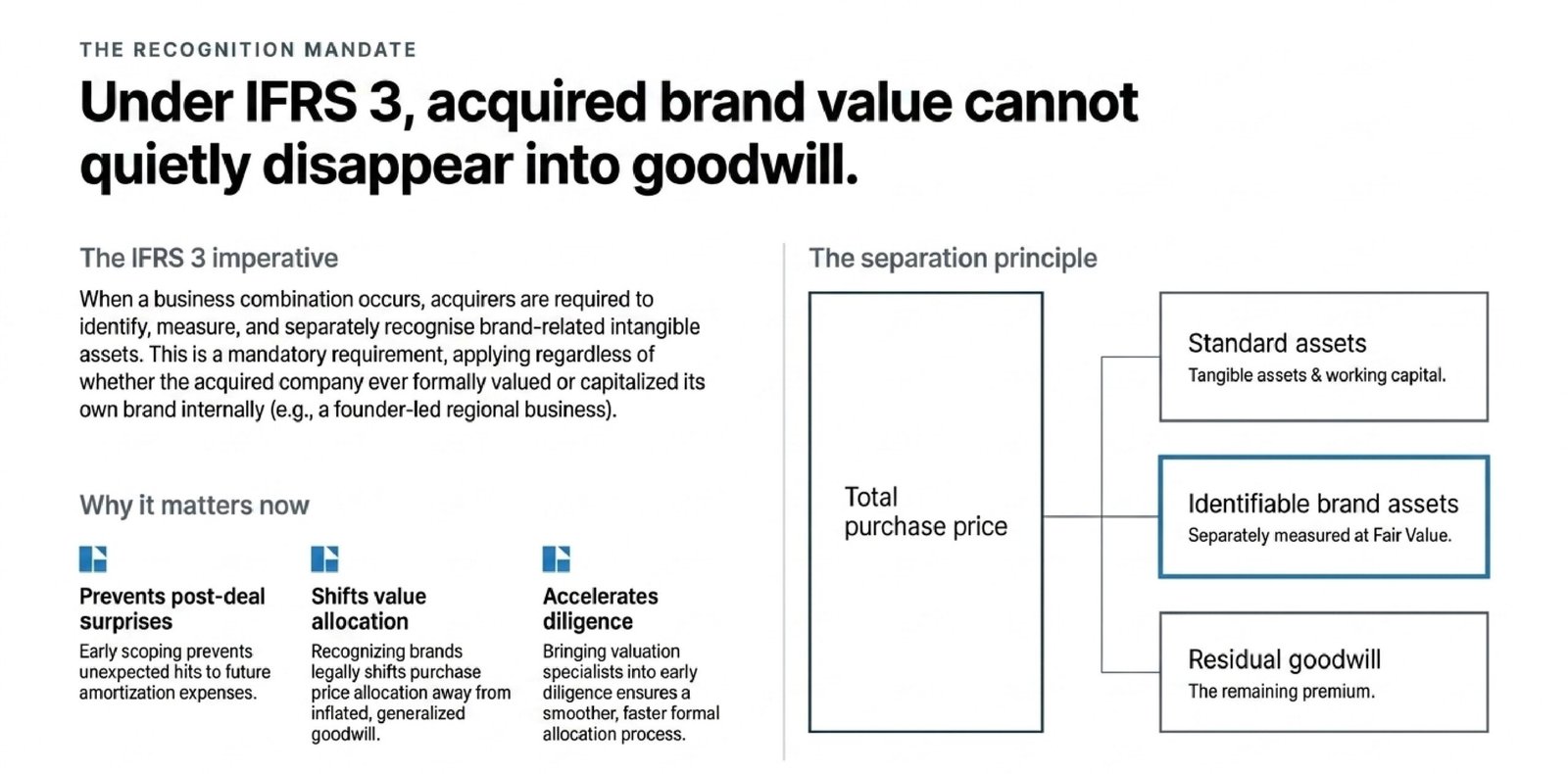
How Is Brand Value Recognised Under IFRS 3 reduces to a specific test: For a brand to be recognised as a separate asset, it must be identifiable, either as a contractual-legal right (arising from a trademark registration or other legal right) or be separable (able to be sold, licensed or transferred separately from the business). In practice, most acquired brand names meet the contractual/legal criterion automaticall,y as the right to use the trademark will be created by the registration of the trademark, and the contractual/legal criterion is therefore typically met much more often than what many finance professionals from a purely domestic accounting perspective expect. This recognition requirement applies even if the acquired company never formally assigned an internal value or capitalized its own brand before its acquisition. Brand recognition is not optional or discretiona,ry as many people who are new to this topic would assume, but is a requirement whenever all the conditions are met, even if the brand may not have been relevant in the target company’s previous financial statements. One of the first things that new analysts in purchase price allocation need to get a handle on is this mandatory nature; it’s a good indication that, from the first meeting, the scoping conversation with the client or internal deal team needs to be asked in a different way.
Many of the newly acquired subsidiaries come as a shock to the recognition obligation, especially those of a founder-led nature that develop a real brand equity over many years but never accounted for the value in their financial statements. For instance, a regional bakery company that was acquired by a larger food company had not recorded any internally any asset related to the trade name, and the company had to value and recognise the bakery’s trade name as a purchase price allocation as the trade name had genuine customer recognition and pricing power in its local market. It is important to understand this requirement early in a deal process, before the accounting team starts the formal allocation process, to be able to anticipate that work will be needed and how it will impact amortization expense. Teams that embed this expectation into their routine due diligence process, as opposed to waiting for the post-closing accounting process to discover it, generally will achieve smoother and faster purchase price allocations on a typical basis. Early diligence discussions, even at a cursory level, with a valuation specialist typically reveal just which brands are going to need to be recognized separately long before the formal allocation work gets underway.
What Makes Identifiable Brand Assets Qualify for Brand Asset Recognition?
Not all valuable brands are necessarily part of the identifiable brands that must be recognized separately under IFRS 3, and knowing this difference is at the heart of the correct recognition of brand assets. Most registered trademarks or trade names are likely to be separable from the rest of the business, such as by a hypothetical sale, license, transfer, etc., because licensing agreements are common in most industries and well understood. The difficulty in separating a brand conceptually from the overall business product/service offering can cause problems, however, when the brand is so integrated into the business that it is truly difficult to do so and support a defensible valuation. Practitioners performing brand asset recognition in these more ambiguous situations often lean on precedent from similar prior transactions within the same industry to help support their conclusion. It’s a good idea to keep a library of past brand recognition decisions and the reasons behind them, so that when a new transaction comes along, the finance team doesn’t have to reinvent the analysis.
An important distinction to make in making the identification of brand assets is distinguishing between the brand and related concepts such as general market reputation or customer goodwill that are not brand-specific, but are not part of the brand and, therefore, not recognized as a separate asset. For example, a software company’s reputation for its excellent customer service would not ordinarily be a separately identifiable brand asset, but the trademarked product name customers actually use to refer to the company’s reputation would. This distinction is important because the definition of a more general reputational benefit from the brand is likely to be the subject of a challenge by the auditors on review if branded as a specific ,identifiable brand asset. If the original brand asset recognition rationale is later revisited and explained in an audit or impairment review, a team that has clearly documented the reason for the recognition of the brand will be spared a lot of difficulty. This is probably one of the most important documentation practices that will help make your annual audit process run smoothly, rather than having to do a lot of reconstruction work.
Table 1: Identifiable Brand Assets vs Non-Qualifying Brand Attributes
| Attribute | Qualifies as Identifiable Brand Asset | Reason |
|---|---|---|
| Registered trademark or trade name | Yes | Meets contractual-legal criteria directly |
| Unregistered but licensable brand name | Often yes | Meets the separability criterion if a licensing market exists |
| General customer goodwill | No | Not separable or legally protected on its own |
| Overall market reputation | No | Too broad and not tied to a specific legal right |
| Domain name tied to the brand | Often yes | Can typically be sold or transferred independently |
How Does IFRS 3 Brand Valuation Actually Work in Practice?
The relief-from-royalty method is widely used for the valuation of a brand under IFRS 3 and is an approximation of the value of a brand if a third party had been required to license a brand name of comparable position. The method is effective in the case of brand assets because, in most industries, there are active markets for licensing, which provide a reference base for valuators in the form of market-based royalty rates, and not just assumptions that are put together inside the firm. The five points below outline the key areas that are considered when conducting IFRS 3 brand valuation work in practice for a real transaction. First, choose the right royalty rate that’s more in line with the specific industry and the strength of the brand than an industry average rate that fails to account for the strength of the brand. Second, projecting future revenue the brand will help create because the royalty rate is applied to the revenue base, and value is estimated. Third, deciding on the right discount rate for the brand asset’s risk profile. Fourth, estimation of a defensible useful life; differentiation between finite and indefinite useful lives depending on renewal pattern and competitiveness of useful life. Fifth, the tax is to be applied to the resulting cash flows, and any tax benefit on amortization (where applicable) is to be added back under local tax laws. The five steps outlined in this document are executed sequentially, instead of taking a short-cut to a “headline” royalty rate pulled from a database, and will likely lead to IFRS 3 brand valuation conclusions that withstand an audit much better than a shortcut approach.
A good example of a successful acquisition is one of a consumer electronics business buying a smaller, respected audio equipment company that is recognized for having high-quality sound among electronics enthusiasts. The IFRS 3 brand valuation for that deal used a royalty rate set based on similar licensing deals in the consumer electronics and audio equipment industry, with a few percentage points added to account for the reputation of the brand in its niche market. Eventually, the valuation team determined that the brand had a limited useful life of 12 years, something that management also believed would be the case; the team had to be in close contact with the acquirer’s marketing team in order to make this judgment. This type of close working together with finance and marketing is becoming more common in the high-quality deal teams, as useful life assumptions based on financial modeling convention alone don’t stand up to scrutiny by close audit during the deal process, not to mention close scrutiny by the commercial team.
What Challenges Arise When Recording Brand Value Under IFRS 3?
Another consistent difficulty in applying IFRS 3 is determining a defensible royalty rate because data on brand licensing transactions is not necessarily available, complete, or representative of the group of transactions with which it can be compared ,as there is a lack of uniformity in the nature of the transactions and the lack of quantitative data. In contrast to a more standardized asset category, valuators often are required to apply multiple imperfect data sources, industry surveys, comparable transaction databases, and their own professional judgment regarding brand strength. When a brand is active in several product categories or geographic markets, each may have different royalty rates in practice, which makes it difficult to select one representative rate for all of the brands. In multi-category measurement scenarios, practitioners who are applying IFRS 3 to record brand value sometimes apply a weighted-average royalty rate based on relative category revenue contribution, instead of having to apply a single uniform rate for a brand that truly has different licensing economics in different markets. The more elaborate the analysis, the more time it requires up-front, but it always yields a valuation conclusion that will hold up better to detailed questioning in audit or by regulators than a simplified, single-rate approach would.
The upside of getting brand value right under IFRS 3 is a set of financial statements that truly conveys what an acquirer actually paid for and for what reasons, rather than a bloated goodwill number that hides the economic value added from the acquisition. Those companies that have been successful in the implementation of IFRS 3 in successive implementing transactions have a reputation that makes the reviewing process even quicker in future transactions, as the auditors and regulators will know that the company has monitored the transaction very well and documented it properly. The difficulty with brands is that useful life projections can be controversial, as it may be possible for reasonable people to have reasonable disagreements about the lifespan of a given brand, particularly in dynamic consumer product categories where trends and preferences are constantly evolving. An imperative that many practitioners have found is to engage the marketing/brand strategy team of the company being acquired as early as possible into the valuation process, rather than to consider brand valuation a purely financial exercise conducted by accountants only
What Lessons Explain How Is Brand Value Recognised Under IFRS 3 in Real Deals?
In numerous transactions already finalised, the same few lessons are repeated in a sufficiently regular fashion to be considered as reasonably useful guidance to those trying to understand in practice How Is Brand Value Recognised Under IFRS 3. The first step is to think that brand recognition will be required, not assumed, as the criteria for having brand assets under IFRS 3 are lower than what many professionals think – especially if it is an acquired company that has a registered trademark. Second, make sure that you hire the brand valuation experts as early in the deal process as possible, as both royalty rate research and useful life analysis is time-intensive work, and if rushed in under the filing deadline, this work can be subject to sharp questions by the auditors later on. Third, work closely with legal counsel regarding the strength and extent of the underlying trademark registration, as important weaknesses or deficiencies in the legal rights can have a material impact on both the valuation result and the useful life assumption applied to that result. Fourth, consider developing a repeatable internal “process” for better brand recognition analysis throughout different deals—companies that haven’t yet developed a repeatable process for brand recognition analysis tend to spend more time and do less well at doing it than companies that have a well-tested process already in place.
The most obvious takeaway, however, is that brand asset recognition must be a truly collaborative process that brings finance, marketing, and legal teams together, not be left solely to the accountants to do based on financial information. Marketing teams tend to have a very good understanding of how a brand is viewed competitively, and for how long it is expected to be relevant, which can have a material impact on the useful life and growth assumptions that are used to value the brand. Professionals who masterthe ways of IFRS 3 brand valuation rather than just passing it on entirely to external brand valuers are more likely to become valuable deal team members in any transaction with a recognizable brand, consumer or business. That fluency can also help the finance professional be part of the larger strategic discussions, as one who can understand brand economics will be able to make contributions when considering whether to merge their brand or pursue a rebranding strategy – which a pure accounting professional wouldn’t be able to make.
Conclusion: Key Takeaways on How Is Brand Value Recognised Under IFRS 3
How Is Brand Value Recognised Under IFRS 3 is a very hands-on book for all accountants, valuers ,and corporate planners, and is not just for specialists. For career-minded individuals who want to learn more about this area, the next step of action is to review an actual purchase price disclosure that includes a well-known consumer product and the disclosure of the royalty rate/useful life relationship to the amortized expense line. The next step of action is to review a real purchase price disclosure, including a well-known consumer product, and the relationship of the disclosed royalty rate/useful life to the amortized expense line, and then practice explaining why one particular brand was identified as one of the identifiable brand assets that required separate recognition. One of the quickest ways to develop the judgment in this area is to read case studies on how various industries have applied IFRS 3 to measure the value of their brands, and compare one of the consumer goods brands which are fast-moving and consumed quickly with an industrial or business-to-business brand that is more durable. If done this way, brand value under IFRS 3 is a straightforward addition to the broader purchase price allocation process and not an intimidating practice only practiced by brand valuation experts. Pick one of the easy ones – one of the very familiar brand names acquired – and take the time to carefully read through the purchase price allocation footnote and try to piece out the allocation of the price based on the disclosed royalty rate and the useful life; do this for a few of the different industries and you will have better judgment than you did before, and will have a more practical understanding of how to allocate the price from the point of view of the accounting standard’s text.