Why Should Business Measure Brand Value?
Understanding Why Businesses Should Measure Brand Value
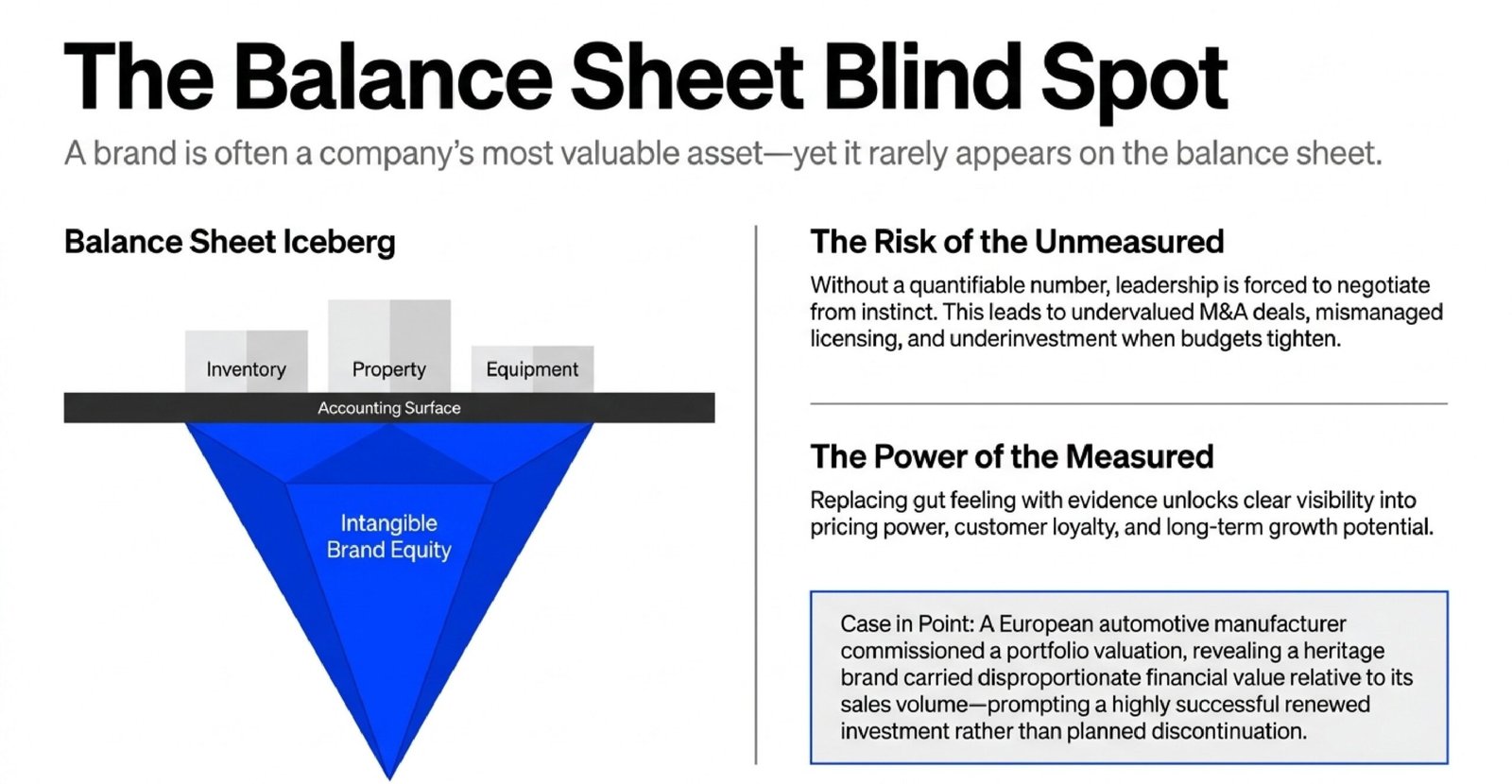
While a brand can be a company’s greatest asset, it is not usually listed with the same level of accuracy as inventory or equipment on the balance sheet. This vacuum poses a genuine strategic threat in that there is no clear number to quantify brand strength, so the leadership teams can underinvest in marketing, mismanage a licensing arrangement, or be naive about the brand’s value in a merger. With the knowledge of the value of a brand, businesses can bridge that gap and make well-informed and reasoned decisions. Constantly measuring brand value gives companies a clearer view of the pricing power, customer loyalty, and long-term growth potential that they can leverage, often ahead of rivals who aren’t realizing the same trends until years later. This article explores why brand valuation is important, how it is done in practice, what benefits of brand valuation can help businesses, and how budding marketing, finance, and strategy professionals can gain a deeper understanding of the increasing value of the discipline.
What Is Brand Valuation and Why Does It Matter?
Brand Valuation is an estimation of the financial value of a brand as a separate intangible asset of a business, apart from tangible assets like property or equipment. This value is usually calculated based on the company’s customer retention, market share, pricing, and its ability to create future cash flows that an unbranded, generic product may not be able to produce. There are established methods such as the income approach, market approach, and cost approach that provide a framework for a company to derive a non-arbitrary estimate, but rather a defensible estimate. It is important that a company’s leadership teams understand the value of their brands from the beginning of their journey, and not as a result of a transaction. An early adopter will also be better equipped to present budgetary decisions that align with the brand when budgets become constrained because they can reference trend data instead of opinion.
The value of a brand becomes evident from the second a business makes a sale, court decision, or strategic move that demands an understanding of brand strength with a real financial impact. From mergers and acquisitions to licensing agreements, litigation over trademark infringement, even marketing budget allocations – having a sensible number for the worth of the brand is essential for all these undertakings. If executives are not armed with this number, they are forced to negotiate blind, underpriced instead of facts, which may result in underpriced deals, weak licensing agreements or marketing expenses not in line with the region/brand/line where brand equity is being created or lost. Investors and lenders are also increasingly looking into intangible assets when evaluating the company’s risk, and a weak brand that is not clearly documented can undermine a company’s position in the financing discussion without anyone realizing it is a marketing issue at all. For this reason, CFOs are no longer just bystanders in the brand valuation discussion at large companies, but are themselves active participants.
How Do Companies Measure Brand Value in Practice?
A company that has made a deliberate effort to measure brand value typically will use a mix of quantitative financial measures and measures of brand strength. The most common approach is the income approach, which involves estimating the cash flows that could be generated specifically for the brand, and then discounting them to the present value, either with a royalty relief or an economic use methodology. A brand strength score is also calculated based on various factors, such as market share, customer loyalty, geographic reach, and trademark protection, which is then incorporated into the discount rate applied to expected earnings. This is a hybrid of hard numbers and a developed qualitative score and is the key to differentiating a credible valuation from a marketing estimate. Typically, analysts compare the data collected from multiple methods, and this is because one method could be affected by extreme market conditions or some temporary rise in sales that is not indicative of the strength of a brand. Some analysts also perform a royalty relief cross-check where the implied royalty rate is compared to industry standards to sanity-check the number before presenting it to stakeholders in cases of existing license agreements. It is more helpful to the decision makers to present two or three results and let them reconcile the different results rather than one number because the decision maker has a better idea of the range in which the true result will likely lie.
Let’s take a look at a global beverage company for an example of this. The company decided to enter into a joint venture in a new regional market; it therefore had an independent brand valuation carried out to establish an appropriate fee to be paid for use of its trademark by the local partner. The valuation process included historical sales, market growth expectations, and a brand strength evaluation against the region, and the structure of the licensing was designed to ensure a fair rate for the parent company with a good understanding of the value the local company would be paying for the brand. At a number of consumer packaged goods companies, a similar approach has been adopted when they license a sub-brand into a new geography; if they can establish a valuation with the partner in advance, it will lead to fewer headaches and renegotiation disputes down the road. The company later applied the same practice to other regional joint ventures, using the first valuation as a blueprint instead of it being a singular project.
What Are the Key Brand Valuation Benefits for Business Strategy?
The brand value benefits don’t end at one time or one transaction or one accounting process. When negotiating M&A deals, a plausible brand value number can provide a firm basis for negotiating the acquisition, because when backed by rigorous analysis, rather than by vague claims about reputation, a brand value number makes it much easier for an acquirer to pay a premium. Brand valuation can also play a role in making better internal decisions, as marketing teams can use it as a basis for making the case for the budget they are requesting based on financial data instead of anecdotal evidence of impact, and finance teams can assess how each brand in a portfolio is generating shareholder value over time. It’s for this reason that the leading companies regard brand value as a fundamental strategy that is not only built into the planning process but also incorporated into the annual cycle of planning. In portfolio-wide valuation exercises, in particular, results frequently come out that even veteran executives are taken aback by, because the internal perception of brand strength does not always equal the market or competitor perception of brand strength. Often, these gaps can close over time as the valuation results inform the day-to-day management of brands by companies that repeat the exercise periodically.
These benefits have been well illustrated by a European car company when it was in the process of rationalising its multi-brand portfolio. Keeping all of the brands in its portfolio, the company decided to have each one valued and found out that one of its heritage brands had an excessive amount of value for its volume of sales, which led the company to invest again in its marketing plans, instead of cancelling a brand as originally planned. In another case, a North American technology company relied on brand valuation data in support of its claim of trademark infringement, and offered the court a defensible dollar amount for its damage to reputation as well as subjective testimony. In both cases, a careful valuation has a direct impact on high-stakes business decisions, and in both cases the companies were struck by the insights into brand perception that the valuation exercise had uncovered that they hadn’t quantified in-house. It is important to understand that these results are justifying the growing requests from boards for brand valuation updates along with the regular financial reporting and are not just about reputation or creativity.
Brand Valuation Benefits by Business Function
The various departments in the company use brand valuation for different purposes, and knowing what these uses are can help make sense of the need for cross-functional consideration of the brand valuation exercise, as opposed to it being solely the marketing team’s responsibility. Having the output also be a shared resource instead of a marketing product also helps get it signed off throughout the organisation. The following table summarizes the typical application of the findings of several key business functions.
Table 1: Brand Valuation Benefits by Business Function – Why Should Business Measure Brand Value?
| Business Function | How Brand Valuation Is Used | Typical Outcome |
|---|---|---|
| Marketing | Justify budget allocation across brands and regions | Investment directed toward highest-value brand equity |
| Finance and M&A | Support deal pricing and purchase price allocation | More accurate valuation of intangible assets |
| Legal | Quantify damages in trademark or infringement disputes | Stronger, evidence-based legal claims |
| Licensing | Set fair royalty rates for brand or trademark use | Balanced agreements for licensor and licensee |
What Challenges Arise When Measuring Brand Value?
Although it is a clear benefit, brand valuation isn’t an easy or mechanical task. Care needs to be taken with the judgement used to isolate the specific cash flows that are due to a brand as opposed to other factors such as product quality, distribution networks or pricing strategy, as the results can vary significantly in meaning with the methodology and assumption used. Another typical challenge is the lack of data, especially in the case of newer brands or private companies that do not have a multi-year history of sales and do not have the credibility to make projections. Additionally, businesses in multiple industries have to account for the differences in competitive dynamics, currency exchange rates, and consumer perceptions in each region, making it difficult for a global brand image to be accurate without any context to the specific region. When the scope of the brands under the business unit’s control is involved, there can also be internal politics, as leaders of these business units may have an incentive to exaggerate the worth of the brands in their care before budget discussions or performance evaluations. That’s why it’s important for teams to have a good faith discussion about the value of recent momentum versus the long-term brand equity, which is one of the reasons it’s valuable to conduct external benchmarking.
The difficulties have actual implications if they are not done properly. If a brand is over-valued during a transaction due to unrealistic growth expectations, there may be disagreements or even write-downs when the actual results do not meet those expectations. Companies that have been through a volatile valuation process frequently find that the best strategy is to be transparent about their process: Keep a record of all their assumptions, use established valuation methods and hire independent valuers rather than relying solely on their marketing numbers. The overarching lesson that many organisations have learned is that the process of brand valuation should be an ongoing discipline rather than some one-off process carried out only when a particular transaction demands it, and that the importance of brand valuation can be learned in advance of facing a crisis is less expensive than it is when one is in the middle of it. Creating a basic internal dashboard that provides information on brand-relevant metrics such as customer retention, price premium over competitors, and social sentiment over the course of a year can also minimize the chasing and grabbing of data that occurs when a formal valuation call is suddenly required. Teams that engage in this practice are more likely to experience the formal valuation later in the relationship process much more quickly and smoothly than they would have without it.
Brand Valuation Challenges and Practical Solutions
Whatever industry or company size you belong to, you will likely face many similar challenges in developing a brand valuation process. Understanding these patterns early in the project can make it easier for the reporting team to prepare for them throughout the project rather than catching them off guard. The following table presents a list of common problems, their root causes, and some helpful solutions that have been successful in many industries.
Table 2: Brand Valuation Challenges and Practical Solutions – Why Should Business Measure Brand Value?
| Challenge | Underlying Cause | Practical Solution |
|---|---|---|
| Isolating brand-specific cash flows | Overlap with product, price, and distribution factors | Use royalty relief method to separate brand contribution |
| Limited historical data | Newer brands or private companies lack sales history | Benchmark against comparable public brands |
| Inconsistent results across valuers | Different methodologies and assumptions applied | Document assumptions and use recognized standards |
| Cross-market complexity | Currency, competition, and perception vary by region | Conduct region-specific brand strength assessments |
How Can Early-Career Professionals Build Expertise in Brand Valuation?
Valuation is a unique skill set that relatively few entry-level marketers and financial and corporate strategists have. Both the qualitative and quantitative aspects of brand strength are attractive to employers in consulting, investment banking, and corporate finance. Even if a junior candidate lacks years of industry experience, having an understanding of the income approach, the market approach, and the cost approach, and basic financial modeling skills, can help him or her stand out in a job interview for a marketing analytics, brand strategy, or valuation advisory position. A decade ago, there was little interest in intangible asset valuation, and now many valuation and consulting firms have structured graduate programs dedicated to the field. When candidates can discuss a recent high-profile brand valuation, whether it’s because of a merger, rebranding or a licensing dispute, it’s impressive to not only the interviewers but to the audience because very few candidates make the effort to keep up with this kind of business news.
This is not a specialized graduate degree that is required to build up this expertise. The professionals who understand the rationale behind the ranking of companies in reports by the major brand valuation firms gain practical knowledge on how theory comes to be a defensible number. There are lots of opportunities to gain credibility in this niche through volunteering to help with in-house brand audits, studying for finance or marketing qualifications, or practicing simple discounted cash flow modelling. The need to value a brand is a part of enterprise value that more and more companies understand and find indispensable, and as a result, professionals who are able to speak the language of both marketing and finance will be well placed to advance their career in either a corporate role as a brand professional or a more focused role as a brand valuation advisor. The analytical approach that the students learned during the course of studying valuation of a brand, with the need to question assumptions and demand evidence for large claims, has also been applicable to other parts of business strategy throughout the course of their careers.
Five Key Steps to Measure Brand Value Effectively
- The valuation’s purpose: The purpose of the valuation will dictate which methodology and assumptions will be used, and one of the most frequent reasons for disagreements between parties is because of an improper purpose setting.
- Determine the approach to be used: When selecting the approach to be used, you will need to choose between the income approach, market approach, and cost approach, depending on the availability of data and the nature of the business, and explain the selection of approach so that you are able to argue your case later in the event that a valuation is subject to scrutiny by auditors, regulators, or opposing counsel.
- Compile reliable financial and market data: Compile multi-year sales figures, market shares, and competitor benchmarking, which can be used to make realistic projections, rather than relying on optimistic assumptions that could be called into question by an independent party.
- Qualitatively measure the strength of the brand: Estimate customer loyalty, market share and trademark protection, and determine the discount rate to apply to estimate the brand’s long-term earnings, as two brands with the same cash flow can have different levels of long-term risk.
- Use independent review when stakes are high: If you have a major transaction or dispute, consider using an independent valuer, as independent reviews offer greater credibility than internal estimates and will help you reap the many benefits of brand valuation through the years.
Conclusion: Why Should Business Measure Brand Value?
Brand value is simply too important an asset not to measure — especially given the rise in competition and the increasing percentage of intangible assets in enterprise value in nearly every industry, from consumer goods to technology to financial services. Reliable and documented valuation processes enable companies to negotiate more effective deals, effectively defend their trademarks and even use marketing budgets more confidently than those that are based purely on intuition. Brand valuation is a process that is done from time to time, not part of the everyday routine, and this often leads to the creation of a brand valuation number at the last minute – at the time when they are most needed, whether it is a merger process or a courtroom. Brand valuation methodology fluency is a valuable asset for any professional, not only in marketing and finance roles, but in legal positions as well. The first mindset shift that sets companies that treat their brand as their real money apart from those that hope it maintains its value is the appreciation of the full range of brand valuation benefits that can be returned to the company, and the understanding that brand valuation is not a one-off event, but rather a continuous discipline. The action item for any organization is to determine which brands are most useful, conduct a preliminary valuation based on a known approach, and then regularly re-value the brands as market and consumer attitudes change. Any reasonable first shot, developed based on reasonable assumptions, which is reviewed annually – and is a modest shot for a company – takes them a long way ahead of competing companies that still believe brand strength is subject to opinion.