What Factors Influence Brand Value?
A practical guide for junior to mid-level finance, marketing, and strategy professionals
Understanding What Factors Influence Brand Value?
Brand value is a commercial value that can be directly attributed to the name, reputation and associations that customers have developed over time with a business. One of the biggest yet most misunderstood elements of a company’s enterprise value. Financial performance, market position, customer loyalty and competitive advantage all are key drivers of brand value. If you are in the valuation, strategy, marketing or corporate finance, you need to know what contributes to the value of a brand and how companies rigorously measure the value of a brand. This article explains the essential components and what it means for those learning more about this.
Why Does Brand Value Matter — and Who Actually Uses It?
Value has always been thought of as being the same as what’s on the balance sheet: physical assets, inventory, receivables and cash. The number of assets that were intangible became more and more apparent, yet brands never seemed to show up as a separate line item on a company’s financial statement. The brand has become a significant asset in the financial, strategic, and operational value of enterprises, which has transformed the way they are assessed, acquired, sold, and operated.
The value of a brand is especially evident in the commercial sphere in the form of M&A deals. As Kraft Heinz tried to buy Unilever in 2017, the value placed on Unilever was far more than the value of its physical assets—the price tag included the intangible value of the companies’ brands, which had been established over decades. The classic fashion house becomes more of a luxury brand when it is bought by a luxury of luxury goods company such as LVMH, where a significant part of the investment price is assigned to the brand and trademark value appearing on the post-acquisition balance sheet. So, the measurement of brand value is not a theoretical academic exercise, it’s a fundamental part of the M&A due diligence process, purchase price allocation and intangible asset reporting.
Brand value is not just about transactions, it is relevant for the day to day strategic decision making. Brands provide the company with price premiums, access to better talent, better supplier terms, and ability to recover from setbacks quicker than their less respected counterparts. A measurement of the drivers of brand value over time provides management with an advance signal of the health of the business, which the financial statements cannot give on their own.
What Are the Core Factors That Influence Brand Value?
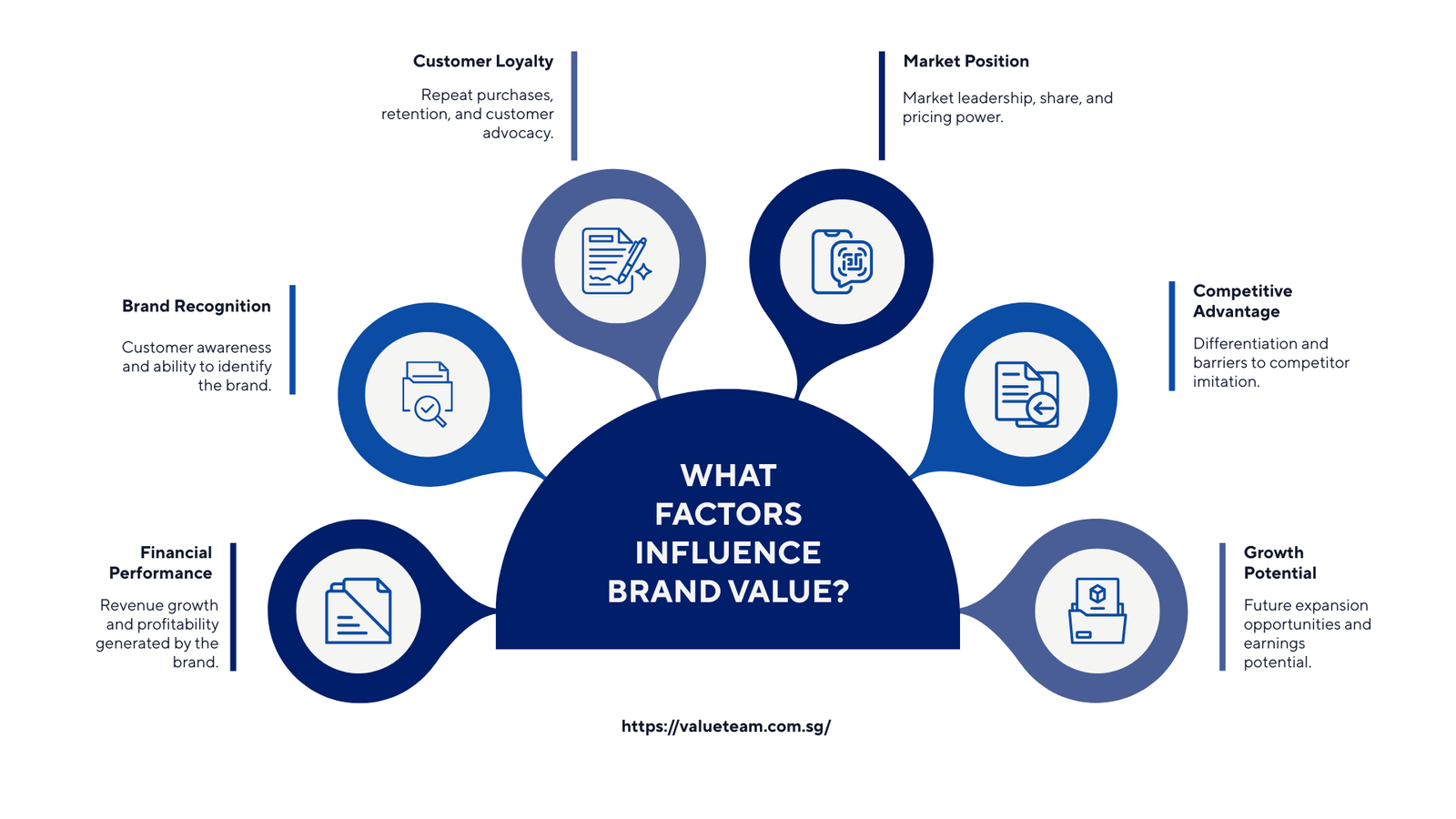
The brand value cannot only be calculated through a single indicator but it also depends on the combination of different non-financial and financial factors that contribute to the premium that the market places on a brand name. The six dimensions that prove to be the main variables in brand value in the industries and geographies studied are always present.
Financial Performance
A brand that is not achieving better financial performance: higher revenue growth, better margins, or both, when compared to unbranded and/or generic products, is not performing as expected commercially. Financial performance is therefore the most concrete measure of brand value – it proves that the brand creates economic value, not just one with which one has to travel. Brand value analysts focus on revenue that can be attributed to the brand itself and not to tangible assets, technology or any other intangible elements to isolate the brand’s earnings power. The more regular and increasing that branded income stream is, the more valuable the brand.
The practical implications for junior professionals is that there should never be a financial performance conversation without a brand conversation. More brand awareness, or more emotional connection, is not enough to add value to the brand — it’s the ability to translate that awareness and resonance into pricing power, volume growth and margin resilience. A brand people love, but don’t buy, or one that sells only when it is reduced in price, is not building brand value; it’s just eating up marketing dollars.
Brand Recognition
For nearly all other activities, Recognition is the prerequisite and the degree to which target customers know and correctly identify a brand as belonging to a category and as promising a product. A brand not recognized can’t command a premium, can’t build loyalty and can’t sustain geographic expansion. In most cases unaided awareness (when the brand name is not given to them) is better than aided awareness (when the brand name is provided to them), as this reflects brand mental salience that can affect a customer’s purchase decision before they are actively shopping.
Strictly measuring recognition is part of the companies’ non-financial scorecard to measure brand value. Global brand valuation companies like Interbrand, Kantar BrandZ, and Brand Finance all use awareness and perception data as part of their brand valuation methods, understanding that a strong, but unknown brand will have future risks which its current profits do not adequately compensate for. Recognition can be achieved gradually via repetitive repetition of the one thing the brand says it will deliver – the creative – and the one thing it actually does deliver – the repeated communication at every customer touch point.
Customer Loyalty
Customer loyalty may be the most directly and measurably related factor in brand value of all the key factors. The value of loyal customers is that they purchase more often, are not as sensitive to price, are less expensive to serve than new customers, and through their recommendations and advocacy create organic growth. The insight gained from customers’ willingness to refer their brand of choice to others is one of the most common and comparable metrics tracked by companies, and it’s called the Net Promoter Score (NPS).
The best example of the ways in which brands can gain value through loyalty is Apple, and fittingly so. Customer retention rates — always exceeding 90 percent in the company’s key smartphone market — are the foundation of a business model where the number of loyal customers becomes a steady stream of predictable hardware sales, app buys and subscription services. This loyalty has been earned, not through discounts, but through the reliability of their products, ease of use and their ecosystem architecture that makes it expensive to switch to a different product. Whether or not you’re in the brand sector, the same rule applies: Loyalty is gained by way of expertise and never marketing, and the monetary worth of loyalty is cumulative.
Market Position
Market position is a mechanism for brand value through two factors: Scale and pricing power. Market share advantages are based on the scale effect, distribution leverage and category authority of a brand as compared to smaller brands. Structurally higher margins are those that flow directly to brand value because they relate to a brand that has pricing power—that is, the brand can price above its competitors for similar products without sacrificing volume.
Market position is especially crucial in categories like luxury goods, automobiles and professional services, where buying decisions are based on social signalling. In these markets, the market position becomes a key feature of the product itself – as the dominant or most prestigious brand in the category, it is a source of value that keeps itself. One of the key reasons companies spend so much money defending market position, even in mature, low-growth categories, can be the understanding that the cost of losing market position is often greater than the cost reduction that can be achieved by decreasing brand spending in the short term.
Competitive Advantage
Brand is one of the most hard-to-replicate competitive advantages, and is one of the most lasting. A competitor can’t replicate a product feature, match a price point or even a new geography, but the sort of resonance and cultural attributes that strong brands build over decades of time cannot be captured by copying. Brand value is therefore closely tied to the competitive moat of brand equity – the more difficult it will be for a competitor to take a brand, the more enduring the earnings stream that a brand will generate, the more valuable the company’s equity in the brand is.
That is why, today, the measurement of brand value also includes a competitive strength analysis, which consists of a structured analysis of the relative position of the brand in terms of its quality perception, its reputation for innovation and its emotional bond. One example of a methodology is that of Interbrand which scores brands on ten factors such as internal commitment, responsiveness, and distinctiveness, each with a weighting to give a brand strength score that directly affects the royalty rate applied to that relief from royalty valuation. It’s a good idea: a brand with more competitive advantages should be worth more than a brand in which the substitutes are a big threat.
Growth Potential
Value of brand is forward looking – it is not only the value the brand earns in the past, but what it is expected to earn in the future. Growth potential, therefore, affects the value of a brand by affecting any discounted cash flow analysis – greater expected future earnings or a longer run of above-average growth yields greater present value. A brand that has a proven international appeal, a strong position and a large/expanding market will be perceived as higher value than a similar brand with a comparable, but more limited, position that may be equally successful.
Growth potential also encompasses optionality, the value of what a brand can do, but hasn’t yet done. A brand with a high level of consumer trust and awareness in its core category could have potential for growth in adjacent categories, for expansion into new geographies, and also to build a new business model, such as licensing, subscription or something completely different. These options are economically valuable and sophisticated brand valuers consider these aspects when estimating future revenues, even if they are not certain. It’s important for professionals in the M&A and licensing business dealing with a brand to understand and explain how a brand can grow as an input to the valuation discussion.
Table 1: Brand Value Drivers: Summary Overview
| Brand Value Driver | Primary Indicator | Example Metric | Relative Weight |
|---|---|---|---|
| Financial Performance | Revenue growth & margin | Revenue CAGR, EBITDA margin | High |
| Brand Recognition | Aided & unaided awareness | Brand recall surveys, share of search | High |
| Customer Loyalty | Repeat purchase & advocacy | NPS, Customer retention rate | Very High |
| Market Position | Share & pricing power | Market share %, price premium % | High |
| Competitive Advantage | Barriers to substitution | Switching cost analysis, moat score | Medium–High |
| Growth Potential | Pipeline & market expansion | TAM growth rate, new market entry | Medium |
Which Factors Have the Greatest Impact on Brand Value — and Why Does It Depend?
Most practitioners will probably say customer loyalty is the key driver of brand value if they were forced to rank the key drivers by impact – albeit not to say that the other drivers are not important, but it is how all other brand strengths are delivered to the bottom line through customer loyalty. If your brand is popular, but not used, then it’s not generating brand value. If a brand is doing well but in a category where customers are easily stolen by another competitor for price, then it’s not a brand that will continue to earn profit in the long run. Loyalty is the flywheel—the stronger it is, the greater the impact for every other brand investment; the weaker it is, the less it helps the other brand investments.
However, the value of each factor is dependent on the competitive landscape, business model and industry. The other dimension of the business is fast moving consumer goods, where recognition and position predominate – the decision to buy is taken in seconds and the brand that’s more in the mind and more on the shelf gets the deal. However, in the case of professional service or enterprise software, where the purchase process is more relationship oriented, complex and long cycle, competitive advantage and trust are more critical than awareness. With luxury goods, the market position and exclusivity is an inherent part of the value proposition of the brand and it is therefore not something that can be bargained for. It’s the insight that comes from knowing these dynamics relevant to a specific sector that makes a brand analysis from a general one one that moves to decisions.
Interactions among the factors are also relevant. Financial performance and loyalty are a positive feedback loop; the stronger the financial performance, the more that will be invested in the brand, the more they will feel a sense of loyalty, and the sense of loyalty will give the pricing power to support the financial performance. The frequency of a brand’s appearance in the eyes of consumers builds a sense of recognition and market positioning: the more people see a brand, the more they will remember it and the more they will remember it, the more they will think of it. Those with an understanding of these dynamics, not simply the individual factors in isolation, will be better prepared to determine where brand values are strong and where they are weak.
How Can Companies Improve Brand Value — and What Does the Process Look Like?
It is one thing to know what makes a brand valuable, but it’s another to identify these points and develop a proper improvement plan. The steps in the brand value measurement and action process are well-known.
Table 2: The Six-Phase Brand Value Measurement and Improvement Process
| Phase | Key Activities | Output |
|---|---|---|
| 1. Define Purpose | Explain the purpose of valuation (acquisition/merger, licensing, reporting or internal benchmarking) | Scope and standard of value |
| 2. Financial Analysis | Do a revenue analysis of the brand revenue and separate tangible asset returns from the brand. | Brand contribution model |
| 3. Market & Competitor Research | Determine the level of brand awareness, perception, brand loyalty, and competitive position. | Brand strength scorecard |
| 4. Royalty Rate Benchmarking | Determine comparable brand licences to make an appropriate rate range. | Royalty rate range |
| 5. Apply Valuation Method | Use one of the three valuation methods: relief from royalty, excess earnings or price premium method to calculate brand value. | Preliminary brand valuation |
| 6. Stress-Test & Report | Sensitivity analysis on critical assumptions; provide final results and supporting arguments | Final brand valuation report |
The biggest mistake made in brand improvement programs is taking a stand in for a stand. It is possible to allocate marketing funds to improve the level of recognition, but if the quality of the product or service or the value it provides the customer is not upscaled to the level of the brand communication, then the recognition will merely accelerate the disappointment. The companies that continue to increase in value over time, like Nike, LEGO and Patagonia, put as much effort into the experience that keeps customers loyal as they do into creating the communication that helps them recognize the brand.
What Are the Most Common Mistakes That Reduce Brand Value?
Brand value can be dissipated at a much greater rate than it is created, and these are often predictable reasons. The worst error is inconsistencies either between what a brand says and what it does, between its presentation in various markets and channels, or between its values and its behaviour. Confusion of customers, disintegration of the mental links that brand recognition creates, and loss of pricing power that is the purpose of the brand value. This is especially true when scaling up quickly, where the operational needs overwhelm the investment of ensuring operational consistency.
The second frequent error is over extension: over-spreading a brand by having it added into too many categories, price points or customer segments at once. Brand extension is a strategy that can be used to generate value if it is executed properly and if the new category is truly related to the brand’s associations. However, when businesses over stretch themselves into brand areas where they have no credibility or quality positioning, they can cause a harm to their brand instead of building on it. A few high-end brands have found this to their cost: taking their branded products into mass-market retailing channels reduces the value of the brand and the price they can set in their traditional channels.
What Factors Influence Brand Value : Conclusion
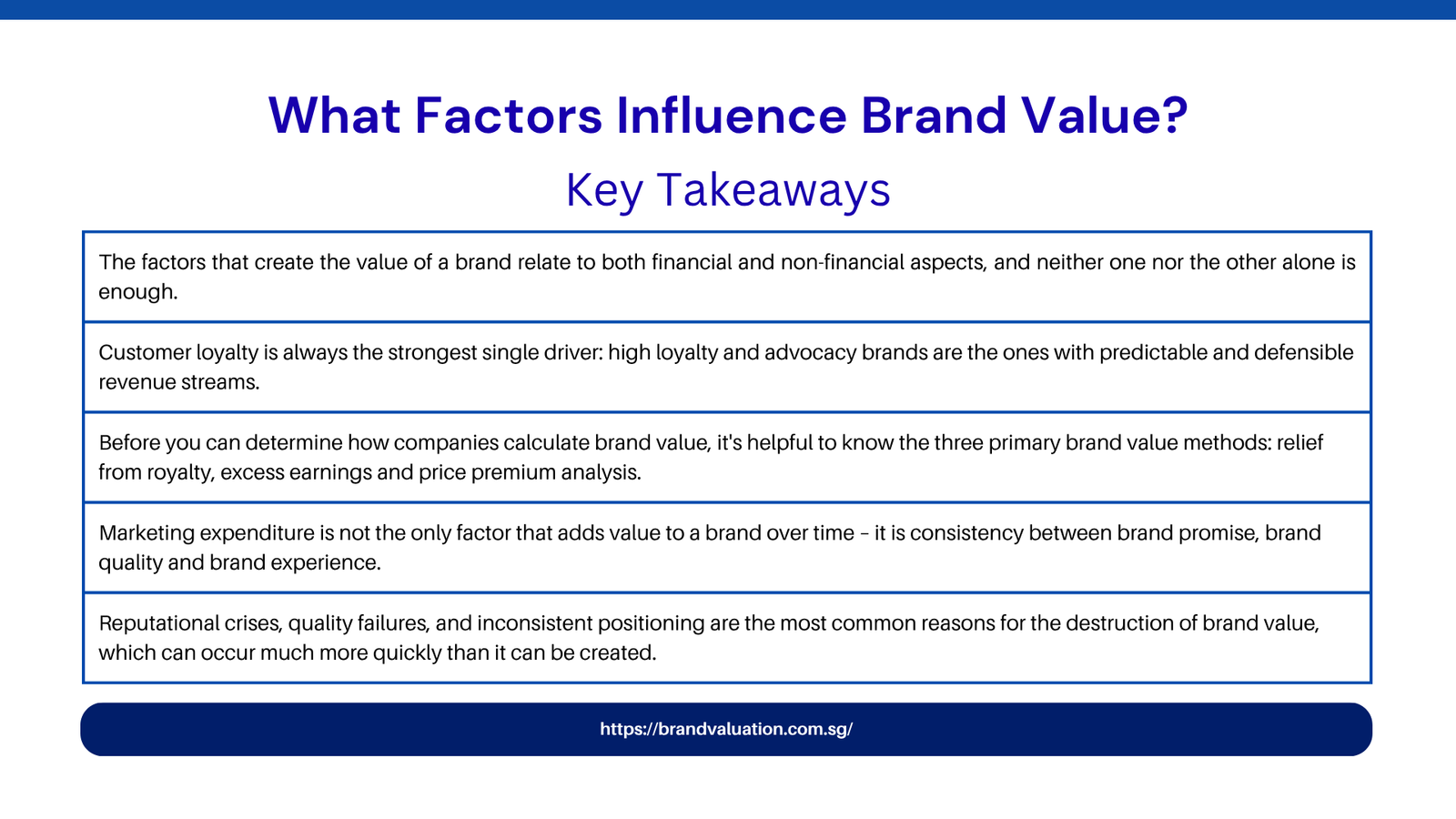
The value of the brand is one of the most significant aspects of business performance which is most often overlooked. What are the key elements of brand value, it’s well known: financial performance, recognition, loyalty, market position, competitive advantage and growth potential. It is not these six that will add value to the brand over time, but rather the consistent way they are integrated into the brand and the disciplined investment made in the experience that leads to brand loyalty and the communication that leads to brand recognition. The potential to link the untouchable with the tangible is a very special skill, and one that those in the business of appreciating how a brand is valued can and will apply to business transactions and strategic decisions.