What Creates Long-Term Brand Value?
Understanig What Creates Long-Term Brand Value?
Brand value is not earned in a moment, it is built over time, and it’s not necessarily a single campaign, logo redesign or viral moment. It is the result of successive decisions—what a company does for its customers, how a company does it, how it changes without altering its essence- as leadership changes, products change and markets change around it. Whether in marketing, product, HR or customer service, it is important for anyone early in their career to grasp the major factors that shape the brand value in order to understand the impact their role has on the brand, even if it is not explicitly described in their job spec. This article examines what really constitutes the power of a long-lasting brand, the strategies that can be used to build a brand for the long-term and what is the connection between customer trust and brand value. You will discover practical examples, some common pitfalls, short reference tables and lessons that you can use no matter what your job title, level of seniority or industry, you are in – whether you are employed or preparing for interviews in a brand-related job.
What Are the Key Factors Influencing Brand Value?
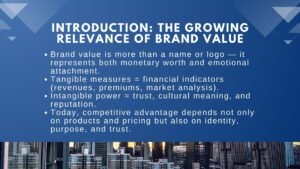
Brand value is determined by a combination of tangible and intangible factors and the factors that are suspected to influence brand value are mostly believed to be only aesthetic in nature such as logos, colors, taglines or a catchy slogan. In fact, brand value is a form of financial and psychological asset which sits on a company’s balance sheet as goodwill, and is evident in customer buying behavior before it appears in sales reports. It’s an indication of the amount of money a customer will pay for a product, their loyalty under stress, and the likelihood that they’ll endorse a brand to a friend, colleague or audience online—even if they aren’t being paid for it. Valuers who specialize in brand valuation usually consider a combination of awareness, perception and financial data, since a brand that performs well on the awareness scores and not very well on the trust scores will not keep its value very long, regardless of the size of its advertising budget. This asset is built over time, not overnight, and it’s consistency, product quality, emotional connection, and reputation management that all contribute to and build over time.It is consistency, product quality, emotional connection and reputation management that all contribute and build over time, making it an asset that doesn’t get noticed from day one and hence why it is so easy for junior employees to underestimate the amount of time it takes to build up a real brand and why leadership teams are sometimes less likely to convince shareholders that the investment is worth making in order to gain returns in the short term.
It is also helpful to recognize that these are not independent—with one another they support or hinder one another in ways that are not at all apparent from the inside of an organization. While a product might be of great quality, if the customer service aspect is not up to scratch, then the brand value will be lost as customer perception of the brand is product based, and one bad interaction can cancel out months of good product interaction. Likewise, if a brand’s positioning in the market is not clearly understood or if what they’ve advertised is not what they’ve provided, the brand loyalty created by the advertising can be quickly lost, as in the case of a high-quality and expensive brand that offers a discount every few weeks. The following table is a breakdown of the key elements according to the majority of brand strategists and analysts who rate a brand’s strength. This can serve as a handy reference guide for junior professionals as they assess the health of their own company’s brand, when they are applying for a job in a marketing or brand role, or when attempting to decipher why some companies are able to withstand negative publicity or competition while others are not, despite having comparable or even superior products.
Table 1: Key Factors Influencing Brand Value – Long-Term Brand Value
| Key Factors Influencing Brand Value | What It Means in Practice |
| Product/Service Consistency | Delivering the same quality and experience across every touchpoint |
| Emotional Connection | Creating meaning beyond the functional benefit of the product |
| Reputation and Trust | How the brand behaves during both good times and crises |
| Market Positioning | A clear, differentiated place in the customer’s mind |
| Employee Advocacy | Internal culture reflecting outward brand promises |
What Long-Term Branding Strategies Build Lasting Value?
While short term marketing can help pump up a quick sales increase, a long term branding strategy can maintain a company’s relevance 5, 10, and 20 years down the road. Some of these strategies take time, and can be harder to sell internally, particularly for someone who is trying to make an impact in a new position where they are looking for quick wins, rather than long-term results that will take time to see. The most resilient brands make all of their pricing, hiring, partnership, packaging, and even the tone of their email newsletter decisions as much as a brand decision, as opposed to an operational one. This change of mindset is what makes some companies weather a tough market while others actually become stronger in it; each touch point is an opportunity to strengthen and consolidate the brand message, and customers know who isn’t “wavering” and who is.
A long-term branding approach also involves the recognition that sometimes it will be seen as inefficient in the short-term. A business could refuse a prosperous partnership if it would not fit with brand beliefs or spend more, slower to manufacture a product in order to keep its word with customers. While they may not fit in a spreadsheet, it’s that transaction that customers notice and appreciate over time, especially when the consumer is buying a product in a category where trust and safety are essential to the bottom line, like food, healthcare, finance or children’s products. The following five practices are the ones that have been shown to be most consistent in driving long-lasting brands, across a range of industries and company sizes. They can be helpful for all professionals developing a career in brand management, for anyone planning to be interviewed for a position with a brand strategy component and for anyone who wants to be a more effective advocate for his/her company’s brand investment.
- Identify a clear brand purpose that is beyond the product or service, ensuring that employees, partners and customers can all see what the company is about, beyond what it sells; this provides a consistent reference for every future decision the company will make.
- Avoid mixed messages – your tone in your social media posts, the tone on your website, and the tone in customer service are not the same – this leads to confusion and makes it less reliable over time.
- Think of the customer experience above all else – if they have one bad interaction – it can quickly undo years of positive impressions in a brand at a much quicker pace than a campaign can build it.
- Select and adjust messaging to respond to cultural and market changes while maintaining the brand’s core values, creating a balance between being relevant to new customers and authentic to existing customers.
- Track brand health beyond sales data, through qualitative and quantitative measures, including sentiment analysis, perception surveys, and loyalty, retention, and share of voice.
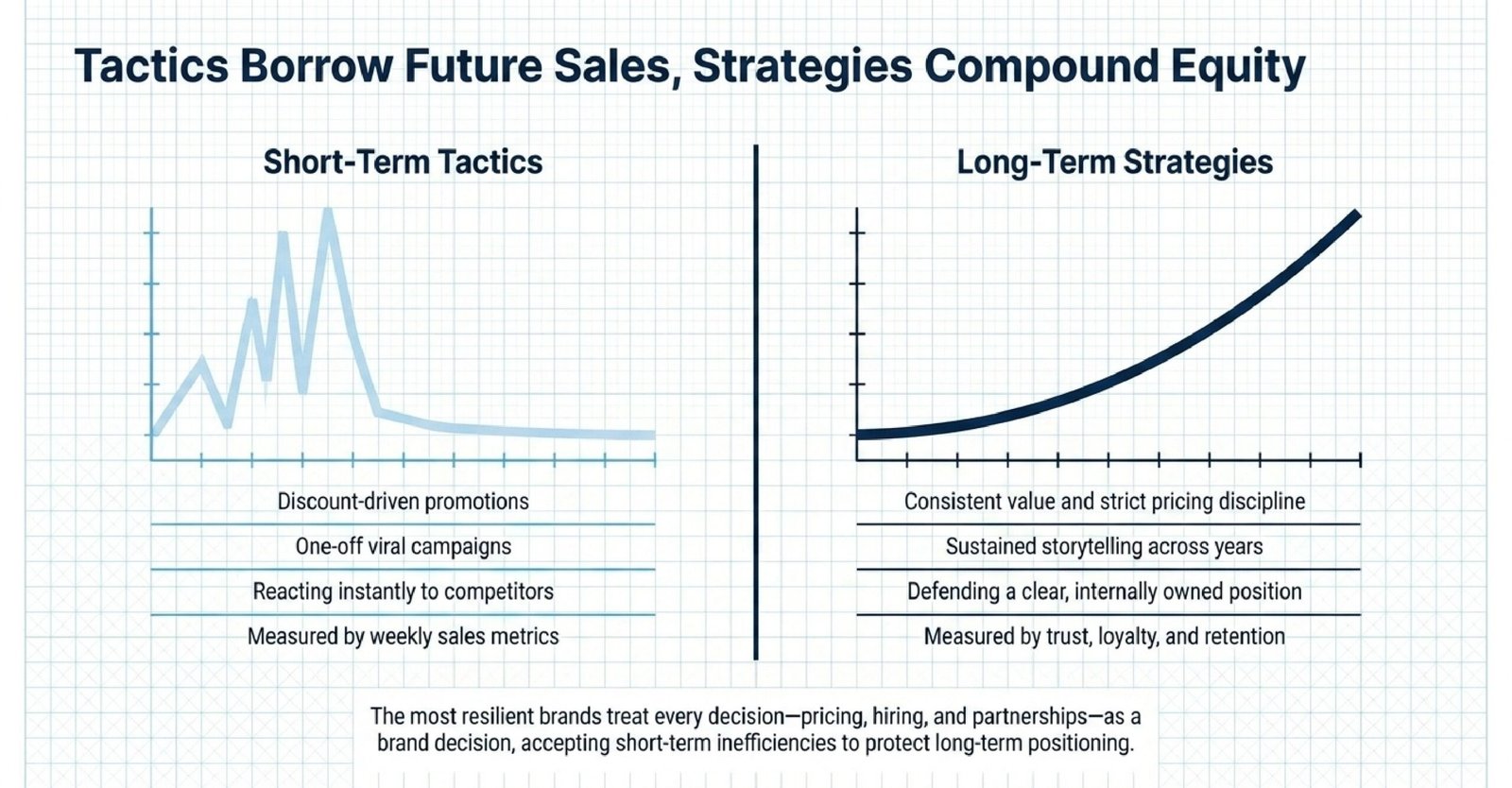
The difference is useful to keep in mind when reviewing a marketing calendar or a proposed campaign; if something you are planning will enhance equity in the long run or just be a short-term boost on the back of future sales.
Table 2: Long-Term Branding Strategies – Long-Term Brand Value
| Short-Term Tactics | Long-Term Branding Strategies |
| Discount-driven promotions | Consistent value and pricing discipline |
| One-off viral campaigns | Sustained storytelling across years |
| Reacting to competitors | Defending a clear, owned position |
| Measured by weekly sales | Measured by trust, loyalty, and retention |
How Do Customer Trust and Brand Value Connect in Practice?
There’s a strong correlation between customer trust and brand value, and in customer research with repeat customers, trust is the number one reason cited for loyalty and willingness to pay a premium; it’s also the number one factor cited in research with customers who have stopped purchasing the brand. When customers have confidence in a brand, they will not mind if there is an occasional error, are more willing to sample a new product with the same brand name, and will go to lengths to defend the brand in public when it is criticised in the press or online. If people don’t trust you, even the most innovative marketing efforts fail to produce loyalty because trust is hard to purchase and can only be won over through repeated proof, consistently shared over a number of interactions. This is a key best practice to internalize early on as awareness and trust are not the same thing, and they take very different approaches, budgets and times to develop; mixing them up can cause teams to invest in visibility but lack in reliability.
A great example of this is the outdoor brand, Patagonia, whose brand equity has been developed to a high degree through transparency about their environmental impact, rather than through traditional advertising. The company shared information on their supply chain, openly discussed the environmental cost of the products, even ran a campaign to get customers to buy less. This is a counter-intuitive tactic that engendered trust, even when it was an unpopular message for people to hear, given the brand’s short-term goal was to generate profits. LEGO is another example, as it rebuilt its brand around its core product quality and took time in the early 2000s to listen to its community of adult toy lovers – not every new toy craze or licensing opportunity it encountered. A third is Toyota, which experienced a severe loss of trust during a big recall of vehicles but regained much of its brand trust in the years that followed via clear communication, vehicle safety enhancements and reassuring product reliability, without the need for a single reassuring advertisement. All of these cases demonstrate that trust is built over time, when you can see the good things you are doing, and it can outlast a crisis if the initial trust was developed in a positive way with customers. To professionals, the operative word is sustain: any initiative for trust building must be maintained long after the new release and communicated persistently to really change the perceptions in a meaningful and lasting manner.
What Benefits and Challenges Come With Building Brand Value?
The advantages that are accrued from a strong and sustained brand value are well known: Companies with high brand equity can enjoy more pricing power, lower customer acquisition costs, better talent attraction and more economic stability during recessions as their customers are less likely to switch to a less expensive competitor solely because of price. Indirectly too, employees are blessed as working for a trusted and well-known brand often makes recruitment easier and hiring cycles shorter and boosts employee morale, which is important for those who are considering hiring on a new brand or looking to improve their own brand’s reputation from within. A strong brand can also lead to other opportunities that a weaker one cannot – such as better partnership terms, smoother market entry and more good will from regulators, media and the public during change or uncertainty which over time can be realized in financial and operational benefits.
But the problems exist and are far more severe than they are initially perceived by those young teams who are looking for easy wins, and it is important to be open about these issues not gloss over them as a purely good thing and one that does not entail too much risk. Creating brand value demands ongoing investment that can have a lagged effect and may be in opposition to the quarterly goals and/or the investor community that value’s instant success over long-term positioning. Another problem is internal misalignment – your marketing team may be telling customers one thing whilst your operations and customer service are telling them another. This disconnect may not be recognized by leadership but is felt by customers and makes them not believe the brand. In addition, in a highly digital world brands are constantly under scrutiny; one wrong move can go viral before a company can have the time to react in a sensible manner, making the preparedness to deal with a crisis an integral but often overlooked component of brand strategy. For smaller companies and startups, the issue is similar: budget constraint requires careful consideration of where they allocate their resources, as it’s unlikely that they’ll achieve stronger results across a greater number of channels than they would by sticking to fewer channels with greater consistency and discipline. This shouldn’t be the limiting factor in the minds of professionals who work in resource-light teams, because this can be a good thing – it can be what helps smaller brands earn more trust than their size warrants.
What Lessons Can Professionals Learn From Real Brand-Building Processes?
Building brand value usually unfolds in a well-defined manner: research and positioning, consistency, feedback and adjustment, and reinforcement through multiple proof points. Successful companies tend to think of this as a never-ending journey and constantly reassess their position as markets, competitors and customer expectations change, and as they develop in-house processes to ensure that there isn’t a gap between promise and delivery. Airbnb, for instance, transitioned its brand story from “cheap accommodation” to “belonging anywhere”, which involved years of sustained marketing campaigns, product updates and community engagement, and required everyone from design, marketing and customer service to be on the same page in order for it to be authentic and not superficial. This kind of repositioning is not done by one statement, it’s done by hundreds of little, consistent actions taken by staff members who may never see the original brand strategy statement and yet act in a manner that is consistent with it. But the take-home message for professionals is that brand strategy (as with any strategy) never ends – it needs to be managed through this process, even after the product launch or campaign has completed, and it can be best improved by subtle incremental tweaks that don’t send loyal customers into confusion with the dramatic changes of a frequency-driven rebranding.
One thing that is learnt in all industries is that it is as important to have internal alignment with the external messages. The company’s response to the controversy surrounding some of its stores went beyond mere public statements and included thousands of internal retraining sessions around the world, pointing to the need to make operational and cultural changes to protect brand value, in addition to communications changes. But this trend across sectors is that the firm which recovers quickest from the reputational crisis are also the more likely to see the crisis as a real problem to solve, not just a public relations one to manage, and the most likely to be willing to incur short term cost or disruption to make the fix believable. One of the other challenges that many businesses encounter is scale – as a business expands and enters new markets, or uses third parties, such as franchisees, or invests in other brands, it can become difficult to maintain a consistent brand experience. The message for the younger professionals: brand value is safeguarded and created in everyday choices by all members of the organisation, not just the marketing team. It can also help you narrow down your daily responsibilities in your job—from customer service to product development, from finance to other internal communications—to being more effective on the job, and it can help you stand out when applying for a job or promotion into a role that requires more responsibility.
What Creates Long-Term Brand Value?: Conclusion
Brand value is developed over a number of years, not with a single campaign or win. It means seeing beyond marketing to the other functions of a business and how they affect the customer experience and brand recall, and being patient, waiting for good decisions to build rather than looking for the quickest short-term lift. It also demands that you are ready to be honest with yourself in terms of measuring progress—sometimes when the numbers don’t start moving fast enough than you or your leaders or investors would like, it’s easy to make declarations of success, but they might reappear later at a higher price. The obvious route to take is clear for those looking to advance their careers or improve the value of their brands: grasp the factors that can make your brand valuable to your industry, in spite of short-term considerations, and understand that each touchpoint with your customer presents an opportunity to strengthen or weaken trust in your brand and strengthen or weaken your brand value. Begin small – audit your own team’s consistency, take a critical look at what your customers are giving you feedback on, observe how your competitors and similar organizations have reacted to a similar situation and promote transparency in your day-to-day work even if it is uncomfortable? These small steps, carried out over a period of time, distinguish brands from fades and can be the same sorts of habits you have when constructing your own reputation and credibility in any organization you join.