Digital Branding Strategy: Adapting to the 2025 Market Trends
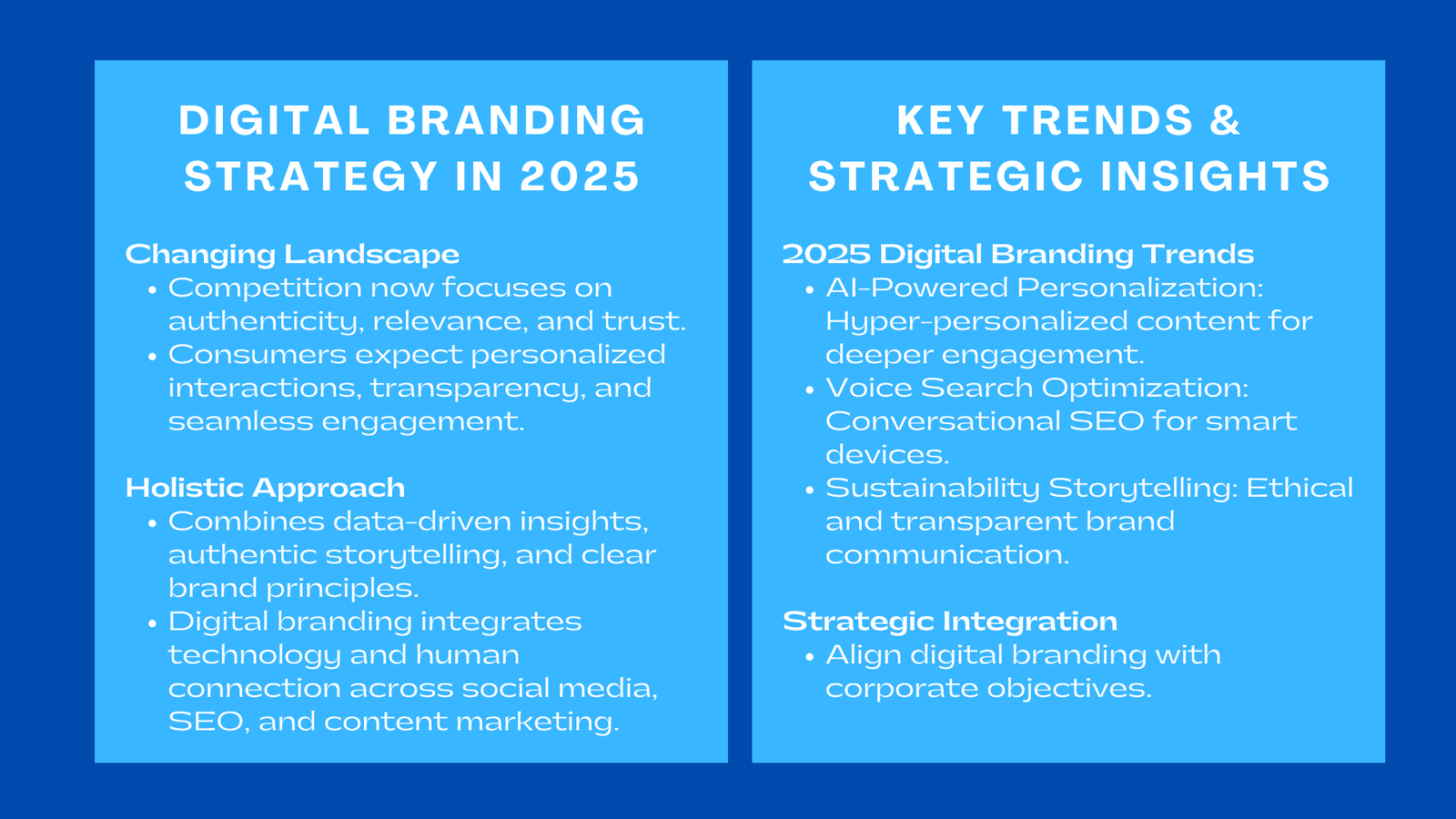
The digital landscape of the world is changing at a rapid rate. In 2025, it will no longer be just the competition of attention among brands — it will be a competition of authenticity, relevance, and trust. Consumers today expect more than polished visuals or catchy slogans; they crave personalized interactions, openness, and seamless engagement across all platforms. This marks a major shift in how brands build relationships and deliver value in a hyper-connected marketplace.
A digital branding approach in the present-day environment should not be visual only — it must incorporate data-driven insights, authentic storytelling, and clearly defined principles that reflect the brand’s values and purpose. As a result, digital branding is no longer merely about aesthetics; it has evolved into a holistic strategy that integrates analytics, narratives, and organizational vision to create a cohesive and meaningful identity that resonates with audiences.
Digital branding nowadays integrates technology and human connection in powerful ways. Social media presence, SEO optimization, and content marketing all play crucial roles, but each must reflect the brand’s purpose and deliver measurable value. Businesses that adopt digital transformation early often emerge as thought leaders — while those that lag behind risk invisibility and loss of credibility in an increasingly interconnected world.
Moreover, modern digital branding relies heavily on analytics and audience insights to ensure that every interaction is intentional and impactful. Brands can now monitor behavior, preferences, and engagement trends in real time, tailoring experiences to strengthen emotional bonds and brand loyalty. Storytelling remains at the heart of digital branding, yet it must be data-informed, authentic, and contextually relevant to sustain engagement over time. Just as companies seek guidance on how to perform accurate brand valuation in Singapore to measure their true worth, businesses that effectively combine technology, data analytics, and human-centered storytelling differentiate themselves in crowded markets and foster lasting relationships with their audiences.
Ultimately, the success of digital branding in this era is measured not by clicks or impressions alone, but by trust, credibility, and emotional loyalty. Businesses that strategically invest in comprehensive digital branding are equipped to thrive in a world where consumers demand meaningful engagement, consistency, and transparency. Every digital interaction becomes an opportunity to create genuine human connection — turning casual awareness into long-term growth and brand sustainability.
Key Trends Shaping Digital Branding in 2025
AI-Powered Personalization for Deeper Engagement
Artificial intelligence has revolutionized the digital communication landscape. Through advanced analytics, brands now possess the capability to understand consumer behavior, preferences, and motivations with unprecedented precision. AI enables hyper-personalization — allowing messages, recommendations, and even visuals to adapt dynamically based on each user’s behavior.
Personalized recommendations digital branding Singapore strategies for 2025 , predictive messaging, and adaptive content journeys ensure that every consumer feels uniquely understood. This individualized attention fosters deeper engagement and transforms customer experiences from transactional interactions into relational connections. In 2025, personalization will define brand relevance, as consumers increasingly expect tailored experiences rather than one-size-fits-all campaigns.
Voice Search Optimization and Smart Device Integration
Optimization for voice search has become essential as more consumers rely on smart devices and AI assistants for everyday tasks. Voice queries tend to be conversational and intent-driven, requiring brands to optimize for natural language rather than rigid keywords.
This trend means companies must reimagine their SEO and content strategies, focusing on how real people speak and ask questions. By aligning content with these spoken queries, brands ensure accessibility and discoverability across voice-driven ecosystems — from smart home assistants to automotive AI systems.
For digital branding Singapore, this adaptation represents not just technical optimization but a shift in mindset — toward designing experiences that are frictionless, intuitive, and responsive to how consumers naturally interact with technology.
Sustainability Storytelling as a Core Brand Pillar
Sustainability storytelling — communicating a brand’s ethical, environmental, and social commitments — has become a cornerstone of modern branding. Consumers increasingly favor brands that align with their values and demonstrate genuine care for the planet and communities.
Effective sustainability storytelling goes beyond marketing claims. It involves transparency, measurable actions, and consistent communication. Brands that openly share their sustainability journey — such as reducing carbon footprints, supporting local communities, or promoting inclusivity — build credibility and trust.
In 2025, ethical storytelling will serve as both a moral compass and a competitive differentiator, driving loyalty among socially aware consumers who choose purpose-driven brands over passive ones.
Immersive and Short-Form Content Experiences
Short-form video remains the undisputed king of digital engagement. Platforms like TikTok, YouTube Shorts, and Instagram Reels have redefined attention spans and reshaped how storytelling unfolds. These bite-sized narratives are not only easy to consume but also emotionally potent, sparking curiosity, humor, or inspiration within seconds.
At the same time, augmented reality (AR) and virtual reality (VR) are transforming brand-consumer interactions. From virtual try-ons in fashion retail to immersive product demos and virtual tours, AR and VR bridge the digital-physical divide. Consumers no longer just watch a brand — they experience it. This interactive immersion creates stronger memory recall and emotional connection, leading to higher engagement and conversion rates.
Emerging Digital Branding Trends
AI-Driven Personalization and Predictive Engagement
Artificial intelligence has become the backbone of contemporary branding. By processing large volumes of data, AI empowers brands to anticipate needs before customers even articulate them. Predictive engagement uses machine learning to deliver personalized interactions at scale, such as dynamic pricing, personalized shopping journeys, and automated yet human-like customer service.
This level of predictive sophistication transforms branding from reactive marketing into proactive relationship-building. In 2025, personalization is not merely a marketing advantage — it is the new baseline of customer expectation.
The Rise of Voice Search Optimization
The growing popularity of smart speakers and AI assistants has made voice-first marketing a crucial aspect of branding. As consumers increasingly depend on voice interfaces for everyday searches, brands that fail to optimize for this medium risk becoming invisible.
Voice search optimization is about conversation design — crafting brand messages that sound natural when spoken aloud. For Singaporean businesses, investing in localized voice strategies also enhances engagement with multilingual and diverse audiences. In this voice-driven era, discoverability is determined by how well a brand “speaks” to its consumers — literally and metaphorically.
Sustainability and Ethical Storytelling
In today’s socially conscious marketplace, sustainability is no longer optional — it’s expected. Brands must go beyond symbolic gestures and integrate ethical commitments into their DNA. Digital channels make it possible to tell these stories visually and interactively, using infographics, documentaries, and behind-the-scenes videos that showcase real impact.
Transparency is critical. Consumers value brands that are open about their challenges as well as their achievements. In the long term, authenticity in sustainability messaging not only strengthens brand reputation but also fosters deep emotional affinity with consumers who share similar values.
Short-Form Video and Immersive Experiences
The demand for short-form, visually engaging content continues to rise. Fast-paced, entertaining, and emotionally charged storytelling remains the most effective way to cut through digital noise.
Simultaneously, immersive technologies such as AR and VR continue to gain traction, enabling brands to create interactive consumer journeys. These technologies transform audiences into participants — allowing them to explore, experience, and emotionally connect with products before purchase. This combination of immersion and brevity is the future of digital engagement.
Integrating Digital Branding into Business Strategy
Aligning Branding with Corporate Objectives
An effective digital branding strategy must align seamlessly with an organization’s mission and long-term goals. Every element — from visuals and content to customer service and communication tone — must reflect the brand’s overarching purpose.
When digital branding is integrated into corporate strategy, it becomes a growth catalyst rather than a support function. Performance indicators such as conversion rates, lead quality, and customer retention help quantify branding’s business impact, reinforcing its role as a driver of profitability and innovation.
Authenticity and Credibility as Strategic Assets
Authenticity remains the defining trait of successful brands. Modern consumers have become skilled at detecting insincerity. They value transparency, empathy, and ethical consistency over polished perfection.
To build an authentic digital brand presence Singapore, organizations must embody integrity in every digital touchpoint — addressing feedback transparently, showcasing real people behind the brand, and sharing genuine customer stories. This authenticity fosters trust, which in turn translates to loyalty and advocacy — the most valuable currency in modern branding.
Analytics and Performance Monitoring
Data analytics is indispensable in measuring and refining brand effectiveness. Advanced tools allow marketers to monitor key performance indicators (KPIs) across multiple platforms — tracking engagement, conversion, and sentiment in real time.
A data-driven culture transforms digital branding from a creative exercise into a strategic science, where every decision is guided by insights. Brands that consistently analyze performance are able to adapt faster, allocate resources smarter, and maintain competitive leadership.
Digital Branding as a Continuous Process
Digital branding is not a one-off campaign but an evolving process that requires agility and consistency. The market evolves, technologies shift, and consumer expectations grow — and so must the brand.
Regular evaluation of campaigns, messaging, and public sentiment ensures that brands stay aligned with audience needs. This ongoing refinement transforms branding from a static identity into a living, breathing ecosystem that grows alongside its consumers. Over time, this adaptability fosters resilience, relevance, and emotional resonance — qualities that define long-term success.
Conclusion to Digital Branding Strategy Adapting to the 2025 Market Trends
In 2025, digital branding will represent the perfect How to build an authentic digital brand presence Singapore balance between technology and humanity. Brands that adapt to change with integrity and innovation will not only survive but thrive — standing out in an increasingly crowded marketplace.
Businesses that invest in innovation, data measurement, and authentic communication can transform their digital presence into a powerful driver of growth and differentiation.
In the long term, a well-crafted digital branding policy becomes a sustainable competitive advantage — enhancing reputation, stimulating growth, and shaping consumer perceptions at every interaction. In an age of information overload and fleeting attention spans, success belongs to brands that remain strategically adaptive, technologically advanced, and authentically human. These are the brands that will lead the next generation — trusted, influential, and enduring.