Emerging Trends in Brand Valuation
Emerging Trends in Brand Valuation 2025: The Next Era of Brand Valuation Technology and Analytics
Introduction to Emerging Trends in Brand Valuation 2025
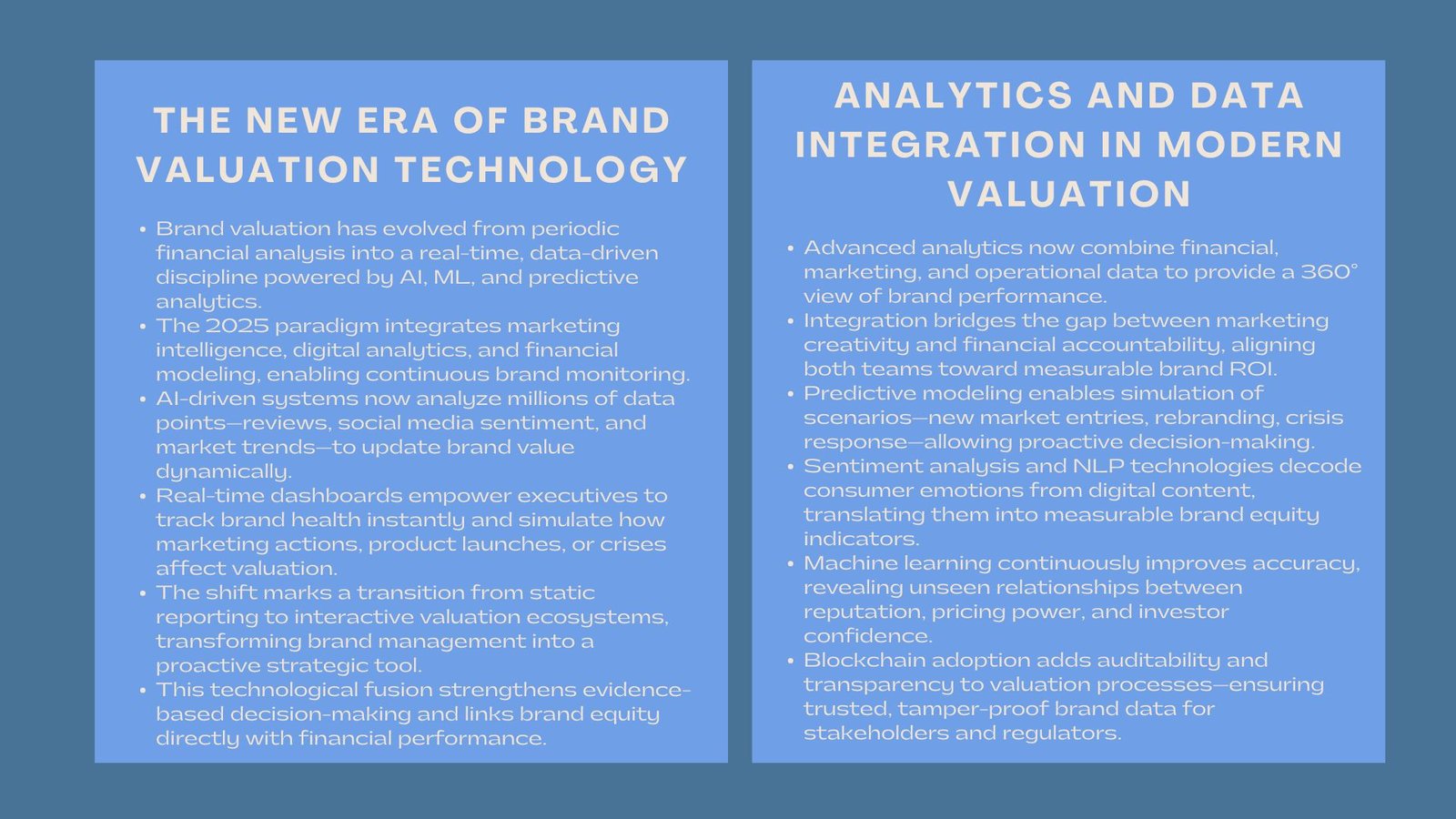
The art of brand valuation in the fast changing business environment is experiencing a paradigm shift. No longer to be considered a separate financial analysis or market survey, brand valuation in 2025 is presently becoming highly intertwined with the most complex technologies artificial intelligence (AI), machine learning (ML), and predictive analytics. Such innovations are reshaping the nature of measuring, monitoring and managing brand equity within organizations- less of a retrospective approach and more of a real-time data driven decision-making approach. This is a new technological paradigm and is the amalgamation of marketing intelligence, digital analytics, and financial insight. Firms are using cutting edge tools to get an understanding of the economic implication of brand perception with greater precision than ever before. The outcome is that we now have a move away of the stagnant brand valuation reports to dynamic and interactive valuation ecosystems which constantly evaluate and predict brand performance.1. The Digital Change in Future Brand Valuation Strategies.
1.1 Financing the Modeling to Data-Driven Intelligence.
In the past, the valuation of brands greatly depended on financial information and opinions of the experts. Determining the worth of brands was based on income-based or market-based models which analysts regularly updated on an annual basis. This method is however less appropriate in the coming 2025 to capture the fast shifting market sentiment and digital consumer behavior. Contemporary valuation methods currently incorporate the use of big data analytics, algorithms of AI, and real-time tracking of the market to deliver a multidimensional interpretation of the brand strength. As an example, AI-based systems can measure brand perception by examining the millions of points of online data customer reviews, social interactions, and others. This constant flow of information helps companies to identify changes in brand reputation within days as opposed to months and respond more quickly and decisively.1.2 Strategic Intelligence as Real-Time Valuation.
The merging of technology has seen brand valuation become a living process and not a periodical evaluation. There are now real-time dashboard valuations where executives can monitor brand performance within markets and customer segments in real-time. These systems give proactive forecasts, indicating the impact that marketing choices, product launches, or image events would have on the future brand value. This change makes brand valuation a fundamental element of strategic management enabling organisations to make evidence-based decisions that enable brand equity to support long-term financial development.2. The Role of Advanced Analytics in Brand Valuation Technology
2.1 Integrating Cross-Functional Data Sources
One of the most significant advancements in brand valuation technology and analytics lies in data integration. The new valuation tools are based on a combination of financial, operation, and marketing data to create a 360-view of brand performance. Using the methods of correlating customer satisfaction measures with growth in revenue and profitability, a company can have a better picture of the role of brand strength in achieving business success. This interdepartmental integration also helps close the loop between the marketing and the finance departments. As the marketers have a better understanding of the economic effects of brand campaigns, the finance departments have a better chance to see a tangible actualization linking intangible brand equity and tangible returns.2.2 Predictive Modelling Scenario Analysis.
Machine learning algorithms can now project the effect that various strategic actions would have on brand value by an analyst. Predictive models assume what would happen in different market situations- entering new markets, rebranding, and crisis response. Such predictions allow making decisions beforehand instead of managing them reactively. As an example, an international technology company can predict the success of an innovation introduction on its brand equity in Asia and remain stable in the mature Western markets through predictive modeling. This vision does not only maximize the decisions made by the investors but also serves to instill confidence in the stakeholders.3. Corporate Strategy Applications Brand Valuation Analytics.
3.1 nurturing marketing using data.
Analytics when incorporated in brand valuation would allow the marketer to know the exact contribution of campaigns to total brand value. Through the comparison of data on campaign performance and valuation, companies are able to identify which channels, messages, or interactions with customers contribute to the highest value creation. This understanding makes distribution of resources smarter and increases marketing ROI. To illustrate, a fashion luxury company may find out using valuation analytics that digital storytelling by influencers adds more to brand equity in the long term than print adverts. With this evidence, the company will be able to shift its marketing budget to more efficient strategies that create maximum values.3.2 Risk Management and Brand Protection
Complex analytics is very important in detecting risks that jeopardize the brand value. By monitoring real-time sentiments, the emergence of brand crisis may be identified (via negative media coverage or customer dissatisfaction) and corrected promptly. By 2025, major companies will have automated systems of monitoring their reputation, which will alert the executive about any changes in their reputation in real-time while damaging brand equity can be limited. This application will make brand valuation more than a passive tool of measurement but rather a proactive risk management tool- one that will safeguard shareholder value and will not lose shareholder confidence.3.3 Strategic Forecasting and Investment Planning.
When valuation analytics are incorporated into strategic planning, it is possible to determine the impact of the future situation on the performance of the brand. The executives of companies planning their merger, acquisition, or global growth can now estimate the impact of each of the initiatives on brand equity and financial performance. These lessons are becoming indispensable in boardroom deliberations in which brand value is viewed as a strategic resource.4. Innovations of Technology that will Determine the Future of Brand Valuation.
4.1 Machine Learning and Artificial Intelligence.
Modern brand valuation systems are based on AI and ML technologies. These tools facilitate the ability to learn continuously as data are fed into them and thus enhanced at a later period. They tend to find relationships between consumer behavior, market conditions, and brand perception automatically- providing information that the traditional models would not have been able to pick. As an example, an algorithm of machine learning will be able to determine the effect of a sudden increase in positive customer reviews on pricing power or stock performance. These forecasting abilities enable the brands to measure the intangible aspects in a monetary form.4.2 Sentiment Analysis and Natural Language Processing.
NLP has become an essential part of decoding the consumer emotions within the digital conversations. NLP algorithms identify tone, context, and sentiments in social media and in reviews on the Internet to understand brand reputation in real time. Sentiment-based valuation models are increasingly being noted in 2025 to be able to capture purchasing behavior and brand loyalty with a very high level of accuracy.4.3 Blockchain and Data transparency.
The blockchain technology will improve the trust and transparency of the brand valuation information. Blockchain guarantees confidence in the valuation procedure by developing tamper-proof documents of brand related transactions, partnerships and communications, which is crucial to investor relations and regulatory compliance.5. Technology-Based Brand Valuation Strategic Advantages.
5.1 Increased Accuracy and Timeliness.
The use of automated data gathering and AI-based analysis removes a lot of human bias in the traditional valuation. Live dashboards provide real-time updates, allowing the executives to react to the changes in the market.5.2 Bigger Interdepartmental Alignment.
The system of valuation that incorporates both marketing, finance and operation data encourages strategic cohesion between departments. The teams of marketers are able to show financial payoff of creative investments whereas finance teams can see the engines of value of intangible assets.5.3 Competitive Advantage and Investor Confidence.
Data-supported brand valuations help to increase investor confidence because they demonstrate that the company can effectively operate and develop its intangible assets. Besides, companies that use high-tech analytics have an advantage, as they are able to predict the changes in consumer perception and implement them faster than competitors.6. The Future: Intelligent and Anticipatory Valuations.
6.1 On-Going Learning Ecosystems.
The following step in brand valuation will be the autonomous systems that can self-develop. This will be AI-led ecosystems analyzing real-time data streams, such as market performance or consumer sentiment, and automatically using this new data to change valuation models.6.2 ESG and Sustainability Metrics Linkage.
With the growing focus of environmental, social, and governance (ESG) factors in corporate strategy, valuation analytics will become more interested in sustainability data. Both investors and consumers are putting more money on brands that portray ethical behaviors, concern of the environment and social welfare. When the factors are incorporated in the valuation models, it is guaranteed that brand value is accurate and captures both financial performance and corporate integrity.Conclusion: Into the Intelligent Age of Brand Valuation.
The 2025 world will be the beginning of a new epoch when technology and analytics will redefine the way organizations perceive and manage brand value. The convergence of AI, predictive modeling, and information integration has turned brand valuation into a living management instrument that will not only inform the strategy but also will reduce risks and fuel growth. In this emerging landscape, companies that harness advanced brand valuation technology and analytics will achieve superior insight, faster responsiveness, and greater strategic control. They will not only measure brand worth but actively shape it—transforming data into a sustainable source of competitive advantage.Frequently Asked Questions
Q1. What are the emerging trends in brand valuation?
Key emerging trends include the use of artificial intelligence, predictive analytics, real-time consumer sentiment monitoring, ESG considerations, and data-driven valuation models. These developments enable businesses to assess brand performance more dynamically and make better-informed strategic decisions.
Q2. How is artificial intelligence changing brand valuation?
Artificial intelligence helps valuation professionals analyze large volumes of customer reviews, social media discussions, web activity, and market data. AI-powered tools can identify brand sentiment, evaluate brand strength, and support forecasting models that estimate future brand value more efficiently than traditional methods alone.
Q3. Why is customer perception becoming more important in brand valuation?
Customer perception directly influences brand loyalty, pricing power, customer retention, and future revenue potential. Modern valuation approaches increasingly incorporate sentiment analysis, brand trust metrics, online reviews, and customer experience indicators to assess how consumers view a brand and how those perceptions affect financial performance.
Q4. What role does ESG play in modern brand valuation?
Environmental, Social, and Governance (ESG) factors are becoming increasingly relevant because consumers, investors, and stakeholders often consider sustainability, ethical practices, and corporate responsibility when evaluating brands. Strong ESG performance can enhance brand reputation, strengthen customer trust, and contribute to long-term brand value.
Q5. How can companies prepare for future brand valuation practices? engagement?
Companies can strengthen future brand valuation efforts by improving data collection, monitoring customer sentiment, investing in brand analytics tools, integrating financial and marketing metrics, and regularly assessing brand performance. Adopting data-driven approaches helps organizations better understand and manage their most valuable intangible assets.