Certified Brand Appraisal and Strategy
Emerging Trends in Brand Appraisal and Strategy for 2025
Introduction: Certified Brand Appraisal and Strategy
The brands have become economic and cultural commodities in the rapidly changing global economy. They determine the behavior of consumers, market positioning, and the impression of the investors on the future value of the company. With the changing consumer demands, increasing competition, and digital transformation of organizations, brand appraisal is no longer a compliance strategy but also a fundamental strategy. By 2025 the brand appraisal will not be only based on how well it has performed or its current valuation rates. It will rather focus on predictive insights, integration of technology, and multidimensional measuring models. As a finance professional, marketer and C-suite leader, the insights into the new developments in the brand appraisal is essential in preserving competitiveness and transparency in the era of data intelligence.The Evolution of Brand Appraisal
The author emphasizes the three fundamental changes in brand perception and identifies the key factors that complicate brand appraisal by consumers. In The Evolution of Brand Appraisal, the author has highlighted the three basic shifts in brand perceptions and has also pointed out the factors that make brand appraisal by consumers more difficult.Traditional Valuation to Predictive Analytics.
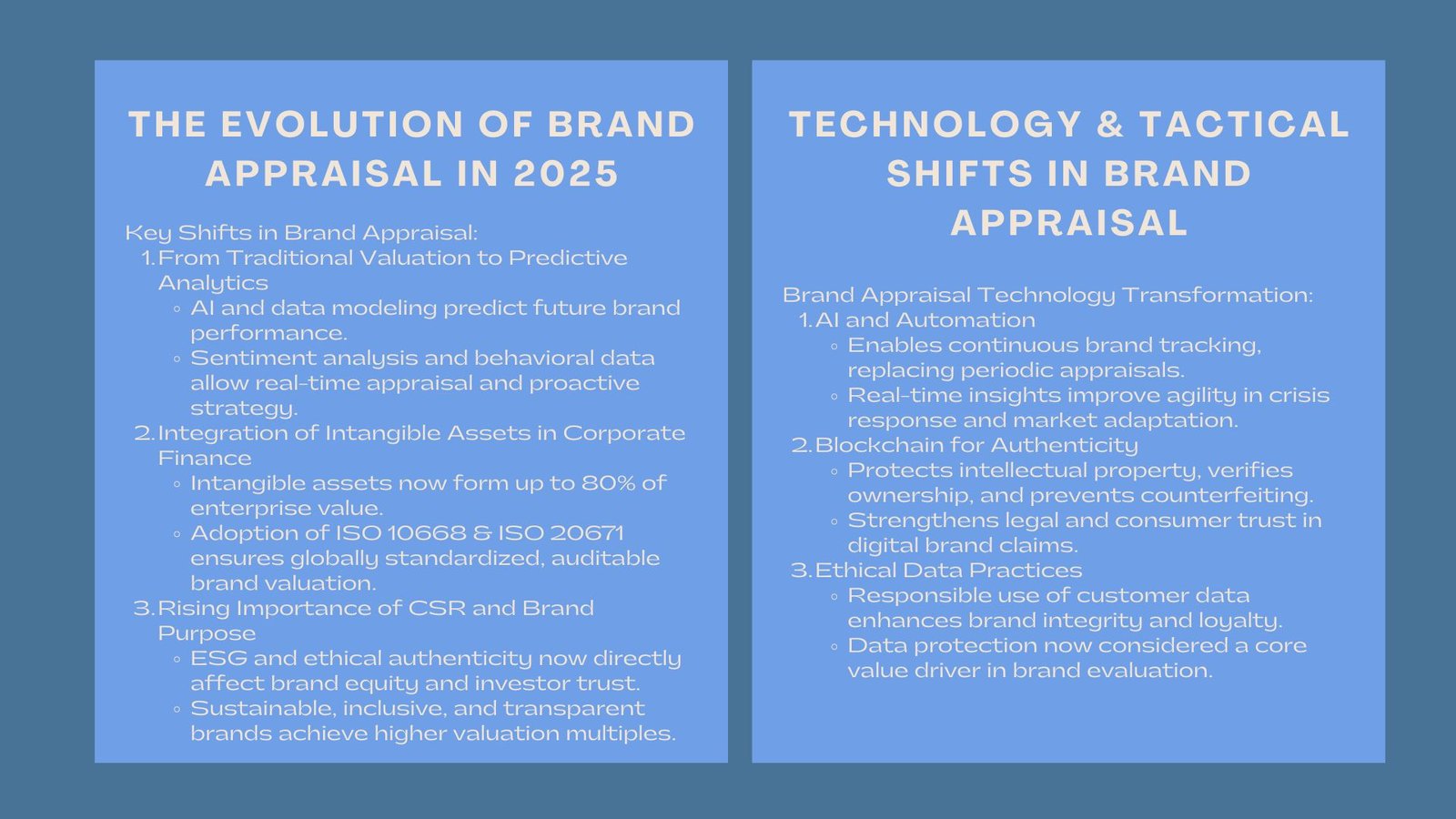
In the past, brand appraisal used backward-looking indicators, which included the financial performance, awareness scores, and prior marketing expenditure. Nonetheless, in 2025 the focus is moving to the future oriented analytics. With the aid of artificial intelligence and data modeling, now companies can predict what outcomes a particular action, such as the launch of a product or a rebranding campaign, would have on future brand equity. Predictive brand appraisal is the implementation of machine learning algorithms combined with sentiment analysis, social listening, and behavioral data. Through this, firms will be able to know how the brand value will go in real time. This model facilitates the speed of decision making and the management is in a position to maximize on strategies prior to market changes taking place.Incorporating Intangible Assets into Corporate Finance.
With intangible assets now having a true representation as leading up to 80 per cent of enterprise value in most listed corporations, incorporating brand valuation in corporate finance has become unavoidable. Shareholders need to know how the brand strength can be translated into the economic performance. Companies adopting the brand valuation process and methodology Singapore standard gain credibility by aligning financial reporting with international valuation frameworks such as ISO 10668 and ISO 20671. These standards harmonize the financial, behavioral and legal dimension, making the evaluation of brand appraisals available, congruent and justifiable in audits, or even, transactions.Increasing CSR and Brand Purpose.
The elements of brand appraisal now include environmental, social and governance (ESG) factors. The perceived authenticity and ethical integrity of a brand in 2025 will have a high impact on consumer loyalty and investor confidence. The multiples of valuation are rising among brands that show their commitment to sustainability, inclusive values and open governance. Recent appraisal models are able to quantify the benefits in regards to reputation because of the ESG which are correlated with future cash flows and risk-adjusted returns. This merger highlights a point that brand strength is now no longer merely a matter of market share- it is also a matter of relevance and reliability in the society.Brand Appraisal Technology and Data Transformation.
Capturing the power of Artificial Intelligence and Automation.
Technology still continues to transform the manner in which brand appraisals are carried out. Unlike traditional manual models, AI-driven valuation tools can process millions of pieces of data (including digital engagement metrics and customer sentiment) in a much shorter and more accurate time. Making brand value tracking continuous as opposed to periodic is the point of automation. Financial and behavioral indicators are updated in real-time and provide companies with a living view of the performance of their brand. This difference between the passive reporting and the active analysis gives an opportunity to react quickly on the newly appeared opportunities or crises.Authenticity of Brands through the use of Blockchain.
Fraudulent online assets and imitated goods are increasingly becoming a threat to brand identity. The blockchain technology is becoming a tool of authenticating the brand, ownership rights and safeguarding the intellectual property. Introducing blockchain into the digital transactions will enhance legal and consumer trust in brand assertions. In the context of the contemporary appraisal practice, blockchain information provides the legal aspect of valuation with ensuring that ownership and protection are measurable and enforceable.Facts: Data Protection and Ethical Branding.
Today, consumers are extremely aware of the way that brands gather and process their data. Inappropriate treatment of customer information may lead to reputational losses and finances. Thus, brand appraisal frameworks of 2025 take into consideration privacy practices and ethical data management. Placing personalization and data integrity in balance, companies receive greater customer loyalty and minimized reputational risk. It is not a mere compliance measure but a serious factor of sustainable brand value anymore.Tactical Changes in Brand management and evaluation.
Dynamic Value Model of Rapid Market.
In unstable industries like technology, retail and media, it is no longer sufficient to use the static valuation models. Dynamic brand appraisal systems change automatically with shifts in consumer attitude, social fashions or competition. As an example, new market perception changes, e.g. as a result of a viral campaign or a crisis, can now be measured via real-time data feeds. The agile models enable the management to make instant changes, which save the brand value in times of uncertainty.Co-operation between Finance and Marketing.
The closer integration of finance and marketing department is one of the most important strategic changes. The concept of brand value has become a collective one, balancing the analytical accuracy with the imaginative approach. Valuation rigour and risk modelling is offered by finance teams, and customer engagement and perception insights are offered by marketing teams. This joint effort will create improved and practical brand performance evaluations, and financial objectives will relate to brand health indicators.External Review and External Checking.
There is a growing demand by investors that third parties verify the brand valuations. Externality also plays an important role in improving transparency as it also offers assurances to its stakeholders that it does not have an internal bias in valuation. Companies engaging in independent brand valuation for financial reporting Singapore strengthen their governance and investor credibility, positioning their brands as financially sound and audit-ready. Especially in the merger, acquisition and capital raising, independent appraisal reports are essential as proper brand values will determine the prices of the transaction directly and the disclosures required.The Future of Globalization and Brand Equity.
Localization and Cross-Market Consistency.
With the growth of business across multiple markets, it becomes difficult to have a similar brand equity across market. Local cultural peculiarities, regulatory frameworks, and competitive conditions may introduce a difference in brand strength perception. The contemporary appraisal plans have both international and national measures to achieve balance of representation. This two-sided strategy makes the value of a brand precisely represented in various areas without disrespect of cultural background.The Emergence of Digital-First Brands.
Digital-native brands Digital-native brands represent brands that have been entirely created online and are transforming the paradigm of valuation. Digital engagement, influencer ecosystems, and platform reputation, as opposed to physical assets are the key drivers of their performance. In these cases the metrics such as the traffic on the websites, the rate of conversion and social interaction are important brand indicators. The methodologies of appraisal are changing to that extent that focus is placed on the digital behavior information in addition to the conventional financial modeling.Brand Agility: Competitive Advantage.
The fastest moving brands will be considered the most valuable in 2025. Agility has become quantifiable- it is the ability to respond to changing consumer needs or market shocks in an efficient manner. Agility indicators that are present in appraisal structures are the speed of innovation, cultural trends adaptability, and responsiveness to consumer feedback. These dimensions turn the valuation of the brand into a dynamic image of performance in the organization.Creating a Future-Ready Brand Appraisal Framework.
The future era of brand appraisal integrates information technology, strategic insights, and accountability. In a bid to be future-proof, organizations should have instituted integrated systems that will keep checking brand performance on financial, behavioral and ethical levels. Technological tools offer accuracy and timeliness whereas standardized methodologies offer credibility. However, the real change is the change of attitude: the brand appraisal should not be viewed as a yearly activity but a continuous strategic exercise. Firms that adopt innovation in the appraisal processes will have greater understanding of what creates brand value- they will invest wiser, communicate better and maintain a better market position.Conclusion
With 2025, brand appraisal will be the borderline of analytics, ethics and strategy. The procedures employed to measure the worth of brands are changing into an age of transparency, technology and business with a purpose. When it comes to contemporary business, understanding how to appraise a brand requires understanding how to speak the language of value, financial as well as emotional. The new frontier of brand strategy will be organisations that incorporate advanced appraisal models, cross-functional governance and technological innovation. Finally, the future of the brands is in those that not only do but also know the exact value of the performance.Frequently Asked Questions
Q1. What is brand appraisal, and why is it important?
Brand appraisal is the process of evaluating a brand’s financial value, market position, customer perception, and overall contribution to business performance. It helps organizations understand the strengths and weaknesses of their brand, supporting strategic planning, investment decisions, mergers and acquisitions, and long-term value creation.
Q2. Who should attend a Certified Brand Appraisal and Strategy program?
This certification program is suitable for business owners, brand managers, marketing professionals, consultants, finance executives, investors, and corporate leaders who want to understand how brand value is assessed and how brand strategy can drive sustainable business growth. A strong understanding of brand appraisal can help professionals make more informed strategic and financial decisions.
Q3. What factors are evaluated during a brand appraisal?
A comprehensive brand appraisal typically considers factors such as brand awareness, customer loyalty, market positioning, financial performance, competitive advantage, reputation, pricing power, and future growth potential. These elements help determine the overall strength and value of a brand in the marketplace.
Q4. How does brand appraisal support business strategy?
Brand appraisal provides valuable insights into how a brand contributes to revenue generation, customer retention, and competitive differentiation. By understanding these value drivers, businesses can refine their positioning, improve marketing effectiveness, allocate resources more efficiently, and develop strategies that enhance long-term brand value.
Q5. What methods are commonly used in brand appraisal and valuation?
Brand appraisal commonly uses the Income Approach, Market Approach, and Cost Approach. Popular valuation techniques include the Relief-from-Royalty Method, Discounted Cash Flow (DCF) analysis, and Excess Earnings Method. The appropriate method depends on the purpose of the appraisal and the availability of reliable financial and market data.