Best Methods to Measure Brand Market Value
Top Approaches to Determine Your Brand’s Market Value
Best Methods to Measure Brand Market Value
In the current competitive business environment, the competitive strength of a firm is often defined by the strength of its brand, which is the ability to capture business, price powerfully, and even remain profitable. However, brand value is a value that is not quantified well in spite of its significance. Knowledge on the market value of a brand is a clear guide in making strategic decisions like mergers and acquisition, reporting to investors and long term growth planning.
Proper brand valuation is not an accounting process but a strategic requirement. It is in the understanding of the brand market value equity whether a firm intends to use its brand as a source of finances or as a source of proper acquisition price or as a source of improved corporate image. The knowledge of the brand market value creates transparency and control over one of the most influential non-physical resources of a firm. This article discusses the most common methods employed by valuation experts in arriving at the value of a brand and how each of the methods can be used to bring a comprehensive comprehension of brand performance.
The role of Brand Valuation in Business Strategy.
The importance of Brand Value to The Growth of the Corporation.
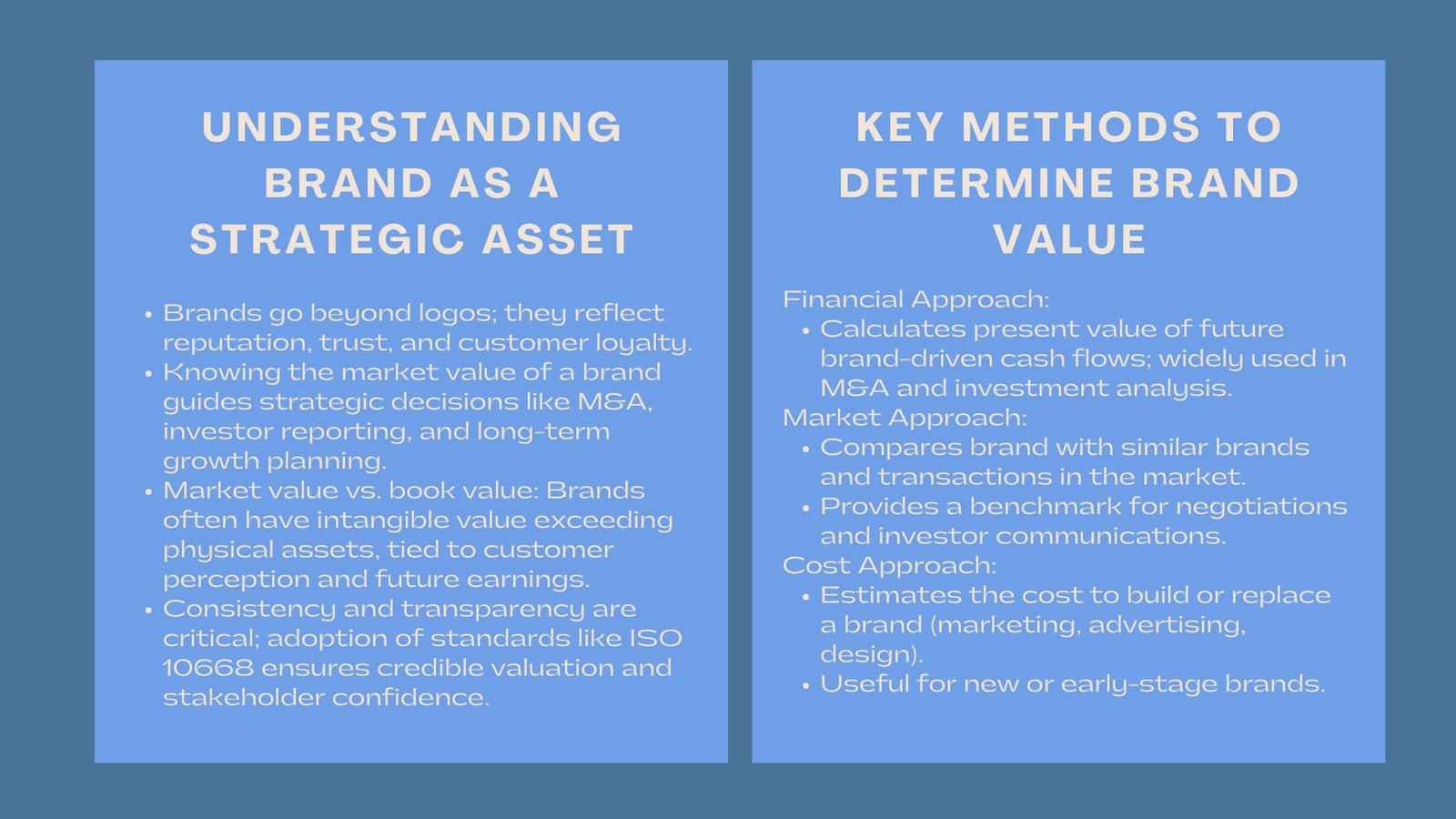
A brand is much more than a logo or a slogan, it is the reputation, trust, and promise of a company to a consumer. Powerful brands lead to customer loyalty, reduce the cost of acquisition and allow the premium of the price. Under the condition that the value of a brand is clearly spelled out, it can be managed as a strategic asset, but not a side effect of marketing action. Under financial strategy, the perception of shareholders and total enterprise value is directly related to brand value.
The Difference between Market Value and Book Value.
As opposed to physical property, which is brought to account at its cost, brand value is highly based on potential future earnings. The market value of a brand is sometimes much higher than the book value of the brand in that they represent the intangible value of equity that is linked to customer perception, awareness and emotional attachment. Understanding this difference will make corporate leaders value how branding decisions impact financial results of a business over the long term.
The Requirement of Consistency and Transparency.
The level of valuation requires the use of a uniform methodology and understandable data. When there are no standardized processes, estimations may be quite different and this causes confusion among the stakeholders. Many organizations now adopt internationally recognized standards such as ISO 10668 to ensure transparency in brand valuation process and methodology Singapore, aligning both internal management and investor reporting with best practices.
Basic strategies of defining Brand market value.
The Financial Approach
Financial approach calculates the value of a brand in terms of the present value of future cash flows of the brand. This is the process of separating brand-driven earnings, projecting them in a given time, and discounting them with a given rate that is demonstrative of market risk.
It is a common strategy when dealing with M&A transactions or investment analysis because the brand value is directly linked to the desired results. Financial modeling software like discounted cash flow (DCF) analysis can enable the analysts to evaluate the sustainability of the earnings and the contribution of the brand to the total profitability. This technique is highly accurate hence suitable in situations where precise financial forecasting is present and necessary in decision making.
The Market Approach
The market strategy determines the value of a brand through a comparative assessment with other related brands in the market. It takes into consideration recent transactions, royalty deals, and such and such company information in order to come up with benchmark values. An example is, should a similar brand be purchased at such and such a multiple of revenue or earnings, the multiples can be used, after some modification, upon the brand under valuation.
The approach offers an effective point of reference in the negotiations process particularly where there is available information about similar deals. It also assists business to focus their internal valuation on the market expectations and form a reasonable platform of negotiation with investors or other prospective acquirers.
The Cost Approach
The cost method uses cost in calculating the brand value as the cost involved in producing or replacing the brand. This covers the marketing, advertisement, design and promotion costs and the time spent in gaining similar recognition in the market. Although this approach does not directly reflect on the potential of the future profitability this gives a low estimate of brand value based on tangible investment.
This method is especially effective when a brand is new or when previous financial information is very small. It will enable businesses to measure the investment in brand building and review the effectiveness of the marketing spending over the long run.
High-tech methods of Holistic Brand Valuation.
The Royalty Relief Method
One of the most acceptable valuation methods of identifying the brand value especially in accounting and tax purposes is the royalty relief method. It approximates the theoretical royalty a business would have to pay in order to license its brand in the event that it did not own the brand. Such evaded royalty payments discounted to the present value are the financial value of the brand.
The popularity of this method lies in the fact that it is consistent with the real-life licensing practice and meets the financial reporting requirements. A large number of multinational firms use this method in distributing purchase prices in earnings in the process of making acquirals or in carrying out transfer pricing studies.
The Income Split Method
Income split approach apportions the entire business earnings between tangible and intangible assets allocating a specific portion to the brand. It separates brand-driven income (e.g., consumer preference or pricing power) and the others (e.g., technology or distribution).
It is also useful in companies that have several brands or product lines since they can isolate the brands that bring the highest contribution to the profitability of the company. It can also help in the decisions of allocation of resources and strategic branding under the management based on the financial contribution.
The Brand Strength Analysis
In most cases, quantitative approaches have to be supplemented by qualitative measurement. Customer loyalty, awareness, leadership perception, and market position are some of the factors that are assessed by the brand strength analysis. This would be a more complete view of brand performance by combining both financial and non-financial indicators.
Practically, analysts can adopt brand rating models which give a score to differentiation, relevance, and credibility attributes. These measures are then cross-linked with the financial performances in order to ascertain the capacity of the brand to continue to create long term values.
Brand Valuation use in the Corporate Context.
Investment Decision Supporting M&A.
In the case of mergers and acquisitions, proper brand valuation offers a justifiable reason as a basis of pricing and due diligence. It makes sure that a buyer and a seller know the extent of the transaction value which gets based on brand equity. Professional brand valuation translates to business gaining more bargaining power on negotiations and increased level of transparency on financial reporting.
Enhancing Financial Reporting and Compliance.
Intangible assets are becoming more important in that regulatory bodies and accounting standards demand companies to identify and report the value of the intangible assets. Proper brand value measurement will encourage monetary reporting standards and enable auditors to have evidence on the allocation of goodwill.
Many organizations partner with firms specializing in independent brand valuation for financial reporting Singapore to ensure that valuations meet international audit and regulatory expectations.
Improvement in Strategic Brand Management.
Knowledge of brand value assists companies to track brand performance, make rational investments in marketing, and trace equity over a period. It offers quantifiable information on whether the value is being created or destroyed through the rebranding, market expansion or diversifying products efforts. Valuation can be a continuous management tool when applied in strategy and not a financial necessity once in a lifetime.
Difficulties in Measuring Brand Value.
As much as methodologies have changed, brand valuation has been a complex issue. Among the key problems is the difficulty in isolating brand performance and external performance based on pricing policies or distribution strengths. Reliability may also be curtailed by data availability and consistency. Also, due to the market conditions, the customer sentiment, and the competitive forces, valuation outcomes may vary over the course of time.
However, the challenges can be overcome with the use of a mixture of a quantitative model and qualitative understanding. An integrated multi-approach structure would provide a more holistic and justifiable estimation of market value and both analytic rigor and strategic situation.
Conclusion
Having a sense of how your brand is valued in the marketplace is not just a financial activity, but is an investment in openness, tactical acuity, and long-term development. Regardless of the approaches taken be it financial, market or hybrid, both methods of valuation offer different perspectives to the overall success of your business.
Through standardization and professional approaches, companies will be able to change the perception of brand valuation into more practical management means. By having a clear and well-founded data concerning brand performance, companies are more equipped to make well-informed decisions and attract investors and create lasting market leadership.
Frequently Asked Questions
Q1. What is brand market value?
Brand market value refers to the estimated financial worth of a brand based on its ability to generate future economic benefits. It reflects factors such as customer loyalty, brand recognition, market position, pricing power, and overall contribution to business performance. Understanding brand market value helps organizations make informed strategic and financial decisions.
Q2. What are the most common methods used to measure brand market value?
The most widely used methods are the Income Approach, Market Approach, and Cost Approach. The Income Approach estimates future earnings attributable to the brand, the Market Approach compares similar brand transactions, and the Cost Approach evaluates the investment required to create or replace the brand.
Q3. What is the Relief-from-Royalty Method?
The Relief-from-Royalty Method is a popular income-based valuation technique that estimates brand value by calculating the royalties a company would have paid to license the brand if it did not own it. The present value of these avoided royalty payments represents the estimated value of the brand. This method is frequently used for financial reporting, tax, and transaction purposes.
Q4. Why is measuring brand market value important for businesses?
Measuring brand market value helps businesses support mergers and acquisitions, investor reporting, licensing negotiations, financial reporting, strategic planning, and marketing investment decisions. A reliable valuation provides greater transparency regarding the contribution of brand assets to overall enterprise value.
Q5. What factors influence a brand's market value?
Several factors affect brand market value, including brand awareness, customer loyalty, market share, reputation, pricing power, competitive positioning, revenue generation, and future growth potential. Strong brands that consistently deliver positive customer experiences and sustainable financial performance generally achieve higher valuations.