The Role of Brand Valuation in Private Equity and Investment Decisions
Introduction to Brand Valuation Role in Private Equity Investments
The first group of numbers includes all numbers: revenue, EBITDA, debt, and cash flow, which the private equity companies consider when thinking of a potential acquisition target. Behind these numbers, however, there is a massive machine of long-term value-creation, which may not be reflected on the balance sheet, the brand. The brand equity and reputation of the company acquiring the company, be it in consumer goods, technology solutions, or professional services, has a direct impact on the potential to pay a price premium, retain or attract customers, retain talent, and gain market share. The decision on investing in the brand valuation Singapore is thus not merely an accounting procedure but also a strategic spectacle which allows the investors to see the actual sustainability of a business.
The need to brand a brand as a financial resource is emerging as a requirement to junior- to mid-level professionals developing careers in the fields of private equity, corporate finance, or brand strategy. The presence of dealmakers who can explain how brand equity can be converted into earning power, or how the brand structure of a portfolio company can be restructured to release value after an acquisition, is always better as a contributor to investment committees and management teams. But brand valuation Singapore is the subject of one of the least understood fields in the financial market – it is believed to be too soft to model, or too complicated to standardize.
The gap shall be addressed in this paper. It describes the place of brand value in the investment process, offers frameworks that can be applied by professionals to measure and assess brand value, and gives practical advice on those who would like to apply these skills within the real-world setting of private equity or investment. This chapter is founded on experiences reported in publicly traded markets across the globe and best practices in the field of financial analysis, as well as brand strategy.
Why brand valuation Singapore Role in Private Equity Investments Goes Beyond Marketing
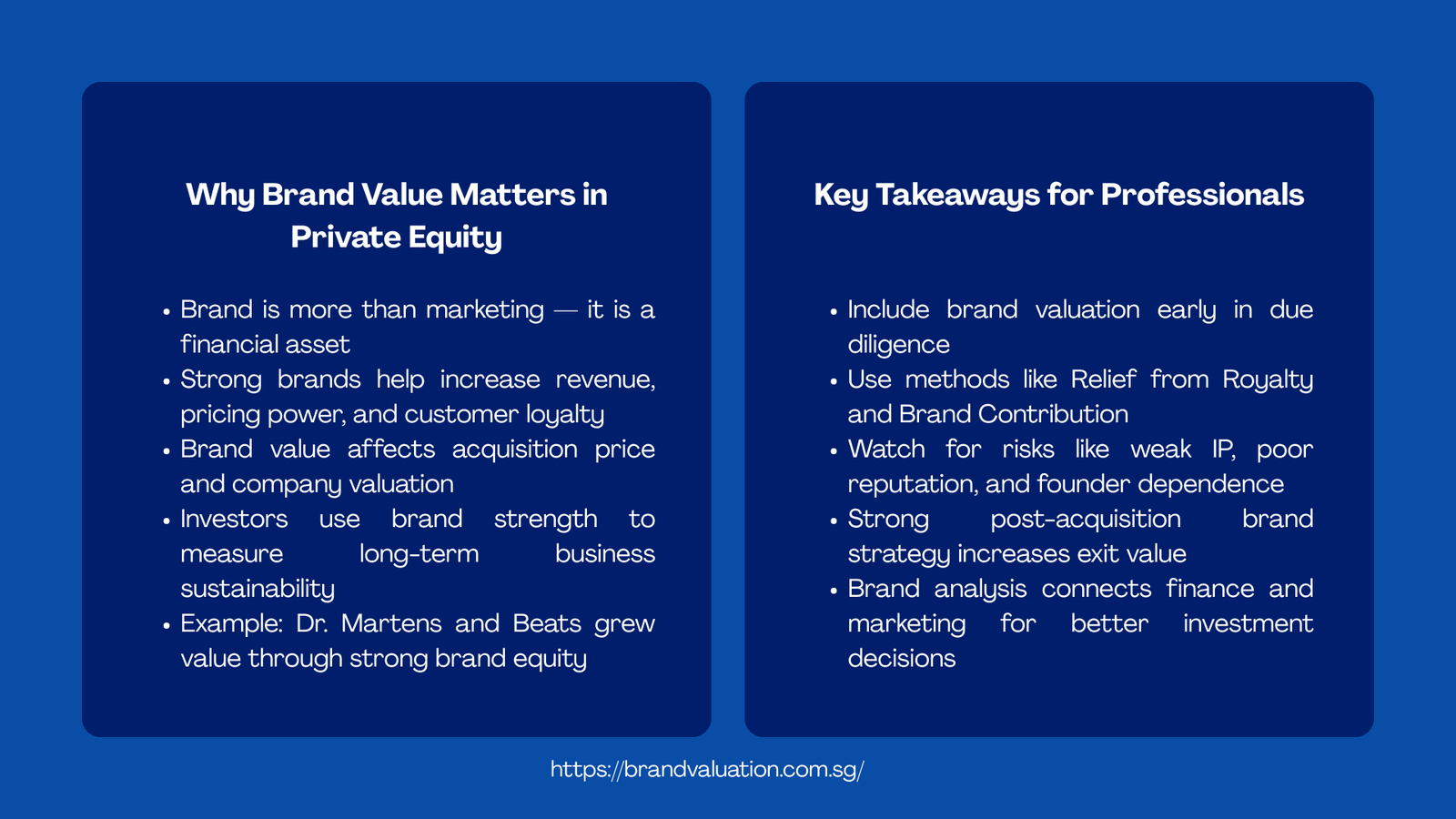
That myth which makes the brand, as the ratings of awareness and Net Promoter s show, is more a marketing problem has been sucking on the blood of those who have their feet in the blood of finance and strategy. The thing is that a strong brand is an economic asset that is not costly but generates financial profits. It will decrease the cost of customer acquisition, lower price sensitivity, and increase cross- and upselling, and barriers to entry will be extremely difficult to copy. These outcomes are not sweeter than honey, but are benefits in the shape of a direct conversion to revenue, margin, and stability of earnings.
The most apparent value that a due diligence of the private equity firm would discover is the brand value. As the investment by KKR in the purchase of the bootmaker Dr. Martens in 2014 was obviously founded on the notion of brand revitalization, the company discovered that the brand equity of the brand was not fully employed, and that strategic repositioning would lead to a substantial increase in revenues as well as expansion into foreign markets. The present value and optionality of the cultural resonance of the brand were used to determine the takeover price. By the time KKR sold the company in the IPO in 2021, Dr. Martens had a much higher valuation, much of which came as a result of increasing sales in Asia and North America.
Practically, this implies that any DCF model not incorporating brand-based revenue premia, customer retention benefits, or pricing power will systematically underprice consumer-facing businesses. The skill to identify and identify such additions to the brand at least in an approximate sense, is a skill that distinguishes technically good analysts, as opposed to those who are actually insightful. It must also be good at financial modeling and consumer behavior, and this is the reason why those who develop both are much sought after in the profession.
Process Flow 1: brand valuation Singapore Role in Private Equity Investments During Due Diligence
| PE Due Diligence — brand valuation Singapore Integration | ||
|---|---|---|
| Step 1 | Initial Screening Assessment of brand presence, category position, and competitive moat in sourcing deals. | ▼ |
| Step 2 | Brand Audit Conduct qualitative and quantitative brand equity, architecture, and consumer perception audit. | ▼ |
| Step 3 | Financial Attribution Estimate the revenue and margin premium that can be ascribed to the brand compared to generic or unbranded products. | ▼ |
| Step 4 | Risk Assessment Establish brand weaknesses, reputational, single-market, and trademark. | ▼ |
| Step 5 | Valuation Integration Brand worth is incorporated into enterprise valuation and a post-acquisition worth creation plan. | ✓ |
How Investors Assess Brand Strength in Private Equity Investments
The question of how investors determine the brand strength is one that has no one-size-fits-all answer, with different companies applying different models, and the perceived value of the brand relying heavily on industry and the nature of the deal. However, there are certain dimensions of analysis that appear to be universal in the higher level of investment processes. The former is brand awareness and association: has the brand of the target firm taken a special and valued position in the minds of the customers? This is typically calculated through carrying out consumer research, gathering Net Promoter Score, and conducting a competitive positioning.
Second is the pricing power. Brands that are able to put a price premium in relation to the competitors, even when a recession is being experienced, are shown to be more valuable than the price-competitive brands. The investors want this to be captured in the history of gross margins, the study of price elasticity, and the retention rate of customers at different prices. A brand that has loyal customers is structurally superior to a commoditized brand, and this superiority is reflected by lower earnings volatility, a feature that is highly prized by financial models that give a higher value multiplier.
The third dimension that determines the degree of brand strength as perceived by the investors is the portfolio and architectural transparency of the brand. The associated overheads of companies include duplicated marketing expenses, internal channel conflicts, and consumer confusion due to the complex, overlapping brand portfolios that cannot be identified and cannot be used to generate growth. Conversely, companies with clear and highly managed brand setups, like a house-of-brands at Procter and Gamble or a portfolio of luxury brands at LVMH, are likely to make more productive use of their capital and generate greater returns. A commercial intuition as well as a rigorous financial analysis is required in order to establish the difference in the due diligence.
Five Key Brand Valuation Dimensions in Private Equity Investments
Typically, seasoned investment teams will consider brand strength using a number of intercorrelated dimensions and then make a judgment regarding value. The five most important areas are listed in the table below, as well as the analysis technique and the risks that are usually encountered in each of them.
Table 1: Five Key Brand Valuation Dimensions in Private Equity Investments
| Dimension | What Investors Analyze | Key Data Sources | Common Risk Flags |
|---|---|---|---|
| 1. Brand Awareness & Equity | Unassisted/assisted recall, affect association, competitive positioning. | Social listening, consumer survey, and NPS data. | Fainting of the main segments; brand mix-up. |
| 2. Pricing Power | Value added vs category average trend of G.M. elasticity. | History of P&L, pricing, and retail audit data. | Margins are squeezed; reliance on promotional prices is too much. |
| 3. Customer Loyalty | Purchase repeat rates, customer churn, customer lifetime values, and Net Promoter Score. | CRM information, cohort data, loyalty program. | Extremely high turnover; single channel. |
| 4. Brand Architecture | Transparency of the portfolio, coherence of sub-brands, licensing framework. | Brand audit, trademark register, and analysis of the structure of the organization. | Duplication of the brands, lack of IP protection, and brand portfolio. |
| 5. Reputational Resilience | Attitude of the press, sustainability reporting, and history of crisis. | Overseeing the media, regulatory filing, and stakeholder surveys. | Poor resolution of controversies, poor ESG practices, and cases in the courts. |
The majority of analysts begin with the initial two dimensions of awareness and the pricing power since they can be directly related to the financial performance. Customer loyalty data, particularly retention data of the cohort, is becoming more available through the CRM and provides a potent connection between brand perception and revenue that can be predicted. Brand architecture and reputational resilience are the most dangerous value-destruction risks and are harder to measure, yet could be the most important currency in consumer-facing business, where trust is the largest currency.
The systematic manner in which one can go about each of these five dimensions, and the capability of describing the connection between them to enterprise value, is a precious differentiator to practitioners who are planning to work in the Investment field of either of the two, which are private equity or corporate development. Reporting by the investment Committee and a strict brand assessment and traditional financial analysis are never unwelcome amongst the senior partners, as it will demonstrate the realization of where the real sustainable value is to be found.
Process Flow 2: Post-Acquisition Brand Valuation Strategy for Private Equity Investments
| Post-Acquisition Brand Value Creation | ||
|---|---|---|
| Step 1 | Brand Baseline Assessment Determine present brand equity ratings, monetary attribution, and competitive standards in the initial 100 days. | ▼ |
| Step 2 | Portfolio Rationalisation Determine unnecessary sub-brands or overlapping product lines; work out a new brand architecture strategy. | ▼ |
| Step 3 | Positioning & Repositioning Strategically position the brand to maximize its premium potential and be in line with its target market. | ▼ |
| Step 4 | Investment Allocation Redirect marketing budget on ROI modeling; allocate channels and markets where they can leverage their brands through maximizing the leverage. | ▼ |
| Step 5 | Track, Report & Exit-Ready Establish brand equity KPIs into management reporting; make brand story complements exit story. | ✓ |
Real Cases Showing Brand Valuation Role in Private Equity Investments
The best understanding of the way brand valuation can be put into practice to make investment decisions is through real deals. This is the thesis that was implemented by Carlyle Group in the year 2013 when it bought Beats Electronics prior to its historic acquisition by Apple, and was nearly entirely brand-based: Beats controlled a relatively small segment of the headphone market in terms of volume, but had a disproportionate pricing power and cultural resonance with younger audiences. The analysts of cultural simulated the value of the brand in relation to the generic rivals and projected how the brand would expand into new product lines. The thesis was vindicated by the fact that the brand-led thesis of investment proved correct with the acquisition of Apple just one year later, paying about 3 billion dollars.
The other lesson is an example of Bain Capital and the licensing of Dolce and Gabbana, which occurred at the beginning of the 2010s. The analysis was focused on the presence of the concentration risk that might adversely influence the future value of the personal brand of the founders of the company, which, in its turn, was associated with the commercial identity of the company. It is among the traps that tend to befall when considering founder-led consumer brands: the personal and the business are so intertwined that any reputational incident with one is sure to influence the other. Single-minded investors who can appreciate the significance of brand value in the environment of the private equity learn how to explicitly model such a discount rate that can be applied depending on concentration aa nd substitutability of brand leadership.
The lesson of the two cases is that brand due diligence is not merely a box-ticking exercise but must have a certain analytical rigor and be able to make defendable decisions on qualitative aspects. Any company that is effective in this can always be top in consumer deals. Brand as a secondary consideration (i.e., simply interested in the earnings multiples and balance sheet ratios), those are always taken by surprise once the post-acquisition brand erosion sets in, which could have been so easily predicted with merely a more rigorous analysis.
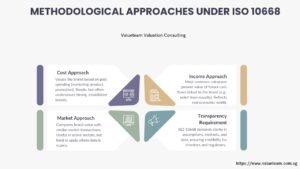
Table 2: Best Brand Valuation Methods for Private Equity Investment Decisions
| Valuation Method | How It Works | Best Used When | Limitations in PE Context |
|---|---|---|---|
| Income-Based (Relief from Royalty) | Discounts royalty that a business would pay to license its brand by a third party; estimates to NPV. | Target has a good, detachable brand identity; licensing similar items is available. | The choice of the royalty rate is subjective; it can lead to underpricing highly differentiated brands. |
| Income-Based (Brand Contribution) | Determines the revenue/margin premium that can be associated with the brand as compared to an equivalent that is not branded. | Retail, consumer goods, hospitality industry, and definite prices. | Needs to have strong market data in order to determine an unbranded benchmark. |
| Market-Based (Transaction Comparables) | Values a brand based on similar acquisitions or licensing that are undertaken by brands in the market. | The sector has a good number of similar deals. | Weak, similar data in small segments; distortions in market timing. |
| Cost-Based (Brand Reconstruction) | It will cost to start afresh with the brand (advertising, PR, time to establish) | Helpful as a floor value, or cross-check, for new or young brands. | Ignores are equity earners; it depreciates mature, trusted brands in a systematic way. |
| Composite Scoring Models | Correlates financial measures and brand equity (awareness, loyalty, differentiation) indices into one index. | Portfolio benchmarking: performance of the brand at the holding period. | The weights of indices are arbitrary; hard to model the enterprise value. |
Common Brand Valuation Challenges in Private Equity Investments
Including the value of a practitioner analysis is an extremely challenging task, even for very experienced investment professionals. The simplest of them is the non-standardization. The brand valuation is also not a standard and is not mandatory, as it is in financial reporting, where the accounting models are adhered to. There is guidance provided by ISO 10668, and several providers, Interbrand, Kantar BrandZ, and Brand Finance, also provide reputable global rankings, but each of the Brand Financeers has a very different methodology – the same brand may be assigned a crazily different value by different providers. The deal professionals ought to know the methodology they are using, what assumptions they are premised on, and how sensitive the results of the assumptions are to any change in the assumptions.
The second problem, which renders the role of brand value a challenging one in the context of private equity, is the accounting of brand in a deal. Such athe asds acquired under the IFRS 3 and ASC 805 intangible assets should be classified as a separate entry on the balance sheet of the acquirer at fair value, and they are also to be subjected to annual impairment tests. This contributes to a post-acquisition reporting disclosure that the majority of the deal teams do not consider when planning the transaction: it was a message to the market in general that brands that are not actively developed and invested in will depreciate, and the financial cost of depreciation is actual and reportable.
The best practitioners are singled out in three ways. One, they do not add brand analysis at the end of a diligence process, but they integrate it at the beginning of the diligence process, to ensure that the brand risks and opportunities actually impact deal pricing and structuring. Second, they use brand KPIs to the operating plan on the post-acquisition day one, as an asset that is managed rather than inherited. Third, and perhaps most importantly, they develop a strong brand story to leave behind them that the next buyer will be asking the investor how they measure brand strength, and that the most value-accretive PE firms are those that may demonstrate brand improvement during the holding period, which can be measured.
Actionable Strategies for Brand Valuation in Private Equity Investments
The brand valuation is on the edge between two worlds, which have little to no understanding of one another: finance and marketing. The possibilities are immense for professionals who can fill that gap. The importance of intangible assets is gaining traction among the ranks of the private equity firms, corporate development teams, and growth equity investors who are increasingly starting to concentrate on intangible assets as the source of sustainable value in the business in the present day. It is no longer a specialist niche to evaluate, assess, measure, and manage brand equity, as it is a mainstream competency of investment.
The following are some definite steps which you can take at this point in case you are developing towards a career in the private equity, corporate finance, or brand st Relief from Royalty method and the Brand Contribution method, which is the most commonly used in transaction situations of brand valuation. Train: Apply these structures to information about consumer firms in the public, and practice the ability to justify the financial rationality of the connection between brand strength, earnings resiliency, and valuation multiples.
Developing the comfort of the qualitative element of brand analysis, including consumer research interpretation, brand architecture analysis, and reputational risk profiling, is also essential. They are not fully automated or can be assigned to models, and there are only a handful of professionals who can integrate analytical rigor and commercial judgment to questions relating to the brand. Case studies: Read about branjudgmentmer buyouts: how KKR bought Dr. Martens, how Carlyle was planning to buy Beats, how Bain negotiated a founder-brand concentration risk. The examples set out in each of the cases are a masterclass in the art of brand valuation in making investment decisions that can not be replicated in a textbook.
And finally, keep up with the changes that are occurring in the field as a result of technology. Predictive brand modeling, sentiment analysis, and real-time brand equity are AI-driven and transforming what is achievable in due diligence and monitoring of a portfolio. Brand value will remain significant in the context of private equity because competition for quality assets will grow, and investors will be interested in getting more value on intangible benefits as the provider of sustainable returns. Technically, commercially, and strategically, investors in the study of this field will be in a good position to be well equipped to do some of the most intellectually and financially effective work in professional services.
Lastly, a brand is a promise, and in terms of investment, it is a promise that it either delivers on the rise or not. The art of knowing what the investors are going to regard as the strength of the brands before the pressure sets in is learning. It is an art that will assist you all in your career, whether you are at one end of the table or the other of the deal.