Strategic Brand Valuation in Marketing
Strategic Use of Brand Valuation in Marketing
Introduction to Strategic Brand Valuation in Marketing
With the current competitive and brand-driven world market, the value of a brand is well beyond accounting and financial reporting. Brand valuation is currently a strategic management instrument used in setting marketing investment as well as pricing, communications, and long-term business planning. Through the combination of financial insights and market perception the brand valuation enables companies to transform intangible equity into tangible marketing approaches.
To marketing professionals and corporate executives, the utilisation of brand value data will be an effective starting point of maximising the campaigns as well as resource allocation and customer relationship enhancement. This article examines the concept of using brand valuation in strategizing pre-informed marketing decisions in organizations and how organizations can maximize the returns on brand-building activities.
Treating Brand Valuation as a Marketing Asset.
Beyond Financial Metrics
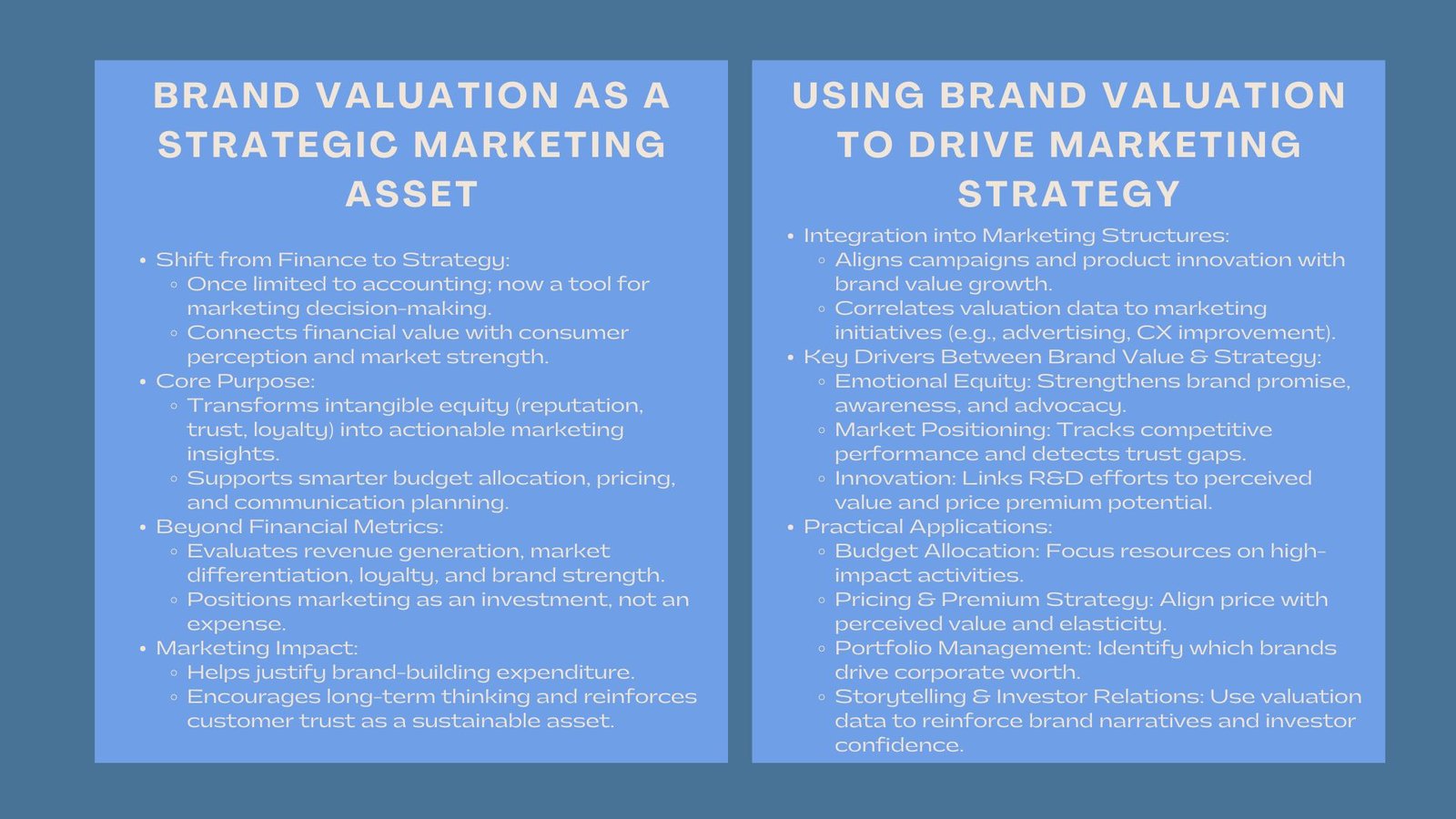
Traditionally, brand valuation was considered as a technical process that was limited to the finance or accounting departments. But in contemporary marketing, it is an inference between the quantitative performance of a business and the qualitative perception of consumers. The valuation process takes into account the revenue generation, brand strength, market differentiation, and loyalty- all those factors that have a direct impact on marketing results.
By understanding the role played by brand value in profitability, marketers will be in a position to justify marketing budgets in a better way. Marketing is then not perceived as a cost; rather it is perceived as an investment into creating values. Such a change of attitude is especially essential in such industries as brand loyalty and consumer trust are long-term assets.
Incorporating Brand Value to Marketing Structures.
Top brands combine valuation data into brand management systems to determine where the campaign or market segment can create the highest level of intangible value. When firms correlate the increase in brand value to marketing programs, they will be able to identify the actual driver of brand growth about whether advertising, product breakthrough, or improving customer experience.
With valuation as a feedback-based approach, marketers can focus on activities that can provide quantifiable value to the company, and short-term promotions should be aligned with long-term brand equity goals.
The Major Drivers between the Brand Value and the Marketing Strategy.
Emotional Equity Customer Perception
A brand is not a logo or a name, it is a promise and an experience that formulates emotional attachments. In most cases, this relationship is measured by such indicators as awareness, preference, and advocacy as reflected by valuation models. To marketers, these measures are useful in ensuring that communication is customized to improve on emotional equity and reestablish the brands positioning in the mind of the consumer.
Market Share and Competitive Positioning.
Brand valuation gives an idea on the performance of a brand in comparison to its competitors. When the financial value of a brand is increasing rapidly compared to its market share, it means that it has strong intangible drivers such as reputation or perceived quality. On the other hand, a falling brand value even with consistent income may indicate the decrease in consumer trust or obsolete communications.
These findings would enable marketers to optimize positioning, establish new opportunities, and modify messaging to the changing market expectations.
Innovation and Product Strategy.
Innovation is also related to brand value. A company that has always presented innovative products is likely to gain more brand equity and price advantages. By connecting innovation indicators with brand value, marketing teams would be able to predict the effect that introducing a new product will have on perceived value and subsequent profitability.
This relationship contributes towards the justification of R&D and product development expenditure as a component of a larger programmes of marketing expenditure and not an independent cost of operation.
Practical Applications: Making Brand Valuation Marketing Action.
Brand valuation offers practical ideas that will transform marketing decisions. The most productive organizations incorporate the valuation results into planning, pricing, as well as communications.
Budget Allocation on Marketing.
Budgets can be allocated more efficiently when the marketer knows what activities will add the most value to the brand. Valuation-driven data-driven marketing helps to avoid wasting resources on low-impact campaigns and concentrates the resources on actions that build long-term equity.
Premium Strategy and Pricing.
More perceived value allows the brands to make premiums without fear of losing their consumers. Through valuation data, marketers will be able to develop pricing strategies that will consider the market expectations and the financial opportunities based on the brand elasticity.
Brand Portfolio Management
In firms that handle several brands, valuation shows the brands that contribute to the total corporate worth. This can assist the marketing departments to make a choice on the type of brands to focus on giving priority, developing or repositioning in the portfolio.
Communication and Storytelling.
Results of valuation may be used to improve brand storytelling: they allow identifying features that consumers value most. They can highlight these strengths in their messaging, which helps marketers to support the emotional and financial worth that consumers put on the brand.
Investor Relations and Stakeholder Relations.
Good brand valuation is not only a booster of marketing campaigns but also boosts investor confidence. It shows that marketing is a strategic resource that adds to concrete enterprise value, and not just a cost.
Aligning Brand Valuation with Marketing Analytics
Bridging Finance and Marketing
One of the most significant advantages of Brand valuation marketing strategy is that it integrates financial discipline into creative marketing. The quantification of intangible assets enables the marketing leaders to use the same lingo as CFOs and investors, and their plans become more convincing.
Applying valuation metrics e.g. brand contribution to revenue or brand return on investment, assists in illustrating the quantifiable effect of marketing activity. This alignment would make sure that artistic decisions are supported by business soundness.
Capitalizing on Data and Technology.
The valuation in modern times is more and more based on data analytics, artificial intelligence, and real-time insights about customers. These tools allow the marketing teams to follow the brand perception in real-time, correlating measures of digital engagement with the valuation results.
Combining financial and behavioral data, organizations will be able to develop predictive models, according to which, the impact of particular campaigns on brand value will be predicted. This ability to predict makes brand management more of a proactive strategy rather than a reactive one.
Competitive Analysis and Benchmarking.
Valuation outcomes also give an opportunity to have a benchmark on brand performance within the industry. The marketer will be able to understand who has a greater perceived value and who has a lesser perceived value and what their reason is; is it because they have more compelling messages, superior customer service, or consistent branding.
With this knowledge, they will be able to further streamline the strategy to seal the gaps and lead competitors in the dimensions that matter.
Case Study: Basing decision making in the market using Brand Valuation.
Take a local consumer goods firm that is planning to move to Southeast Asia. It has performed a brand valuation before rolling out its marketing campaign to establish its existing home markets equity. The findings were that there was high awareness and low perceived quality in some segments.
Based on these perceptions, the marketing department made changes to its message that focused on the quality and reliability of the products. Follow-up valuations over time also showed higher scores in brand strength and willingness to pay a premium by consumers.
This approach demonstrates how Marketing decisions using brand value can provide an empirical foundation for market entry, pricing, and positioning strategies—reducing risk and increasing effectiveness.
Implementing Brand Valuation Insights Across Marketing Functions
Although finance teams may be the most common drivers of valuation exercises, their level of production must be distributed throughout all the marketing functions. Best companies in this integration generally tend to do the following:
- Integrate the marketing KPIs of valuation into dashboards and reports.
- Tie marketing performance to financial performance e.g. contribution to revenue and brand return on investment.
- Finally, walk through brand audits which are a combination of valuation, perception study, and digital analytics.
- Train cross functional teams on how to convert intangible value into marketing success.
This interdepartmental partnership will make the brand value information not a reporting occasion, but rather a component of daily decision-making.
Brand Valuation Future Trends in Marketing.
The history of brand valuation is changing the process of brand performance measurement and management by the marketing team. This intersections of finance and marketing is being influenced by a number of new trends:
- AI-based brand analytics is delivering up-to-date insights on how consumers feel.
- ESG branding and sustainability are shaping the manner in which the brand value is understood and quantified.
- Financial and marketing information is being brought together in integrated reporting frameworks to give a comprehensive view of brand health.
- Social media engagement, influencer influence, and online reputation are now part of the list of quantifiable drivers of equity in digital brand valuation models.
These advancements are assisting marketing experts in making quicker, smarter and more calculated in valuation.
Conclusion
Brand valuation has ceased being merely a financial reporting requirement, but it is now a strategic marketing tool. Organizations can also drive their customer responses, price policies, and economic value justification of marketing initiatives by instilling valuation knowledge in decision-making.
The success of contemporary business will be determined by the capacity to relate marketing performance and quantifiable brand value as the global marketplace grows increasingly data-driven. By adopting brand valuation as a marketing tool, companies will not only increase brand equity, but also, in the long-term, improve investor confidence, and maintain a lead in the market.