Step-by-Step Brand Valuation Implementation Guide
Brand valuation has become a critical component of corporate strategy, investment analysis, and financial reporting. A strong brand not only drives customer loyalty and market share but also contributes significantly to the overall enterprise value. Understanding how to implement a systematic brand valuation process allows organizations to quantify the financial contribution of their brand and make informed strategic decisions.
The implementation of brand valuation aligns with international standards, such as IFRS, ensuring transparency, consistency, and comparability in reporting. Brand valuation also supports marketing strategy, investment planning, mergers and acquisitions, and stakeholder communication. Organizations that successfully implement brand valuation are better positioned to manage intangible assets, measure return on marketing investments, and leverage their brand in strategic negotiations.
This guide outlines the brand valuation implementation steps in a structured and comprehensive manner, highlighting practical approaches, methods, and considerations for organizations seeking to align brand valuation with IFRS and industry best practices.
Establishing the Purpose of Brand Valuation
Defining Strategic Objectives
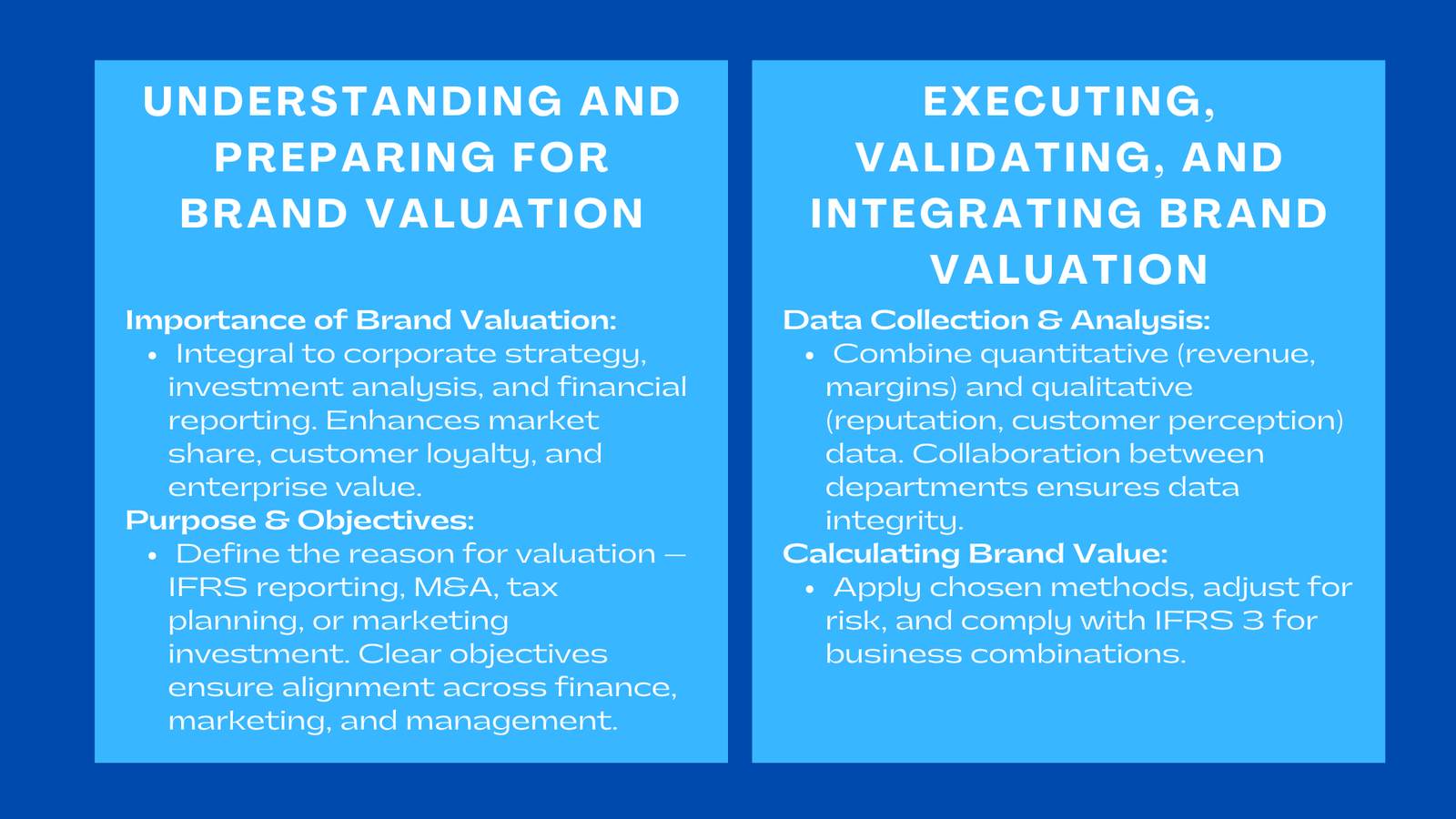
Brand valuation begins with clearly defining its purpose. Without a well-articulated objective, the valuation may lack focus and fail to meet business needs. Companies may pursue brand valuation services Singapore for multiple reasons, including financial reporting, tax planning, licensing, mergers and acquisitions, or guiding marketing investment. For instance, a company preparing for an acquisition may need to value its brand to determine the purchase price allocation (PPA) and to comply with IFRS 3 standards. Conversely, a marketing-led initiative may focus on measuring the return on brand-building activities and optimizing customer engagement.
Aligning Stakeholders
Establishing purpose also ensures alignment across key stakeholders. Finance, marketing, operations, and executive leadership must share a common understanding of why the brand is being valued and how the results will be used. Misalignment can lead to conflicting assumptions, inappropriate methodologies, and underutilization of the insights derived from the valuation. Clear communication of purpose ensures buy-in and sets expectations for data collection, reporting, and strategic application of findings.
Identifying Brand Assets
Tangible and Intangible Assets
Identifying brand assets requires a detailed inventory of both tangible and intangible components. Tangible assets include logos, trademarks, packaging designs, and physical promotional materials. Intangible assets encompass customer loyalty, reputation, intellectual property, proprietary technology, and social media presence.
Comprehensive Inventory Assessment
A thorough inventory ensures that no valuable element is overlooked. For example, a global fashion brand may have intangible assets such as celebrity endorsements, high social media engagement, and an extensive e-commerce ecosystem that directly contribute to revenue and brand equity. By capturing all elements, the valuation reflects the full scope of the brand’s contribution to enterprise value, avoiding underestimation of its strategic importance.
Selecting the Appropriate Valuation Method
Evaluating Methodologies
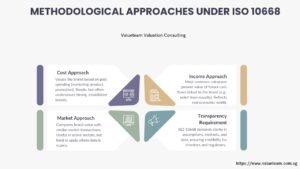
Organizations must choose the most appropriate valuation approach. The Income Approach estimates the present value of future cash flows generated by the brand. The Market Approach benchmarks the brand against comparable transactions or licensing deals, while the Cost Approach estimates the cost to recreate or replace the brand. Each method has strengths and limitations, depending on data availability, market dynamics, and the brand’s revenue model.
Combining Approaches for Accuracy
In practice, combining approaches increases robustness. For instance, a technology brand may primarily use the Income Approach to capture revenue potential but also cross-check against Market Approach multiples to validate assumptions. This triangulation ensures reliability, supports regulatory compliance, and strengthens stakeholder confidence in the results.
Data Collection and Analysis
Gathering Quantitative Data
Quantitative data is critical to brand valuation. Revenue streams, cost structures, profit margins, and market share metrics provide the foundation for financial modeling. Detailed analysis of sales channels, pricing strategies, and customer lifetime value informs the expected cash flows associated with the brand.
Gathering Qualitative Data
Qualitative factors, such as brand reputation, consumer perception, and competitive positioning, complement numerical data. These elements provide insight into long-term sustainability, market influence, and the brand’s ability to command premium pricing.
Cross-functional Collaboration
Successful data collection requires collaboration across departments. Marketing provides customer insights, finance delivers historical and forecasted revenue, while legal identifies intellectual property and regulatory constraints. This ensures that all relevant inputs are included, assumptions are well-documented, and data integrity is maintained for accurate valuation.
Calculating Brand Value
Income Approach Application
The Income Approach calculates the present value of projected brand-related cash flows, factoring in discount rates, growth assumptions, and risk adjustments. For example, a consumer goods brand projecting ten years of incremental revenue from loyal customers would apply a discount rate reflecting market risk, brand volatility, and economic conditions.
Market Approach Application
The Market Approach uses comparable brand transactions, such as acquisitions or licensing deals, to estimate value. Adjustments account for differences in scale, market presence, or brand recognition.
Cost Approach Application
The Cost Approach evaluates the cost of replicating the brand’s assets, including marketing investments, intellectual property, and product development. Although less reflective of future earnings, this approach provides a baseline for replacement value.
IFRS Compliance
Valuation must comply with IFRS, particularly IFRS 3 for business combinations. Accurate and auditable documentation of assumptions, methodology, and results ensures regulatory compliance and provides transparency for auditors, investors, and stakeholders.
Sensitivity Analysis and Scenario Planning
Identifying Key Variables
Sensitivity analysis tests the impact of key variables, such as discount rates, revenue growth, and customer retention, on brand value. This identifies assumptions that significantly affect valuation outcomes.
Scenario Planning
Scenario planning allows companies to model different outcomes, such as slower market growth, brand reputation risk, or regulatory changes. For example, a global hospitality brand might simulate the effect of a temporary decline in travel demand on projected cash flows and overall brand valuation. Scenario analysis informs risk management, investment decisions, and strategic planning.
Validation and Reconciliation
Internal Validation
Internal validation ensures consistency and accuracy. Results from different valuation approaches are compared, industry benchmarks are referenced, and historical brand performance is reconciled with projections.
External Validation
Engaging independent valuation experts or auditors provides an objective review of assumptions, methods, and outcomes. This step is crucial for IFRS compliance and enhances stakeholder confidence in reported brand value.
Reporting and Disclosure
Comprehensive Documentation
The valuation report should clearly document methodology, assumptions, data sources, sensitivity analysis, and reconciliation with alternative approaches. This ensures transparency and provides an auditable record of the process.
Communicating Strategic Implications
Beyond numerical results, reporting should contextualize findings in terms of market trends, competitive positioning, and potential risks. For instance, explaining why customer loyalty contributes to long-term brand revenue helps executives understand the strategic significance of the valuation.
Integration with Strategic Management
Aligning Brand Valuation with Operations
Brand valuation insights inform strategic decision-making, including marketing investments, product launches, mergers and acquisitions, and licensing agreements.
Driving Decision-making
Integration ensures that brand value is actively managed to enhance enterprise value. For example, a consumer electronics company might allocate additional marketing spend to reinforce brand positioning in underperforming markets, based on valuation results.
Continuous Monitoring and Revaluation
Ongoing Brand Assessment
Brands evolve with market dynamics, consumer trends, and competitive pressures. Continuous monitoring of key performance indicators, customer perception, and revenue streams ensures valuations remain accurate.
Periodic Revaluation
Periodic updates to the brand valuation reflect changes in market conditions, strategic initiatives, and operational performance. Regular revaluation supports IFRS compliance, informs strategic planning, and maintains alignment between brand management and enterprise value.
Case Study: Brand Valuation in a Global Consumer Goods Company
A multinational consumer goods company implemented a structured brand valuation to inform both IFRS reporting and strategic decision-making. The valuation began with a detailed inventory of tangible and intangible brand assets, including trademarks, customer loyalty, distribution channels, and market positioning.
Using the Income Approach, the company projected brand-related cash flows for the next ten years, adjusting for market growth, competition, and risk factors. A Market Approach was applied to benchmark the brand against similar acquisitions and licensing deals in the sector. Sensitivity analysis tested assumptions regarding discount rates, growth forecasts, and potential brand erosion due to market volatility.
The valuation report highlighted both the financial contribution of the brand to enterprise value and strategic insights for marketing investment. Based on the results, management allocated additional resources to strengthen weaker markets, justified premium pricing strategies, and leveraged the brand in licensing negotiations. Regular revaluation ensured that brand value remained aligned with changing market conditions, supporting compliance with IFRS and improving stakeholder confidence.
Conclusion to Step-by-Step Brand Valuation Implementation Guide
Implementing brand valuation is a multi-step process that combines financial modeling, market analysis, and strategic insight. By following structured implementing brand valuation IFRS, organizations can quantify the financial contribution of their brand, support IFRS-compliant reporting, and make informed strategic decisions.
From defining purpose and identifying assets to selecting valuation methods, collecting data, performing calculations, and integrating insights into strategic management, each step reinforces the connection between brand perception and enterprise value. Continuous monitoring, sensitivity analysis, and transparent reporting ensure that brand valuation remains relevant, credible, and actionable over time.
Organizations that successfully implement brand valuation gain a competitive advantage by maximizing the economic potential of their brand, supporting mergers and acquisitions, guiding marketing investment, and strengthening stakeholder confidence. Properly executed, brand valuation transforms the brand from a marketing asset into a measurable financial driver that contributes to long-term growth, sustainability, and corporate success.