Intangible Valuation IFRS Requirements
in Singapore
Introduction to Intangible Valuation Requirements
Significance of Intangible Valuation
Intangible valuation Singapore has grown to become a specialist compliance issue to become a core part of corporate financial reporting. The value of most contemporary businesses is now not in their physical assets but in their brands, relationships with customers, proprietary technology, and the rights of the contract with the technology platforms. Singapore being one of the financial, legal and commerce centres of Asia is at the centre of this revolution.
The quality and reliability of financial statements are directly related to the ability to identify, measure and report identifiable intangible assets correctly. The underestimation of the intangibles will result in overstated goodwill, understated amortisation expenses, and misrepresented earnings quality. Bringing them on the balance sheet at a high value inflates the balance sheet, which results in the imposition of impairment risk. Any of the mistakes blunts investor confidence and exposes them to regulatory risks.
The issue of intangible asset valuation cannot be avoided in the case of Singapore-listed companies, the companies seeking the listing on SGX, or companies conducting cross-border mergers and acquisition. It is generated during the acquisition, at each annual reporting period and when a business is restructured, refinanced or sold. The financial officers, advisers and auditors should understand the framework by which this valuation will be conducted and the practical standards that will be applied to it.
Intangible Valuation under the IFRS
IFRS 3 — Business Combinations
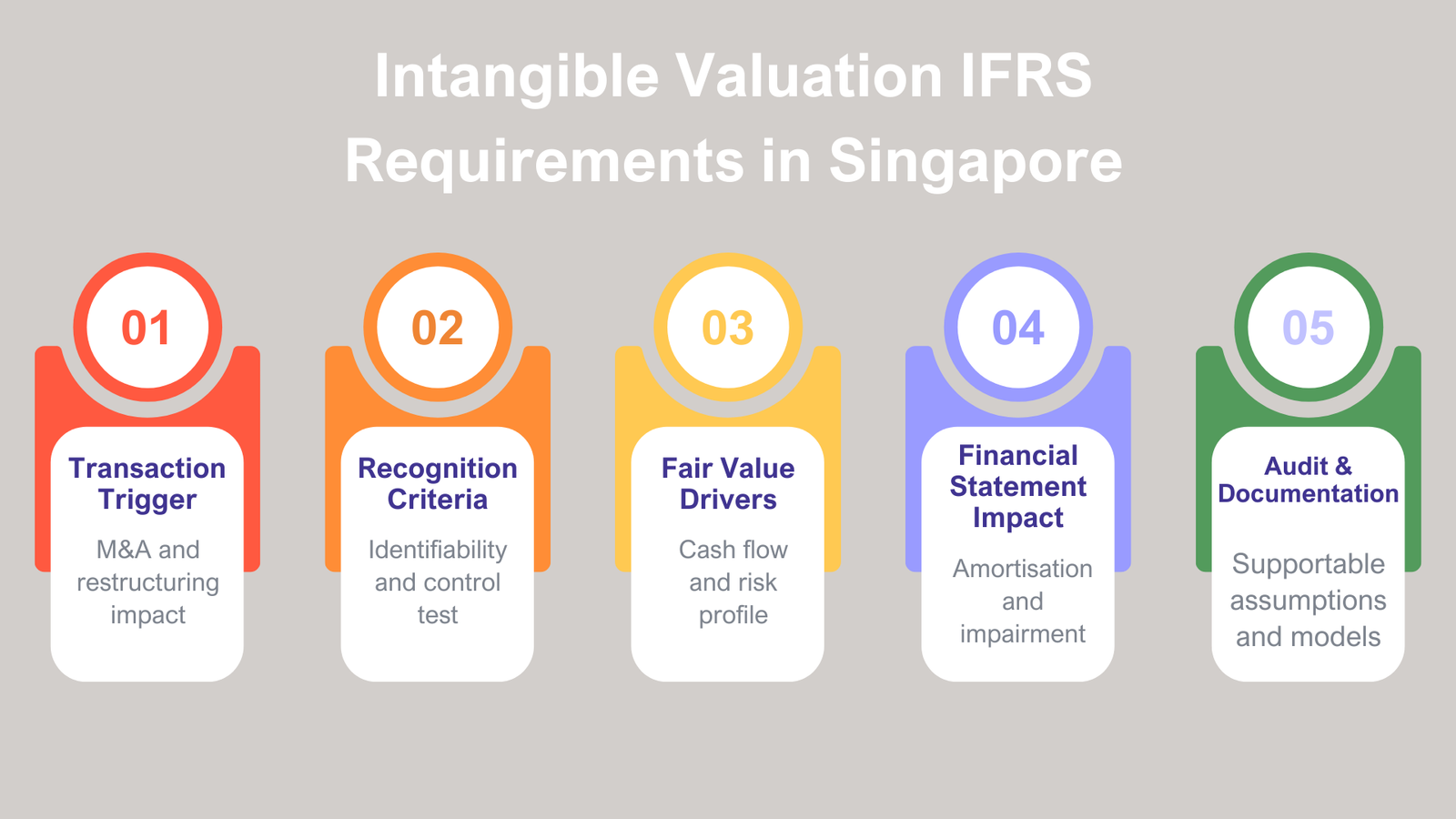
The first standard that will have an impact in the treatment of intangible assets during an acquisition is business combination IFRS 3. It also stipulates that the acquirer should use the method of acquisition, under which all identifiable assets acquired and liabilities assumed should be recognised and measured at their fair value at the time of acquisition intangible (and other asset) amounts. More importantly, IFRS 3 intangible valuation requires that intangible assets that pass the identifiability criterion be recognised separately regardless of whether such intangible assets had been recognised on the balance sheet of the acquiree.
This necessity is transformative in nature. A technology firm in Singapore that internally developed its customer platform will never have capitalised such platform under IAS 38 (which does not allow most internally generated intangibles to be capitalised). In the event of such a company being acquired, however, the platform will have to be recognised in the acquiring company as a separate intangible asset in its consolidated financial statements. This is also true of brands, customer lists, licences and non-compete agreements all of which can have zero carrying values on the books of the acquiree but has high fair values.
IFRS 13 — Fair Value Measurement
The IFRS 13 gives the general definition and measurement framework of fair value intangible assets. Under IFRS 13, fair value refers to the amount that is likely to be received to dispose an asset (or paid to transfer a liability) in a competitive and orderly transaction among market participants at a particular measurement date. It is the market-participant, exit-price notion, it is not the value to the particular acquirer, or the historical cost, or a distress value.
The IFRS 13 provides a three-level fair value hierarchy that will decide the observable inputs of a valuation:
Level 1: Active markets of the same assets quoted prices. Hardly the case with intangibles, which are generally unique and not subject to active transactions.
Level 2: Noticeable inputs not of Level 1 prices – e.g. similar royalty rates of licensing databases, or observed multiples of transactions of similar customer lists.
Level 3: Unobservable inputs that are based on the own assumptions of the entity, that are adjusted to the market participant assumptions. Level 3 is the most intangible valuation which needs a lot of documentation and support.
Level 3 classification implies that IFRS intangible valuation would be judgement-intensive in nature. It is the expectation of the auditors, regulators and investors that Level 3 valuations should be backed with rigorous models, defensible assumptions and transparent sensitivity examination.
The position of Valuation in Reporting Requirements
Under the IFRS, intangible valuation occurs in a number of points of the financial reporting life cycle:
Preliminary recognition (acquisition): Under business combination IFRS 3, all identifiable intangibles should be recognised at fair value at the entry date of the acquisition and separately recognised.
Subsequent measurement: According to IAS 38, intangibles, except those with indefinite useful life, are amortised; those with indefinite useful life are not amortised but are rather impaired annually according to IAS 36.
Impairment testing: IAS 36 mandates the annual impairment testing of goodwill and indefinite life intangibles and the impairment testing whenever impairment indicators of finite life intangibles are present.
Disclosure: both IAS 38 and IFRS 3 expect a large amount of disclosure about the nature, carrying amounts, amortisation methods, and important assumptions made in determining the valuations of intangible assets.
Under the IFRS, recognition criteria are as follows
Identifiability: Separable vs Contractual/Legal
Identifiable intangible assets as identified by the IFRS paradigm is based on the identifiability criterion. An intangible asset is identifiable where it passes either of the two tests:
Separability criterion: The asset can be separated or divided out of the entity and sold or transferred, licensed, rented or exchanged, either alone or along with a related contract, asset or liability. This condition does not state that the entity actually intend to sell or part ways with the asset, ability to do so suffices.
Contractual -legal criterion: The asset is created under contractual or other legal rights, with or without the transferability and separability of the rights and obligations. Some of the examples are a licence, patent, franchise agreement and a non-compete covenant.
Practically, the majority of intangibles that are found in the Singapore M&A transactions qualify at least one of these criteria. Customer relationships Customer relationships Customer relationships are not usually contractual, but are usually deemed separable since there are observable transactions in the market of purchasing and selling customer lists and books of business. Trade names would pass the separability test since the transactions of licensing and sale of brand names are commonly witnessed.
Differentiating Intangible and Goodwill
Under business combination of IFRS 3 the residual after measuring all identifiable net assets at fair value and deducting them to the total consideration paid is goodwill. It is the value that is added to the assembled workforce, synergies, market positioning and other drivers of value that are not identified and measured as discrete assets.
What is of critical importance is the difference between identifiable intangible assets and goodwill. Individually recognised intangibles are amortised – declining future reported earnings in an orderly and predictable manner. Goodwill is never amortised but may be impaired with potentially volatile charges. Separately identified intangibles tend to be more favourable to investors and analysts than undifferentiated goodwill, since they give some insight into the particular nature of the value obtained.
One of the mistakes made by Singapore SME acquisitions is to consider all excess purchase price as goodwill without conducting the process of identifying the intangibles required. This method is against the IFRS guidelines of intangible valuation and will be faced by auditors especially in cases of significant transactions.
Practical Implication to Singapore Companies
To Singapore firms, the recognition requirements have a number of practical implications:
In the case of technology and software-based businesses, they often have a large intangible value on their books, that cannot be recognised otherwise, and which has to be brought to light and recorded at the time of acquisition.
Firms in professional services (legal, accounting, consulting, etc.) can hold huge numbers of non-contractual relationships with clients that can be treated as identifiable intangible assets under the separability criterion.
The separate valuation of brands and customers relationship is almost always a requirement in retail and consumer brand acquisitions.
Classes of Intangible Assets Valued
Intangible valuation Singapore practice has a large variety of assets. The most frequently used in business combination and standalone valuation exercises are the following:
Brands and Trademarks
One of the biggest identifiable intangible assets of consumer facing businesses is brand equity. A Singapore brand, either a retail brand, a food and beverage concept or a professional services mark has an economic value in the form of recognition on the part of the customer, a premium price and a potential to generate revenue. Registered brands, which are legally established as trademarks, satisfy the contractual-legal requirement and have to be recognised separately under business combination IFRS 3. Unregistered brands that are independent of the entity (by virtue of license deals or sells) may be eligible.
Customer Relationships
Customer relationships denote the financial worth of the current clientele and anticipation of a further purchase or intercourse. They are also the most commonly occurring intangibles in Singapore M&A especially the financial services, professional services, retail, and subscription based companies. The separability criterion recognizes non-contractual relationships with customers; the criteria of both applied to contractual relationships (like retainer agreements or service contracts).
Customer relationship value is extremely sensitive to customer retention rates (attrition assumptions), revenue per customer and cost of acquiring a customer that would be incurred to replace the one leaving. These variables need special consideration of estimation in any fair value intangible analysis.
Technology and Proprietary software
In the case of technology firms, fintechs, and enterprises that have in-house developed digital infrastructure, often the most important source of value is the technology developed internally. The internally developed software and technology is not usually capitalised under IAS 38 (because of the difference of research/development stage and the limit of recognising the costs of development). Nonetheless, based on IFRS intangible valuation principles upon acquisition, acquired technology should be specifically recognized and valued at fair value intangible values.
Intangibles in technology consist of basic platform code, algorithms, databases, and online instruments. Their economic life is, as they remain, both technically obsolete and displaced by competition, a fundamental supposition in valuation.
Licensing Agreements
Favourable licensing agreements as either licensor or licensee may be material identifiable intangible assets under business combination IFRS 3. An asset is a below-market licence (a situation in which the acquiree pays less than the market rates to use an asset); an above-market licence (a situation in which the acquiree is paid more than the market rates) is also an asset in the eyes of the licensor. Regulatory licences – in Singapore, regulatory licences, e.g. MAS-established Capital Markets Services (CMS) licences, or Financial Adviser (FA) licences, can have considerable value in case they are transferable and limited.
Non-Compete Agreements
The non-compete covenants (breaching which sellers or key staff members can no longer compete with the acquired business after the deal) are seen to address the contractual-legal requirement and should be accounted as intangible assets under business combination IFRS 3. They are used to represent the economic damage that would otherwise be produced by the limited party were it able to operate freely, which is usually determined by the with-and-without technique, which calculates the present value of the cash flows that will be received in the future with and without the covenant being implemented.
Valuation Methodologies
Relief-from-Royalty (RFR) -For Brands
Relief-from-royalty is the prevailing method of fair value intangible measurement of brands and trade names in the intangible valuation Singapore practice. It determines the worth of an intangible asset based on the royalty payments that the owner is relieved to make it owns, and not licenses, the asset. The idea behind it is simple: in case the owner did not own the brand, he or she would have to license it at the market rates; capitalised value of the saved royalty was the fair value of the brand.
The method requires:
- The rate of royalty that can be supported, which is based on similar brand-licensing deals (based on databases like RoyaltyRange, ktMINE, or Bloomberg) or based on a top-down examination of brand contribution to revenue.
- Projections of revenue during the remaining life of the brand.
- Tax saving the royalty savings (Tax-deductible royalty payments are generally deductible).
- Risk-adjusted rate of discounting that is based on the risk profile of the brand.
Multi-Period Excess Earnings Method (MEEM) per Customer Assets
The Multi-Period Excess Earnings Method is the most desirable method of valuing the relationships with customers and other key revenue generating intangibles. Under MEEM, the value of the intangible is the present value of after-tax cash flows that can be attributed to intangible after the subtraction of fair returns of all other assets (tangible and intangible) that result in the generation of such cash flows. These deductions are called contributory asset charges (CACs) and are a unique and a technically challenging aspect of the method.
To make intangible valuation under the IFRS, MEEM needs:
- The forecast of customer revenue by vintage of cohort or relationship.
- The rate of attrition per year (by revenue) or as a percentage that is supposed to drive the customer base decadence over time.
- Contributory asset charge on all support assets (working capital, fixed assets, brand, workforce, technology)
- A customer specific risk-adjusted rate of discount.
- Within/Without/Incremental Technique.
The with-and-without approach is used to determine the value of the future cash flows taking the case where the entity is operating with the intangible and when the entity is operating without the intangible. The fair value of the intangible is the difference in the present value. This is mostly used in non-compete agreements, regulatory approvals, and favourable contracts, in which economic effect of removal can be directly modelled.
In the case of non-compete valuations in Singapore, the without-scenario usually models the competitive disruption period, which includes a period of declining revenues, compression of margins, and the reacquisition costs, which can be described as the economic damage that the seller might cause in case he is free to compete. The fair value of the covenant is the probability-weighted present value of such disruption.
Market and Cost Approaches
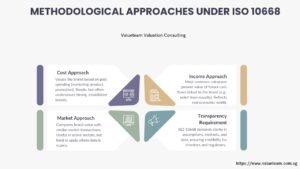
Where there is adequate similar transaction data, the market approach, i.e. where prices paid on similar intangible assets in perceived transactions are used takes place. The market data of the intangibles is usually limited in intangible valuation Singapore practice, especially in niche industries or proprietary assets. Nevertheless, market data are quite often employed to support the conclusions of the income approach especially with regards to brand royalty rates and multiple of customer relations.
The fair value of intangibles cannot be estimated by fair market value because they are determined using the cost method which uses costs to recreate or replace the asset adjusted to functional, technological and economic obsolescence. It best suits internally developed technology, built databases, and processes that proprietors are interested in that lack adequate market and income information. The cost approach is also commonly utilised to valence specialised software and ERP implementations.
Assumptions and Data of Valuation
Discount Rates and Risk Premiums
The discount rate used in intangible valuation is used to reflect the risk level on the cash flows that can be expected to be generated by the intangible. In IFRS valuation of intangibles, the Weighted Average Cost of Capital (WACC) of the acquired business is normally used as a starting point, whereby, risk-adjusted premiums on the assets are introduced to capture the risk profile of the individual intangible against the business as a whole.
The correlation between the asset-specific discount rates and the WACC is controlled by the principle of the Weighted Average Return on Assets (WARA) that validates the returns suggested by particular asset rates of discounts and the WACC. This is a significant quality check in any PPA – when the WARA significantly deviates with respect to the WACC then it indicates that there is a need to revise the discount rates or weights.
The Singapore risk-free rate (which is usually presented using the yields on the Singapore Government Securities) affects the discount rates of intangibles in Singapore, the equity risk premium, entity-specific risk adjustments, and the asset-class risk premiums. In 20242025 valuations, the increased interest rates have increased discount rates throughout the board and shrunk the intangible values as compared to 2022 levels.
Utilizable Life and Final Growth
The amortisation period of an intangible asset is based on the useful life of the asset and in valuations based on income the horizon within which cash flows are estimated. The useful life of an asset is finite (the asset is amortised) or indefinite (the asset is tested annually against impairment) under IAS 38. Most intangibles are put under finite useful lives at acquisition as per the purposes of business combination IFRS 3.
The identification of useful life will involve an examination of the nature of the asset, past experiences of similar assets, contractual conditions (in case of legally-bounded assets) and competition. Technology intangibles in Singapore have an average useful life of three to seven years, as the technology cycles are relatively short and customer preferences change very fast, whereas an established brand and long-established customer relations might justify a useful life of between ten to twenty years or more.
Revenue Forecasts and Attrition Analysis
Income-based intangible valuations actually focus on the projections of revenues. The projections used under the IFRS unexposure valuation standards of intangibles should reflect those of the market participants not the particular synergy expectations of the acquirer. This implies that the forecast of revenue must represent what a hypothetical market participant would forecast the asset on a standalone basis prior to taking into consideration the integration benefits.
Attrition analysis – the process of modelling customer churn, contract expiry, or technological obsolescence – is also paramount as well. In the case of customer relationship valuations, the annual attrition rate is the most influential assumption, frequently. It must be based upon the historical data of the acquirer (where available), compared to industry standards, and put through stress test under sensitivity analysis. When there is limited data about the targeted company (typical in the case of acquiring a private company), practitioners have to use estimates of management, supported by the third-party industry research and other similar transactions.
Audit and Regulatory Considerations
Documentation Expectations
Regardless of IFRS intangible valuation standards and the Singapore regulatory expectations, the quality of valuation documentation is equal to the technical rigour of the analysis itself. Auditors are mandated to have a written report of valuation which effectively explains the extent of the engagement, assets to be valued, methods used, major assumptions and their source, analysis of sensitivity and a reconciliation of the aggregate amounts of all fair-valued assets and liabilities to overall consideration.
In relation to material acquisitions, the Singapore Exchange (SGX) might demand fairness opinions or valuation disclosures among Singapore-listed companies. Such disclosures undergo the scrutiny of the public and they should be able to withstand the test of scrutiny of analysts, minority shareholders, and regulators.
Accounting and Corporate Regulatory Authority (ACRA) has indicated that more attention is to be paid to the quality of acquisition accounting in Singapore, as well as sufficiency of the identification and measurement of intangible assets. Regulatory scrutiny may be targeted at companies that in their financial reports show an insufficient PPA, such as where they assign materially all purchase price to goodwill.
ACRA / SGX / MAS Focus Areas
The three main financial regulators Singapore has three main financial regulators all with different but overlapping interests in intangible valuation Singapore practice:
ACRA: Devotes attention to the quality of financial reporting in general, with respect to whether the recognition of intangible assets is adequate, and that sufficient explaining the application of IFRS 3 has been disclosed in audited accounts.
SGX: Listed issuers are obligated to make extensive disclosure in respect of material acquisitions including, where necessary, independent valuations required by the Listing Rules. SGX Regulation has been putting more emphasis on the quality of goodwill and disclosures of intangible assets in annual reports.
MAS: MAS also assumes that valuations that justify regulatory capital adequacy, licensing decisions or that valuations that justify investment suitability determinations should be undertaken to high professional standard in the case of financial institutions and capital markets entities.
Independent Expert Support
It is highly advisable that material identifiable intangible assets in Singapore accounting of acquisition should be engaged to an independent valuation expert instead of the management internal valuation. Independent experts offer credibility, methodological expertise and audit efficiency. They also play a role to counterbalance the management bias in which projections and assumptions are made based on the views of the market-participants as opposed to the optimistic rationales of the deal.
Singapore Qualified specialists of intangible valuation engagements typically qualify as Chartered Valuer and Appraiser (CVA), CFA charterholder, Chartered Accountant (CA Singapore), or as a member of a professional organisation, such as RICS or ASA (American Society of Appraisers).
Case Study Singapore Situation
When: Hypothetical Acquisition of a Singapore Fintech Platform
In order to demonstrate the applicability of IFRS principles in intangible valuation to a practical situation, we would like to take the following hypothetical situation with an acquisition:
The intangible assets identified in the PPA exercise of PayStar include:
| Intangible Asset | Method Used | Key Assumptions | Fair Value (S$M) |
| Technology platform | Relief-from-Royalty | 4% royalty rate; 5-yr life; WACC+2% discount | S$12.0M |
| Customer relationships | MEEM | 12% annual attrition; 8-yr horizon; WACC+3% | S$10.5M |
| MAS licence (transferable) | With-and-Without | 18-month re-licensing delay modelled | S$3.5M |
| Brand name “PayStar” | Relief-from-Royalty | 1.5% royalty rate; 10-yr life | S$4.0M |
| Non-compete (founders) | With-and-Without | 3-yr restriction; 15% revenue-at-risk | S$1.5M |
| Total Identifiable Intangibles | S$31.5M | ||
| Residual Goodwill | Synergies, workforce, market positioning | S$8.5M |
The Applicability of Methods in this Case
In the PayStar case, the technology platform and brand are appraised to the relief-from-royalty technique with references to observed royalty rates based on IFRS intangible valuation databases. Customers relationships are with MEEM, the attrition rate is based on a cohort of the customer of PayStar itself over a period of three years. With-and-without modelling is applied in the MAS licence and non-compete agreements, which are based on the regulatory and competitive specifics of a Singapore fintech.
The outcome is goodwill balance of S 8.5 million which constitutes 19 percent total consideration as opposed to S 40 million (89 percent) that would have occurred otherwise without the intangible identification exercise. This is a radically different image of the acquisition and explains why strict compliance with business combination IFRS 3 provisions is important on the integrity of financial reporting.
Popular Difficulties and Pitfalls
Data Scarcity
The lack of reliable data is one of the most enduring issues in the intangible valuation Singapore practice especially when it comes to the acquisition of a privately held company. The projections of the revenues might be restricted to two or three years of managerial accounts; the data on customer attrition might never have been systematized; there might be no similar brand royalty rates in niche sectors.
To deal with the data scarcity, a set of strategies should be employed: using management estimates as the initial point, adjusting them to the industry standards and to third-party studies, making relatively safe adjustments in the case of a high level of uncertainty, and report the findings with well-defined ranges of sensitivity. In the case of an absence of data upon which a particular methodology is not justified, an alternative approach (such as the cost approach) can be suitable.
Over-Optimistic Forecasts
The enthusiasm of the deal often permeates the financial projections applied in intangible valuations. The fair value of intangible amounts will be overstated by revenue forecasts that incorporate the expectations of the acquirer in its synergy instead of its assumptions in the market as a participant of the market. According to the standards of intangible values valuation in the IFRS, the valuation should be made under the assumptions that are market-related and not specific to the acquirer.
This risk particularly attracts the attention of the auditors and they regularly make comparisons between PPA projections and the historical performance of the acquirer prior to the acquisition, projections made in the acquisition due diligence and actual results thereafter reported by the management throughout the measurement term. In situations where the projections in the PPA have significant differences with the post-acquisition actuals the auditors might need revision or impairment.
Method Misuse
Using an inappropriate approach to valuing a particular intangible, such as a cost approach to a customer relationship a relationship (where income-based MEEM is the most commonly used method) or relief-from-royalty on a non-compete agreement (where with-and-without is the most appropriate method), gives the false impression of reliability and creates audit risk.
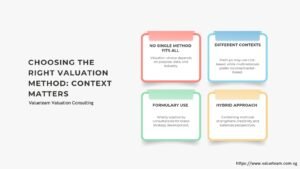
The choice of the method should be based on the nature of the intangible, the kind of economic benefit it creates, as well as the presence of corresponding market data. Where feasible primary conclusions should be corroborated with the help of a secondary methodology.
Conclusion
Strategic Value of Intense Intangible Appraisal
Strict Singapore practice of intangible valuation is not only a check-compliance requirement, but also a source of strategic intelligence. An exhaustive intangible asset identification and valuation exercise informs the management, investors and regulators what, at what value and why it was acquired. It forms the basis of post acquisition performance monitoring, integration planning as well as capital allocation decisions.
In the case of Singapore companies, in a jurisdiction where transparency and professional conduct and investor trust are the key to business success, the quality of intangible valuation in the acquisition accounting is a direct indication of the credibility of the management. Those companies which are serious about their IFRS intangible valuation and Purchase Price Allocation Requirements are showing the discipline and rigour that are desired by institutional investors and sophisticated counterparties.
Correlation With Shareholder Needs
Investors and analysts are increasingly questioning the quality of disclosure of intangible assets as a proxy of acquisition quality. A balance sheet with undifferentiated goodwill, that has little separately identifiable identifiable intangible assets, implies that the acquiring company has not obtained a complete grasp, or has otherwise chosen not to reveal, what it actually purchased. On the other hand, comprehensive schedules of intangible assets with well defined assumptions and amortisation policies are indicative of transparency and analysis.
The trend of making intangibles more disaggregated, improving the quality of disclosure and increasing the rigor of fair value measurement is clear in both IFRS standards of intangible valuation. It is companies in Singapore, and also in the region, who develop the capacity and the professional relationship they need to make the high quality intangible valuation that will be better placed to meet such expectations, retain investor confidence and be able to report the true value of their acquisitions in an integrity manner.
The skill of quantifying and reporting intangible value is not simply another accounting art in a world where the most prized resources are not reported on the balance sheet until their acquisition throws them into the limelight. It is a competitive advantage.