How Brand Reputation Drives Customer Loyalty and Growth
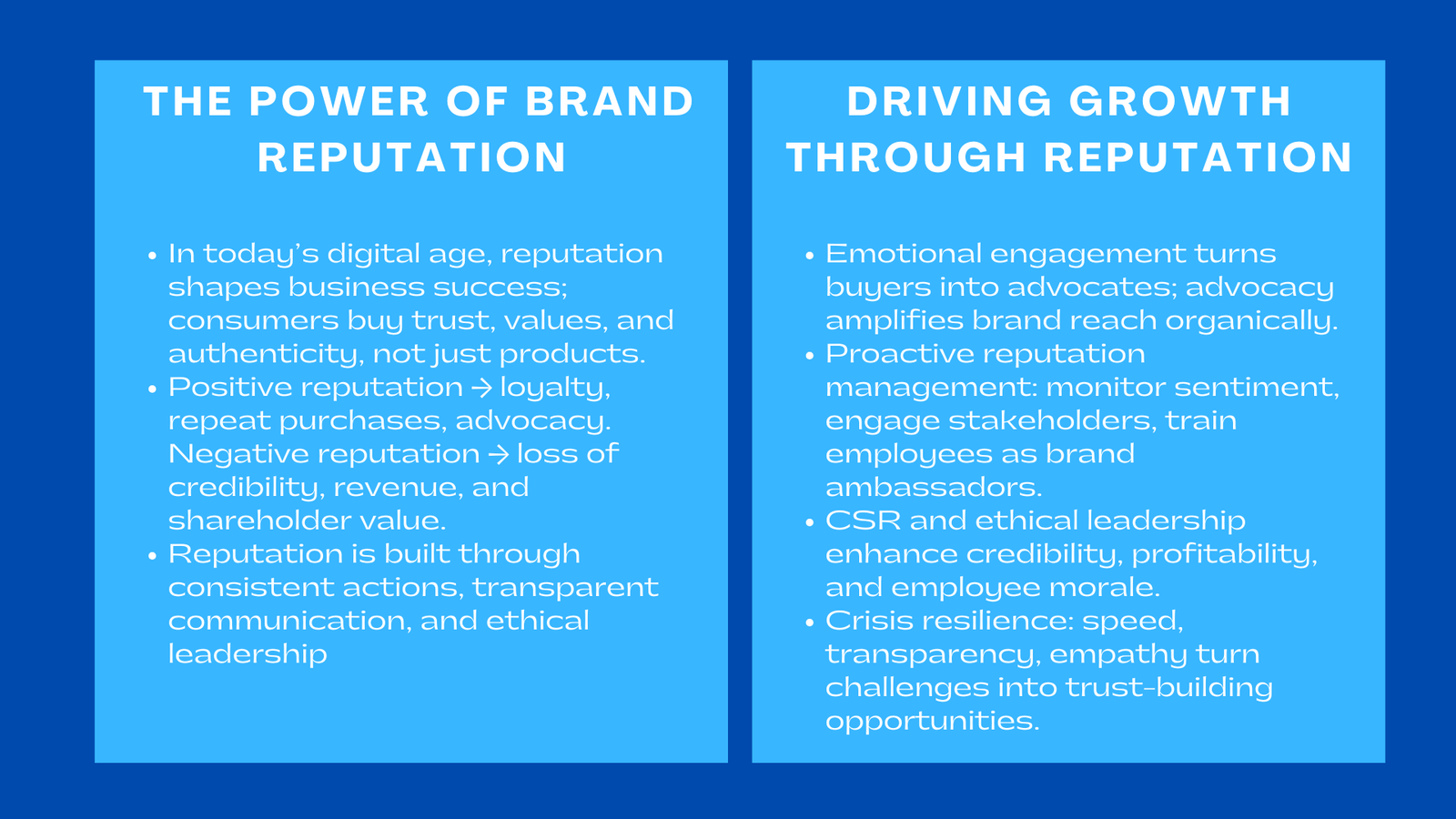
In today’s hyper connected and transparent marketplace, brand reputation has become one of the most powerful determinants of business success. The digital age has given consumers unprecedented access to information, allowing them to evaluate a company’s behavior, ethics, and performance in real time. In this environment, reputation can make or break a business. Consumers no longer simply purchase products — they purchase trust, alignment of values, and authenticity. A strong reputation equates to loyalty, repeat purchases, and advocacy, whereas a damaged reputation can undo years of progress and investment.
Reputation is the mirror that reflects what customers truly think and feel about a brand. A positive reputation attracts and retains customers, strengthens investor confidence, and provides a protective shield during crises. Conversely, a negative reputation can erode credibility, drive customers away, and destroy shareholder value almost overnight. In the modern business landscape, the importance of brand reputation management for customer loyalty Singapore cannot be overstated — it influences every stage of the customer journey and every stakeholder relationship.
Brand reputation is the accumulated perception of customers based on their collective experiences, social interactions, and perceptions of corporate ethics. It is built over time through consistent actions, transparent communication, and responsible leadership. Importantly, reputation is shaped not only by marketing messages but also by everyday business decisions — how leaders act, how employees behave, and how the company contributes to the community.
In essence, reputation functions as the emotional currency of a business — a form of trust capital that must be earned and protected. Just like financial capital, it compounds over time when handled responsibly. Brands that remain transparent, authentic, and accountable cultivate deep emotional connections, transforming casual buyers into loyal advocates. Over time, this emotional equity becomes a competitive moat that is difficult for rivals to replicate, driving long-term growth and resilience.
The Link Between Reputation and Loyalty
Trust as the Cornerstone of Loyalty
Trust is the foundation upon which loyalty is built. Customers are inherently drawn to brands that they believe in — those that demonstrate honesty, reliability, and consistency. Research from Edelman’s Trust Barometer consistently shows that trust is now a deciding factor in purchase intent, often ranking higher than price or product quality. Understanding the benefits of brand valuation in Singapore can further strengthen trust, as it provides transparency and insight into a brand’s value and credibility. When customers trust a brand, they are more willing to forgive mistakes, recommend products, and remain loyal even in the face of competitive alternatives.
This is because trust offers emotional assurance. Consumers feel secure knowing that their purchasing decision aligns with their beliefs and values. A trusted brand provides a sense of stability in an uncertain world — a psychological comfort that reinforces habitual buying behavior.
Take Toyota, for instance. Even after global recalls, the brand retained its customer base because its long-standing reputation for reliability and integrity outweighed temporary setbacks. The same applies to Patagonia, whose environmental activism and authenticity have transformed customers into lifelong supporters rather than one-time buyers.
Trust, however, must be earned through consistent performance. It is built incrementally through repeated positive experiences and transparent communication. A single breach of trust — whether from misleading advertising, unethical practices, or poor customer service — can undo years of progress.
Transparency and Consistency as Loyalty Drivers
Transparency and consistency are critical in sustaining loyalty over time. When a brand’s actions align with its promises, consumers recognize authenticity. This alignment creates confidence and emotional security — the feeling that a brand is dependable in both good and bad times.
Transparency becomes particularly valuable during crises or periods of uncertainty. Brands that address issues openly, provide clear explanations, and outline corrective actions often emerge stronger than before. Johnson & Johnson’s Tylenol crisis remains a benchmark case — the company’s open and responsible handling of a life-threatening issue not only saved its reputation but strengthened it.
Consistency, on the other hand, reinforces recognition and reliability. Whether it’s in visual identity, customer experience, or messaging tone, every element should reflect a unified brand personality. Customers who encounter consistent experiences across platforms develop unconscious trust — they know what to expect and what the brand stands for.
Inconsistent messaging or shifting values, by contrast, can confuse audiences and erode credibility. Maintaining consistency across global operations, product lines, and communication channels is therefore a hallmark of mature, trustworthy brands.
Emotional Engagement and Brand Advocacy
While transactional loyalty is driven by satisfaction, emotional loyalty stems from genuine attachment. Customers who feel emotionally connected to a brand are not just repeat buyers — they become vocal advocates. This emotional dimension transforms the relationship from business to belonging.
Brands that foster emotional engagement do so by connecting with deeper human motivations — purpose, identity, and community. For instance, Nike’s “Just Do It” campaign resonates because it empowers consumers to associate personal achievement with the brand itself. Similarly, Apple has built a tribe-like following by framing innovation and creativity as shared values.
Advocacy, in this sense, is the highest form of loyalty. It transforms customers into ambassadors who promote, defend, and humanize the brand organically. In the digital era, this word-of-mouth influence carries greater credibility than traditional advertising, amplifying brand reputation exponentially through authentic voices.
Managing and Protecting Brand Reputation
Proactive Reputation Management
Proactive management is the cornerstone of reputation protection. It requires constant monitoring, engagement, and agility. Instead of reacting to crises after they escalate, leading brands track public sentiment continuously using analytics, social listening, and stakeholder feedback.
By detecting shifts in perception early, companies can address concerns before they spread. A brand that engages constructively with customers, responds to feedback, and demonstrates accountability reinforces trust rather than risking damage.
For example, Starbucks’ response to public criticism over inclusivity issues involved rapid action, staff retraining, and transparent communication — turning potential reputational harm into a demonstration of corporate responsibility.
Proactive management also includes training employees as brand ambassadors, ensuring that internal behavior reflects external promises. Since employees are often the first line of brand representation, their actions significantly influence how customers perceive integrity and credibility.
Corporate Social Responsibility and Ethical Leadership
In the modern era, corporate social responsibility (CSR) is not a bonus — it’s an expectation. Consumers, investors, and regulators demand accountability from the companies they support. Ethical leadership, sustainability, and social impact now serve as defining elements of brand reputation.
When companies demonstrate environmental stewardship, fair treatment of workers, and involvement in social causes, they signal authenticity and integrity. Brands like Unilever, Ben & Jerry’s, and Microsoft have proven that ethical leadership not only enhances public image but also drives profitability and employee morale.
In Singapore, CSR initiatives such as sustainability reporting and community partnerships are increasingly viewed as measures of corporate maturity. Companies that integrate ethical values into their core strategy not only attract customers but also win the trust of employees, partners, and regulators — creating a powerful ecosystem of goodwill.
Crisis Communication and Resilience
Every brand faces moments of scrutiny. The difference between recovery and ruin lies in how that moment is managed. Effective crisis communication is built on three principles: speed, transparency, and empathy.
Brands must communicate quickly to control narratives before misinformation spreads. They must be transparent in acknowledging errors and outlining remedies. And they must show empathy — putting customer well-being and public interest above corporate image.
Companies that follow these principles often transform crises into opportunities to demonstrate responsibility and leadership. In doing so, they don’t just protect their reputation — they enhance it.
The Business Value of a Strong Reputation
Reputation as a Strategic and Financial Asset
Reputation is not an abstract ideal; it’s an economic driver that impacts profitability, valuation, and market resilience. A brand with a strong reputation can charge premium prices, attract better partnerships, and secure customer loyalty with lower acquisition costs.
Investors recognize reputation as a critical factor in long-term value creation. According to studies by Interbrand and Brand Finance, up to 30–40% of a company’s market capitalization can be attributed to intangible assets like brand reputation.
This perception-based value becomes even more important during economic downturns. While weaker brands struggle to retain customers, reputable ones maintain stability because loyalty cushions revenue volatility.
Reputation and Competitive Advantage
A strong reputation acts as a moat against competition. It gives brands the benefit of the doubt in times of uncertainty and sets them apart when products or prices are similar. Consumers gravitate toward brands that have proven trustworthy over time, while partners and suppliers prefer associations that enhance their own credibility.
In Singapore’s competitive environment, where businesses operate in highly informed and socially aware markets, reputation is often the ultimate differentiator. It influences not just sales but talent acquisition, regulatory trust, and investor interest.
Reputation Fuels Innovation and Growth
Reputation also accelerates innovation adoption. Customers are far more willing to try new offerings from brands they already trust. Apple’s product launches, for instance, consistently draw immediate demand not merely due to novelty but because of trust in its quality and ecosystem reliability.
Likewise, Tesla’s reputation for innovation and sustainability drives consumer anticipation and advocacy, reinforcing its market leadership. This trust-driven innovation cycle shows how reputation amplifies growth opportunities and cements competitive dominance.
Conclusion
Reputation is not merely a reflection of public opinion — it is the heartbeat of sustainable success. It defines how customers, investors, and employees engage with a company and influences every aspect of business performance.
A strong reputation fosters customer loyalty, drives retention, and transforms perception into advocacy. It shields the business during crises, enhances brand equity, and attracts stakeholders who share similar values. Over time, how transparency and ethics build long-term brand trust, consistent ethical behavior, transparent communication, and responsible leadership convert reputation into a renewable source of competitive energy.
In the long term, reputation becomes a form of invisible capital — one that cannot be replicated through marketing alone. It is the bridge between perception and performance, between words and action. Companies that protect and nurture their reputations cultivate a reservoir of trust that sustains them through market turbulence and industry evolution.
Ultimately, reputation is what remains when marketing stops and actions speak for themselves. It fuels customer loyalty, inspires advocacy, and ensures that a brand’s legacy endures beyond products or trends. In a world where every interaction shapes public perception, the brands that thrive are those that understand one simple truth: reputation is not built by what you say — it’s built by what you consistently do.