ESG Compliance and Brand Reputation
Introduction to ESG Compliance and Brand Reputation
Environmental, Social, and Governance (ESG) aspects have gained relevance to the role of corporate reputation assessment by global stakeholders, but there are numerous organisations that fail to implement ESG standards properly. Although the strategic importance of the ESG integration is a generally accepted fact, there are operational and reporting challenges that establish an ongoing challenge that directly affects the brand credibility. This paper reviews the definite challenges business organizations encounter in their efforts of trying to convert ESG pledges to quantifiable deliverables that enhance brand equity. The growing demands of the investors, regulators and customers heighten the significance of accurate, transparent and consistent ESG reporting as a significant component of corporate reputation management. Nevertheless, the gap between promise and delivery continues to be a big gap in multinational organisations having varying organisational structure, and regulatory environment. These barriers must be comprehended by those companies that would like to attain a real ESG maturity and safeguard their reputational positions in the most competitive markets, especially when supported by a Corporate ESG training Singapore firm that helps translate ESG commitments into measurable actions.
1. Structural Difficulties in the Way of ESG integration.
1.1 Disjointed Regulatory Frameworks.
It is common to find discrepancies among international ESG guidelines, and such inconsistencies make implementation a challenge to companies. Disparate reporting structures, and inconsistent materiality standards, and fluctuating disclosure requirements necessitate a lot of interdepartmental co-ordination. This disintegration makes internal governance processes more difficult and in most cases the adoption of ESG is only partial undermining the credibility of the public commitments.
1.2 Organisational Misalignment and a Lack of Accountability.
Absence of cohesive ESG ownerships in leadership teams compromises implementation. Different departments have varying interpretations of the ESG priorities leading to disconnect efforts and inconsistency in reporting. Lack of accountability means that the ESG programs lack momentum and are not able to deliver the quantifiable outcomes to reinforce the brand reputation.
2. The challenges of data and measurement.
2.1 Weakness in Data Systems to monitor ESG.
ESG reporting needs reliable, consistent and auditable data. Most organisations do not yet have data systems that are integrated to capture performance indicators in the environmental measures, workforce practices, and governance standards. Lack of strong data capacity renders the ESG reporting to be more reactive than strategic rendering its impact less potent in building its reputation.
2.2 Difficulty of Measuring Qualitative Factors of ESG.
The social impact, reputation and ethics are all measurements that are not easy to measure. When investors become more and more demanding about tangible steps of ESG advancement, businesses fail to make their qualitative success measurable. Such a measurement gap does not allow ESG communication to contribute to the brand story benefit in terms of credibility as much as possible, which restricts the benefits in the reputation in the long term.
3. The Strategic Role of ESG in Brand Strength
3.1 Stakeholder Expectations for Responsible Conduct
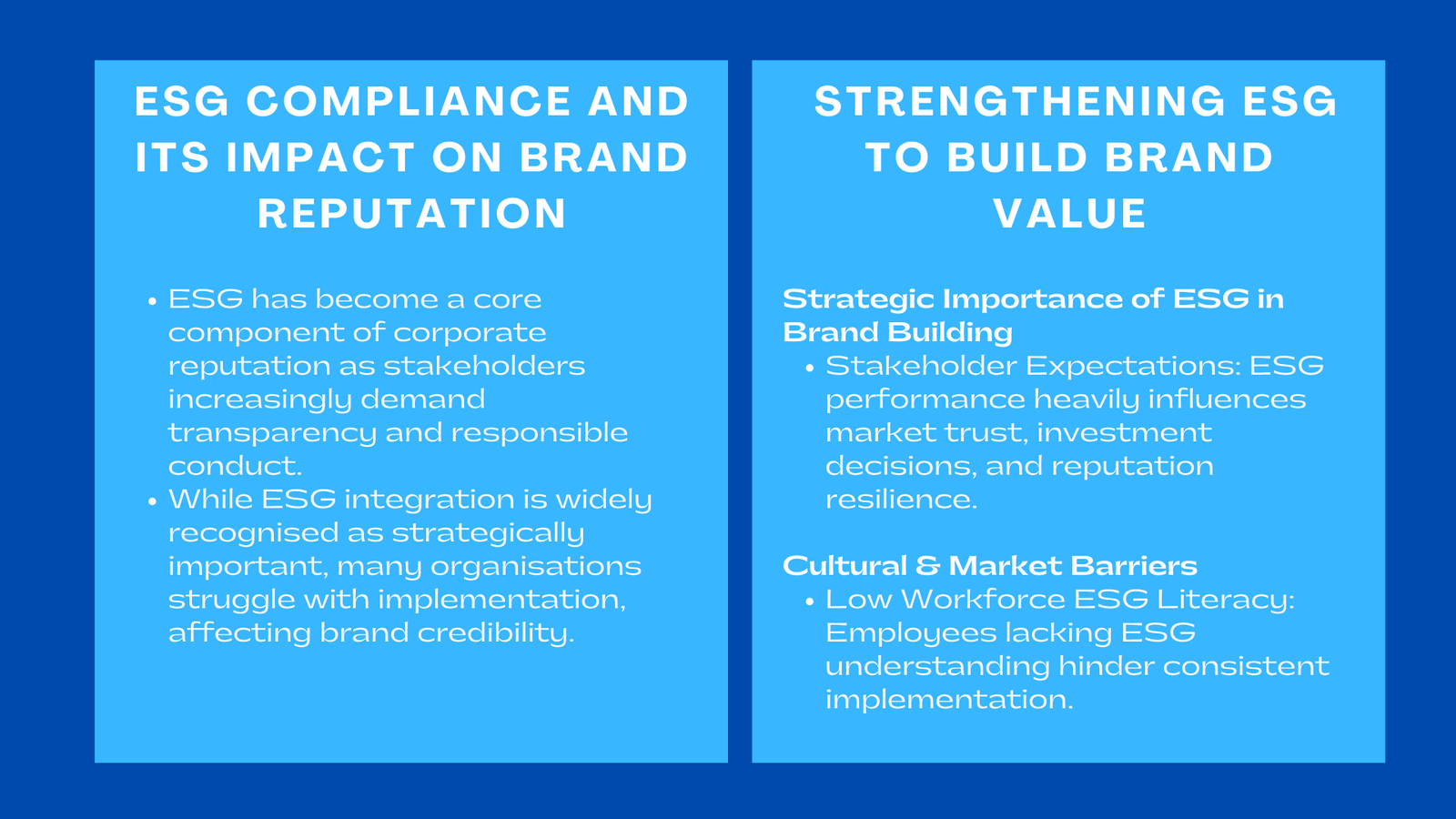
Customers, investors, and regulators increasingly evaluate companies through the lens of ESG performance. Demonstrating leadership in sustainability, labour practices, and compliance strengthens trust and elevates market positioning. In this context, ESG compliance brand value becomes a core determinant of reputation resilience, influencing both market preference and investment attractiveness.
3.2 Linking ESG Performance to Reputation Outcomes
Firms that report genuine ESG improvement tend to have a high loyalty towards their stakeholders. Credibility however lies in transparency and quantifiable reporting. Associating ESG performance with brand positioning helps organisations to support a reputation established through responsibility and long-term value generation.
4. Difficulties in Incorporating ESG in Corporate Culture.
4.1 Low ESG Literacy of the Workforce.
The staff would not have enough knowledge of ESG principles which would lead to inconsistent implementation of the same within the business functions. The training programs are often poorly developed, which does not allow the staff to consider ESG when making their daily decisions. The culture difference undermines the credibility of ESG commitments and diminishes their brand-enhancing capabilities.
4.2 Resistance to Behavioural and Operational Change
The application of ESG standards implies operational changes, which can interfere with the workflow. When sustainability efforts are looked at as a cost centre as opposed to value drivers, resistance is likely to arise. This intra organizational conflict slows down ESG integration and minimizes chances to improve brand reputation on the basis of better sustainability performance.
5. Centrality Problems that are weakening the credibility of ESG.
5.1 Overstatement as well as Greenwashing risk.
The need to look ESG-congruent causes certain companies to exaggerate success. The nature of inaccurate or exaggerated claims poses the risk of a reputational harm in case the regulators, the media, or activist groups discover the discrepancy. Accuracy and transparency is hence crucial in order to maintain the integrity behind ESG-based brand stories.
5.2 Weak Stakeholder Communication Strategy.
Even in the cases when organisations are running the ESG initiatives successfully, the stakeholders cannot realise the impact due to the communication gap. Organisations are not able to build brand reputation without clear messaging that makes ESG performance correlated with business outcomes. The integration of Sustainable branding strategy Singapore helps demonstrate how structured communication supports credibility in markets that prioritise responsible business practices.
6. External Market Pressures Affecting ESG Implementation
6.1 Competitive Pressures and Resource Constraints
In intense markets, the competing priorities tend to pull resources off the ESG programs. Firms in the highly competitive industries might focus fewer resources on sustainability investments compared to the short-term performance indicators, undermining the strength of the resilience of brand reputation in the long term.
6.2 Regulatory and Disclosure Risk.
Regulators are on the rise ensuring that ESG claims and the accuracy of reporting are taken into consideration. Those companies which do not comply are punished, criticized publicly, and damaged in terms of reputation. The difficulties of compliance are also higher in medium-supplies chain industries where the transparency is low and the company cannot easily keep a reputable public ESG image.
7. Enhancement of Brand Reputation through Strengthening of ESG Governance.
7.1 Establishing Strong ESG Supervisory Frameworks.
Having well laid governance structures with responsibilities enables a uniform implementation in operations worldwide. Committees that are specifically devoted to ESG, the executive-level control, and the effective mechanisms of audit control make sure that the sustainability actions are performed in accordance with the committed statements of the organisation.
7.2 ESG Metrics: Incorporation into Strategic Planning.
Incorporating ESG metrics as part of strategic planning creates better accountability and makes it compliant with the long-term corporate policy. As the ESG factors influence the investment allocation, product development, and risk assessment, enterprises can attain more authoritative and effective sustainability performance, which strengthens brand faith.
Conclusion
Making significant ESG compliance is a complicated task, but a crucial condition of contemporary brand image. The barriers to operations, such as the regulatory fragmentation and data constraints as well as the cultural resistance and the communication gap, need to be tackled in a systematic manner to release the entire reputational value of ESG integration. Organisations that have made investment in strong governance systems, open reporting, and alignment will be at a better position to enhance brand equity in a competitive global world. In order to reinforce further the ESG-driven brand reputation, firms should adopt a continuous improvement model that is backed up by high quality information, inter-functional cooperation, and open communication with the stakeholders. Due to the changing nature of markets, organisations that are proactive in integrating ESR will win over their rivals by exhibiting resilience in the long term, capacity to lead with ethics and exercise discipline in operations. Such capabilities build credibility in addition to making the brand a responsible industry reference point with the potential to provide sustained value. Moreover, the long-term investment in ESG capabilities helps the companies to predict a change in regulations, reduce the emergent risks, and enhance the confidence of investors. With a long term orientation to strategic planning and operational performance, organisations are more visible in terms of brand and reputation stability in the world that grows progressively competitive. Such proactive attitude eventually helps sustainable corporate reputation.