ESG Trends Affecting Brand Value
In the contemporary business landscape, Environmental, Social, and Governance (ESG) considerations have evolved from being peripheral reporting metrics into central drivers of corporate strategy and brand value. No longer optional disclosures, ESG factors have become integral in shaping investor decisions, consumer perceptions, employee engagement, and regulatory evaluations. Stakeholders increasingly assess companies not only on financial performance but also on ESG track records, reflecting a fundamental shift in market expectations. Companies are now judged on their ability to operate sustainably, ethically, and responsibly while maintaining profitability.
ESG performance has a measurable ESG impact on brand valuation, influencing both how a brand is perceived and its tangible financial outcomes. Organizations that integrate ESG successfully are viewed as credible, responsible, and forward-looking, strengthening brand equity, fostering customer loyalty, attracting investors, and enhancing long-term profitability. Conversely, companies that fail to adopt ESG principles risk reputational damage, reduced stakeholder trust, lower consumer preference, and diminished market valuation.
The evolution of ESG from optional reporting to strategic necessity underscores the convergence between financial and non-financial performance. ESG integration enables operational efficiency, innovation, and long-term strategic advantage. Companies that anticipate and act on ESG trends position themselves as leaders in sustainability and market performance, achieving resilience in increasingly complex global markets.
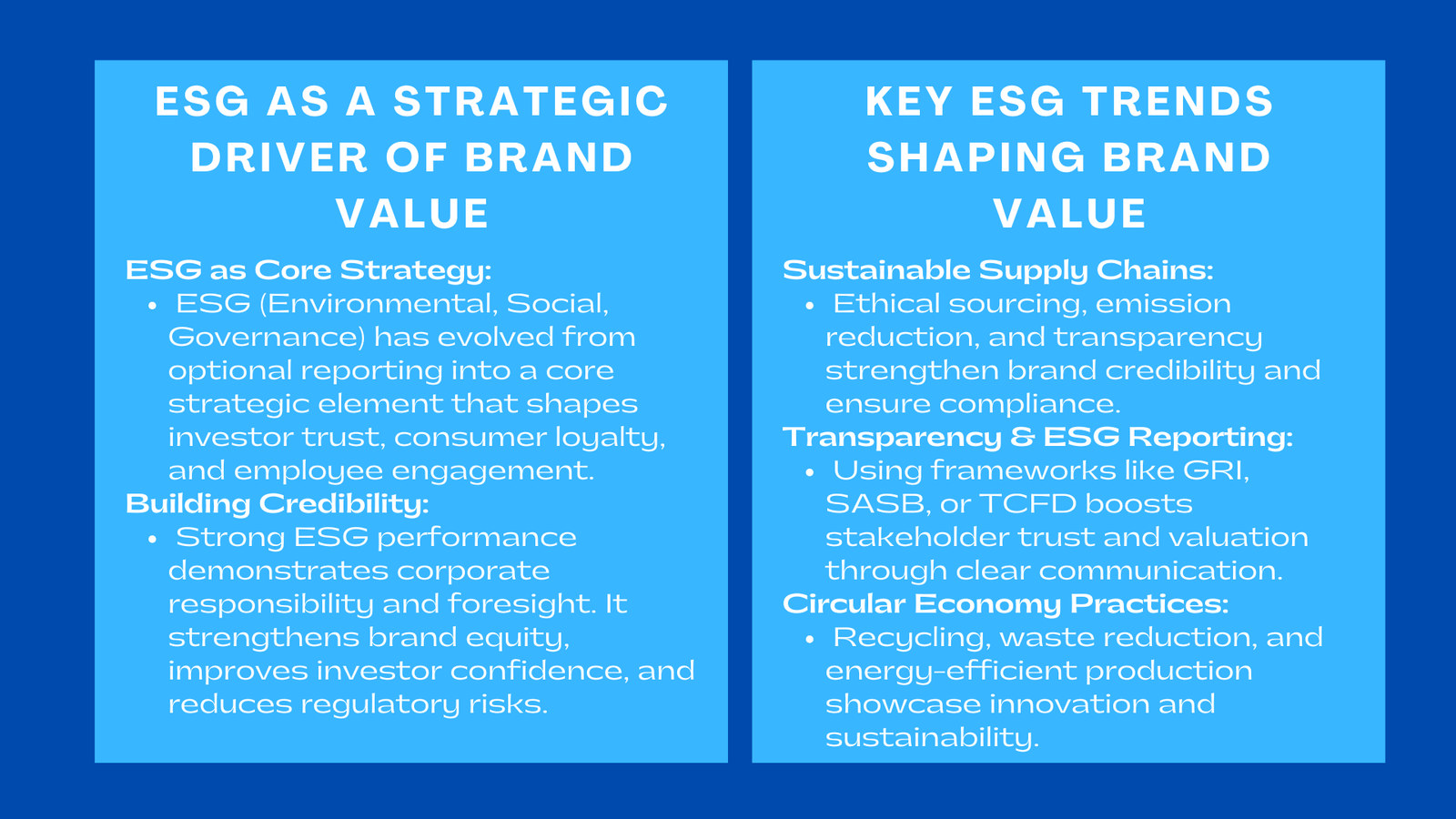
ESG as a Strategic Driver of Brand Value
Beyond Compliance: ESG as a Core Strategy
ESG is no longer just a compliance requirement or reporting initiative; it has become a strategic lever that informs key operational, marketing, human resources, and investor relations decisions. Companies that embed ESG into core strategies gain multiple advantages, including enhanced credibility, stronger stakeholder relationships, and improved financial performance. ESG-driven brands differentiate themselves by demonstrating responsibility, foresight, and alignment with societal values, which is why many organizations now seek ESG services Singapore for corporate sustainability strategy to effectively integrate these principles into their long-term business planning.
Building Credibility through ESG Performance
Strong ESG performance signals corporate responsibility, resilience, and forward-thinking management. Brands that are perceived as environmentally conscious, socially responsible, and well-governed gain credibility with investors, consumers, regulators, and the broader community. This credibility is especially valuable in highly scrutinized industries such as energy, manufacturing, finance, and consumer goods.
For example, companies implementing rigorous environmental standards, ethical sourcing practices, and transparent governance demonstrate discipline and foresight. This not only strengthens operational stability but also enhances investor confidence, reduces regulatory risk, and supports higher brand valuation. ESG credibility builds trust over time, positioning a company as a reliable and responsible market player.
ESG Influence on Consumer Loyalty
Consumer behavior is increasingly influenced by a company’s ESG performance. Shoppers are more likely to choose brands that align with their values, and consistent ESG commitment fosters emotional connection, trust, and loyalty. Brands that demonstrate environmental responsibility, ethical labor practices, and social engagement often enjoy higher retention rates, increased word-of-mouth advocacy, and greater willingness to pay premium prices.
Over time, these consumer behaviors translate into predictable revenue streams and enhanced brand equity. A positive ESG reputation reduces customer churn, amplifies lifetime value, and directly contributes to financial brand value. Companies that fail to prioritize ESG may face customer attrition, negative publicity, and lower engagement, which can ultimately erode both brand equity and financial performance.
Investor Confidence and ESG
Investors increasingly integrate ESG considerations into valuation, risk assessment, and capital allocation decisions. Companies with robust ESG practices often benefit from lower cost of capital, higher investor confidence, and more stable stock performance. Institutional investors regard strong ESG performance as indicative of effective risk management, compliance, and long-term resilience.
For example, firms that excel in ESG reporting may attract ESG-focused funds, sustainability-linked financing, and strategic partnerships. Strong ESG performance therefore not only enhances reputation but also has direct financial consequences, linking intangible brand value to measurable economic outcomes.
ESG as Risk Mitigation
Beyond creating value, ESG serves as a proactive risk management tool. Companies with embedded ESG practices are better equipped to anticipate regulatory changes, mitigate environmental and social risks, and avoid reputational crises. By integrating ESG into strategy, businesses reduce operational, legal, and financial risks, protecting brand equity and sustaining long-term enterprise value.
Key ESG Trends Affecting Brand Value
Understanding global ESG trends enables companies to implement sustainable brand value strategies more effectively. Awareness and proactive response to these trends directly influence brand perception, loyalty, and market valuation.
Sustainable Supply Chains
Supply chain sustainability has emerged as a critical ESG factor influencing brand perception. Companies ensuring ethical sourcing, minimizing environmental impact, and maintaining transparency across their supplier networks are increasingly preferred by consumers, investors, and regulators.
For example, an apparel brand sourcing organic cotton, enforcing fair labor standards, and reducing carbon emissions demonstrates responsible management. Such sustainable supply chains reduce operational risks, improve regulatory compliance, and reinforce brand credibility, contributing to both operational stability and financial outcomes.
Transparency and ESG Reporting
Transparent ESG reporting enhances credibility, reduces uncertainty, and strengthens stakeholder trust. Companies adopting internationally recognized frameworks such as GRI, SASB, or TCFD allow investors and consumers to assess ESG performance effectively.
For instance, energy firms reporting on greenhouse gas emissions, renewable energy adoption, and community investments signal accountability and proactive management. Transparent ESG communication underpins brand valuation by demonstrating reliability, fostering stakeholder confidence, and aligning expectations with corporate performance.
Circular Economy Practices
Circular economy initiatives—including recycling, waste reduction, product lifecycle management, and resource efficiency—are increasingly crucial for ESG-conscious brands. Organizations adopting circular practices reduce environmental impacts, demonstrate innovation, and enhance long-term brand value.
For example, a technology company implementing device take-back programs, e-waste recycling, and modular product design showcases responsibility toward both consumers and the environment. Circular practices also improve operational efficiency, reduce costs, and reinforce the perception of a forward-looking brand, contributing to sustainable brand value strategies.
Social Responsibility and Community Engagement
Social responsibility encompasses diversity, equity, and inclusion (DEI) initiatives, employee welfare, and community engagement programs. Companies that actively support societal causes enhance emotional connections and social credibility.
For example, corporations that invest in education, healthcare, or local entrepreneurship programs build goodwill, improve employee engagement, and reinforce brand identity. Social initiatives strengthen brand equity by demonstrating reliability, ethical conduct, and commitment to societal well-being, translating into long-term financial and reputational benefits.
Integrating ESG into Brand Strategy
Embedding ESG in Core Operations
ESG principles should guide operational decisions across the entire business. From product development and manufacturing to marketing, customer service, and logistics, ESG integration ensures sustainability is a central driver of brand value.
For instance, a consumer electronics firm focusing on energy-efficient products, ethical sourcing, and environmentally friendly packaging reinforces operational performance while enhancing brand equity. Companies that treat ESG as a core operational principle are better positioned for resilience, innovation, and sustained market relevance.
Communication and Stakeholder Engagement
Effectively communicating ESG initiatives reinforces credibility and stakeholder trust. Companies should leverage multiple channels—annual reports, digital platforms, press releases, and direct engagement—to transparently convey achievements and challenges.
Clear communication ensures stakeholders understand a company’s ESG commitment, creating alignment between perception and performance. Transparent ESG communication also provides a competitive advantage, supporting investor relations, enhancing customer loyalty, and improving employee engagement.
Continuous Monitoring and Improvement
ESG is a dynamic, ongoing process. Regular audits, impact assessments, and stakeholder feedback allow organizations to identify gaps, refine initiatives, and maintain compliance with evolving ESG standards. Continuous improvement demonstrates genuine commitment, strengthens stakeholder confidence, and drives measurable outcomes in brand perception, loyalty, and financial performance.
Measuring ESG’s Impact on Brand Valuation
Quantifying ESG Contributions
Linking ESG performance to brand value is essential for informed strategic decision-making. ESG initiatives influence stock price stability, cost of capital, and investor confidence, while also affecting customer behavior and lifetime value.
Brands with strong ESG practices often experience lower volatility, improved profitability, and higher market valuation. Tools such as ESG scorecards, sustainability audits, and brand equity models allow organizations to measure both tangible and intangible impacts of ESG efforts. By connecting ESG outcomes to revenue streams, operational efficiency, and risk mitigation, companies can prioritize initiatives that maximize both financial and reputational returns.
ESG as a Risk Management Tool
Beyond creating value, ESG provides a protective mechanism against operational, regulatory, and reputational risks. Companies with strong ESG practices can better anticipate crises, mitigate potential damages, and maintain continuity in operations. Effective ESG risk management preserves brand equity, supports investor confidence, and safeguards long-term enterprise value.
Case Study: ESG Driving Brand Value
Global corporations demonstrate the tangible effects of ESG on brand valuation. Apple Inc., for example, leverages carbon neutrality, renewable energy adoption, and ethical sourcing to reinforce credibility, premium brand positioning, and appeal to environmentally conscious consumers and investors.
Unilever has embedded sustainability across its operations through initiatives like sustainable sourcing, waste reduction, and community engagement, strengthening trust, operational efficiency, and financial performance. Singapore Airlines demonstrates leadership through waste reduction, sustainability programs, and employee and community engagement, which enhance customer loyalty, brand perception, and competitive positioning.
Patagonia’s environmental advocacy, sustainable products, and transparent reporting illustrate how ESG alignment differentiates a brand, builds loyalty, and supports long-term financial success. These examples show that ESG integration is both ethically responsible and strategically advantageous, impacting perception, operational efficiency, and enterprise value.
Future Outlook for ESG and Brand Value
As ESG continues to evolve, companies must anticipate regulatory changes, stakeholder expectations, and market dynamics. The growing demand for climate disclosures, social equity programs, and governance transparency will make ESG a standard criterion for brand valuation. Organizations that proactively adopt ESG strategies are likely to experience enhanced brand equity, stronger financial performance, and sustained stakeholder trust.
Companies should explore innovative ESG initiatives, such as decarbonization, circular product design, community co-investment, and digital transparency tools, to strengthen both social impact and brand value. ESG will increasingly intersect with technology, data analytics, and consumer experience, reinforcing its role as a strategic brand driver.
Conclusion to ESG Trends Affecting Brand Value
ESG is now a fundamental determinant of brand value. Companies integrating ESG into operations, stakeholder communications, and continuous improvement processes strengthen both brand equity and financial performance. Sustainable brand value strategies make brands resilient, respected, and valuable to consumers, investors, employees, and society.
In a business environment where sustainability and ethical conduct are non-negotiable, ESG is not optional—it is a strategic imperative. Proactive ESG sustainable brand value strategies adoption enhances reputation, customer loyalty, operational efficiency, and financial outcomes while contributing positively to society and the environment. Viewing ESG as both a reputational driver and a financial asset enables organizations to maximize brand value, strengthen stakeholder trust, and secure sustainable competitive advantage in the long term.